Anganwadi Workers Organisation Demands Rs.42,000 Minimum Wage and Rs.30,000 for Helpers in Tripura, Rs. 21,000 Pension Also Sought
By Our Correspondent
Agartala, October 5, 2026
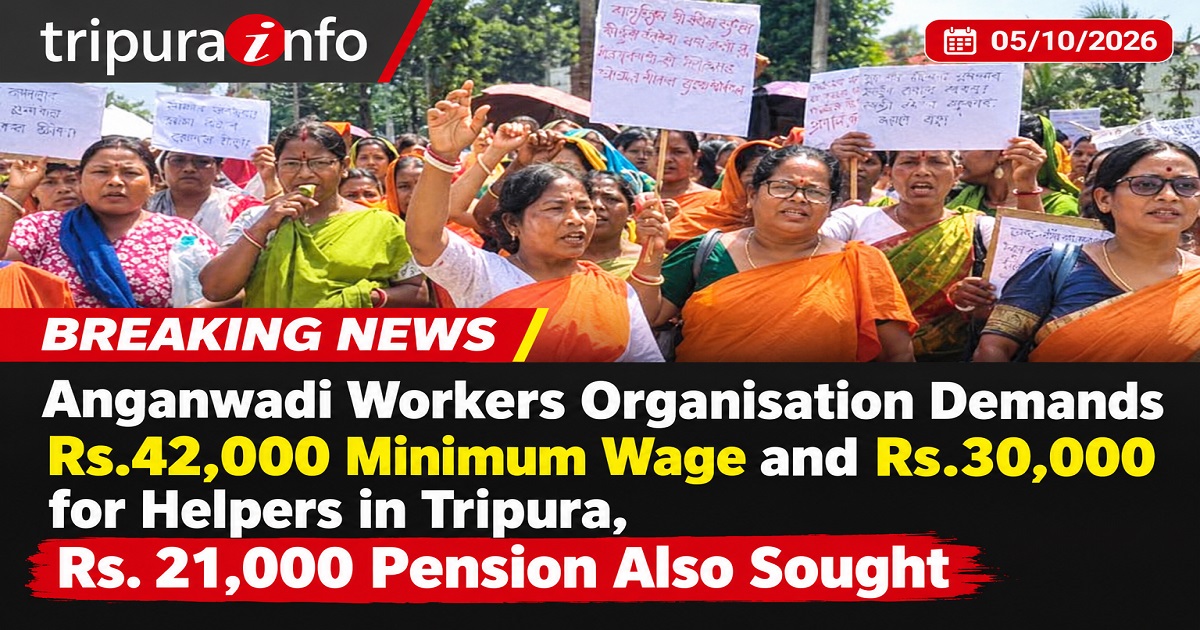 Demanding social security, better remuneration and recognition of their long years of service, Anganwadi Workers and Helpers in Tripura have raised a demand for a minimum monthly wage of Rs.42,000 for Anganwadi Workers and Rs.30,000 for Anganwadi Helpers, along with a Rs.21,000 monthly pension after retirement.
The demands were raised at a press conference organised in Agartala on October 4 in connection with the 52nd foundation year of the Integrated Child Development Services (ICDS) programme. Representatives of the Anganwadi Workers and Helpers' organisation alleged that despite decades of service, workers associated with the programme continue to face financial insecurity, increasing workloads and inadequate post-retirement benefits.
According to the organisation, Anganwadi Workers should be recognised as workers and provided a minimum wage of Rs.42,000 per month, while Anganwadi Helpers should receive Rs.30,000 per month.
The organisation also demanded a Rs.21,000 monthly pension, along with gratuity and other social-security benefits, arguing that workers who spend decades implementing government programmes should not be left without financial protection after retirement.
The representatives said the demands are based on the principle that Anganwadi personnel should receive remuneration commensurate with their responsibilities and the minimum wage requirements applicable to workers.
ICDS was launched nationally in 1975 as a major intervention aimed at improving child nutrition, health, pre-school education and the welfare of mothers.
Over the years, Anganwadi centres have evolved into an important grassroots platform for delivering services related to child nutrition, maternal health, immunisation, pre-school education and community awareness.
The organisation claimed that nearly 26 lakh Anganwadi Workers and Helpers across the country have been associated with the delivery of these services and have played a major role in reaching children and mothers at the grassroots level.
However, the representatives argued that the expansion of responsibilities has not been matched by corresponding improvements in remuneration, employment conditions and retirement security.
The organisation alleged that Anganwadi personnel are increasingly being assigned responsibilities beyond their traditional duties.
Apart from their core ICDS-related work, workers are involved in maintaining records, surveys, nutrition-related activities, health campaigns, awareness programmes and coordination with different government departments.
According to the representatives, the situation has created additional pressure on workers without ensuring corresponding improvements in their financial benefits.
They also alleged that many Anganwadi Workers and Helpers have been working for decades but still do not have adequate retirement protection.
A major component of the demands is the introduction of a proper pension and gratuity system.
The organisation claimed that some workers who have already retired have faced uncertainty over their post-retirement financial security and that there have been cases where workers remained deprived of pension-related benefits for months.
The representatives demanded that retirement benefits should be made systematic and legally enforceable instead of depending on administrative decisions or ad-hoc arrangements.
They also referred to the demand for implementation of social-security benefits, including pension and gratuity, for Anganwadi Workers and Helpers.
The organisation further expressed concern over changes in early-childhood education policy.
According to its representatives, the National Education Policy (NEP) 2020 has placed greater emphasis on early childhood care and education for children aged three to six years.
They argued that Anganwadi centres have historically played an important role in preparing young children for primary education through nutrition, pre-school activities and health-related interventions.
However, they alleged that the gradual shift of children towards formal primary-school structures could reduce the number of children attending some Anganwadi centres while simultaneously increasing the administrative and operational responsibilities of existing workers.
The representatives also reportedly raised concerns about the infrastructure available at several Anganwadi centres.
Issues such as food supply, weak network connectivity, mobile-related problems and technical difficulties in providing services through digital systems were highlighted.
They argued that workers should not be held responsible when beneficiaries fail to receive services because of infrastructure limitations or technical failures beyond the workers' control.
Demand for Government Intervention
The organisation called upon both the Central and Tripura Governments to take immediate steps to address the problems faced by Anganwadi Workers and Helpers.
more news...