Tipra Motha chief asks supporters to shun violence during and after counting, says electoral victory must not turn into a fight within the community
By Our Correspondent
Agartala, October 4, 2026
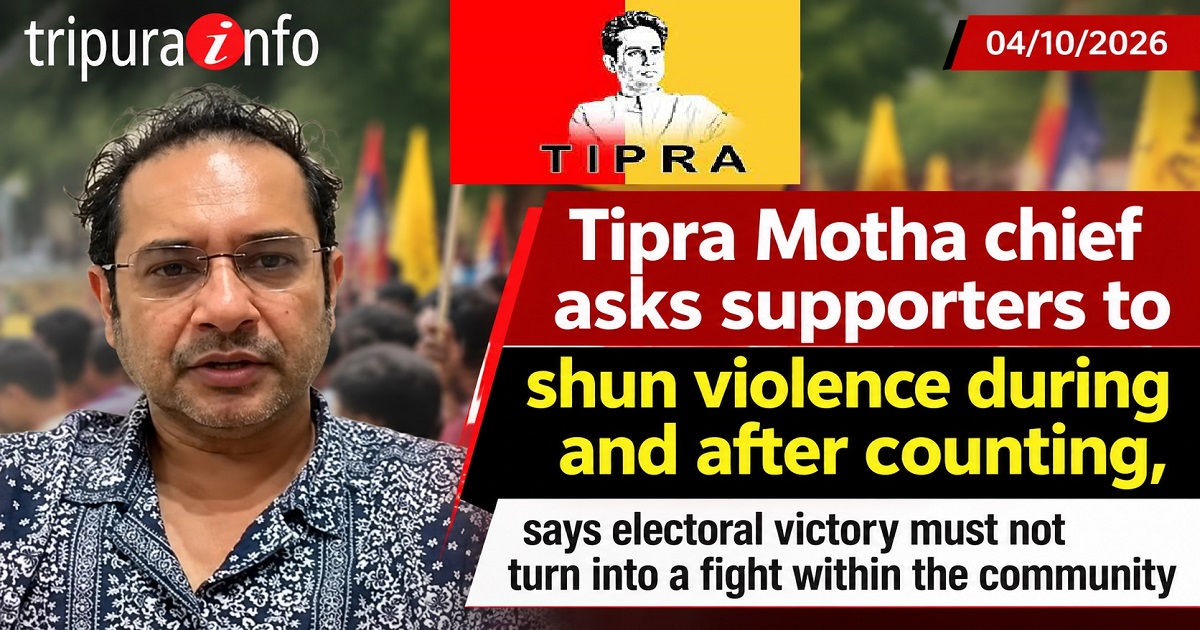 Tipra Motha supremo Pradyot Kishore Debbarma has appealed to the Tiprasa people to stay away from violence during and after Monday’s counting of votes for the Village Committee elections, warning that any clash between members of the community would ultimately hurt the community itself.
The appeal comes ahead of counting scheduled from 8am on Monday, following elections held on September 28 after a gap of nearly a decade. The counting is taking place amid heightened security across the Tripura Tribal Areas Autonomous District Council (TTAADC) areas.
“After a wait of 10 years, the elections to the Village Councils were held and counting is scheduled to take place on Monday. I appeal to all Tiprasa people not to indulge in ‘marpeet’ (fighting) in the villages during or after counting,” Debbarma said in a social media post on Sunday.
He stressed that victory and defeat were an intrinsic part of any election and urged supporters of all sides to accept the outcome without resorting to retaliation.
“In an election, one side will win while another side will face defeat. This is universal,” Debbarma said, adding that if those who win were to beat up those who lose, “it will go against the Tiprasa people”.
The appeal assumes significance against the backdrop of an atmosphere of political competition and sporadic violence during the election process. On September 28, a Tipra Motha candidate was shot at Warengbari in Gomati district, triggering tension in the area. Two suspects were subsequently arrested in connection with the incident.
Referring to the shooting, Debbarma said there could be no gain for the Tiprasa community from violence within its own ranks.
He questioned the logic of Tiprasa people attacking one another in the name of allegiance to different political parties, arguing that such conflicts would only weaken the community and allow others to exercise greater control over its political future.
The former royal also sought to place Monday’s counting in the context of the larger political struggle over Tiprasa issues. He said he had fought in the Supreme Court for the Village Committee elections to be held, not for the benefit of any particular political party but for the wider interests of the Tiprasa people.
According to Debbarma, the long political and legal struggle had helped bring issues concerning the indigenous population of Tripura into wider political discourse in the Northeast.
“If we fight among ourselves now, people will mock us,” he said, arguing that internal conflict would undermine the larger political cause for which the community had fought.
The message from the Tipra Motha chief was therefore not limited to maintaining peace at counting centres. He appeared to be addressing the possibility of post-result clashes in villages, where electoral rivalries can often spill over into personal and community-level disputes.
The Village Committee elections are politically significant as they were held after nearly 10 years and are being closely watched for their implications for the balance of power in the TTAADC areas. The results are expected to provide an indication of the organisational strength and grassroots influence of the competing political formations.
With the results due on Monday, celebrations by victorious candidates and supporters, as well as disappointment among those who lose, could create fresh tensions in some areas. Authorities have accordingly strengthened security arrangements around counting centres and are also keeping additional forces ready to deal with any post-poll law-and-order situation.
Debbarma’s intervention comes at a time when the political contest in the tribal areas remains sharply divided. His appeal seeks to draw a line between electoral competition and violence, stressing that political differences should not turn into hostility within the Tiprasa community.
For him, the larger concern appears to be what happens after the ballot boxes are opened. Candidates may change, parties may gain or lose village councils, and political equations may shift. But the people who contest against one another today will continue to live in the same villages tomorrow.
The message, therefore, was pointed: victory should not become an excuse for intimidation and defeat should not become a reason for revenge.
The Village Committee elections have already marked the return of grassroots electoral politics to the TTAADC areas after a prolonged gap. Monday’s counting will determine the political winners and losers. But, as Debbarma’s appeal underlines, another test will begin once the results are declared — whether political rivalry can remain confined to the ballot box.
For the Tipra Motha chief, the answer should be clear: the electoral battle must end with the ballot, not with bloodshed.
more news...