Maitri Setu Waiting for the Green Signal Since 2021: Tripura’s Gateway to Southeast Asia Remains Idle as Border Haats Struggle to Function
By Our Correspondent
Agartala, October 4, 2026
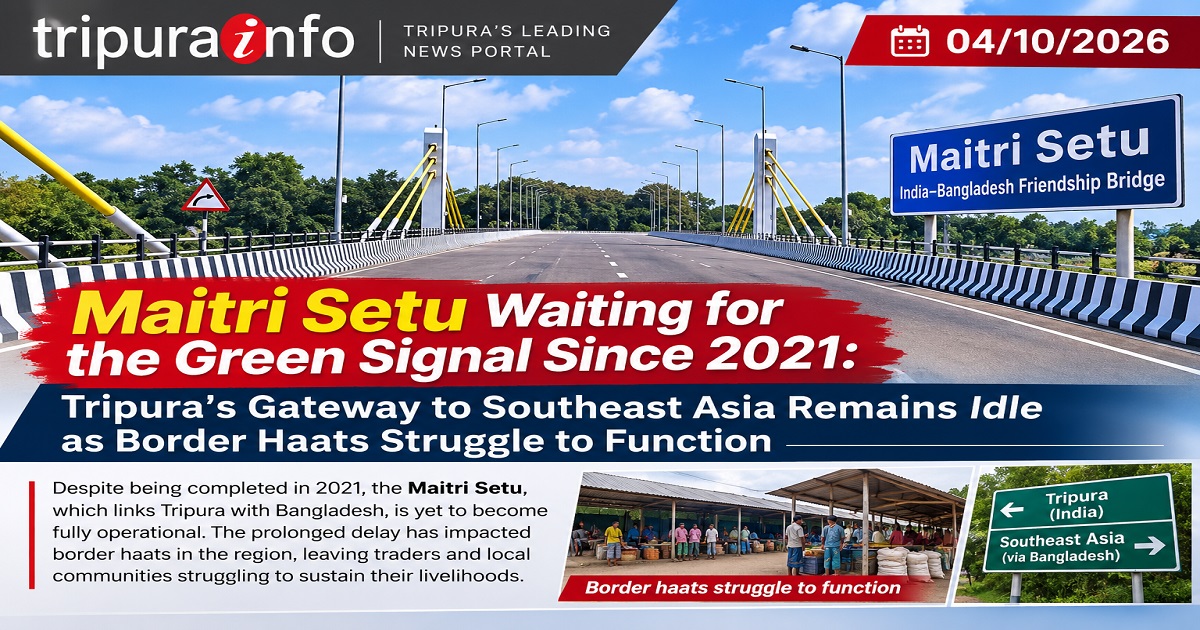 Tripura’s much-publicised ambition of emerging as an international business and logistics hub, and a gateway to Southeast Asia, continues to face a major connectivity bottleneck as the Maitri Setu at Sabroom remains pre-operational more than five years after its inauguration, while the State’s India-Bangladesh border haats have failed to achieve sustained functioning.
The 1.9-km Maitri Setu over the Feni River, connecting Sabroom in Tripura with Ramgarh in Bangladesh, was virtually inaugurated by Prime Minister Narendra Modi and then Bangladesh Prime Minister Sheikh Hasina in March 2021. The bridge itself has been completed, and the National Highways and Infrastructure Development Corporation Limited (NHIDCL) lists the Maitri Setu project as “Completed.” Yet the crucial question of when the bridge will actually become a fully operational international trade and passenger corridor remains unanswered.
The issue has become increasingly significant because the bridge provides Tripura and potentially the wider Northeast, with access to Bangladesh’s Chattogram port, located roughly 70–80 km from Sabroom. The Centre itself has described the Sabroom route as having the potential to make Tripura a “Gateway of North East” because of its access to Chattogram Port.
The delay is particularly striking because successive Tripura governments have repeatedly projected Maitri Setu as a transformational infrastructure project.
Chief Minister Manik Saha has previously said that once Maitri Setu becomes operational, Tripura could become a gateway to Southeast Asian countries through Chattogram Port.
At the Destination Tripura Business Conclave 2026, the Sabroom Land Port again emerged as one of the major issues discussed by investors, exporters and business delegations. Participants sought clarity on the timeline for commencing full-fledged commercial trade through the Sabroom-Ramgarh corridor, arguing that its strategic location could transform Tripura into a logistics and export hub for the Northeast.
Union DoNER Minister Jyotiraditya Scindia also projected Tripura as a gateway to Southeast Asia during the 2026 business conclave and referred to projects including Maitri Setu and the Sabroom Integrated Check Post as important components of the State's emerging connectivity infrastructure.
But despite these repeated projections, the bridge is still not functioning as the full-fledged international commercial gateway for which it was built.
A recent assessment by the Manohar Parrikar Institute for Defence Studies and Analyses (MP-IDSA) described the Maitri Setu/Sabroom-Ramgarh corridor as “pre-operational”, citing infrastructure and institutional issues and the continuing effects of political and security frictions following the political upheaval in Bangladesh.
Notably, in May 2026, Industries and Commerce Minister Santana Chakma said the government was making continuous efforts to launch the bridge after overcoming obstacles and that its operationalisation would improve goods transportation, cross-border commerce, employment and tourism.
In another statement, Industries and Commerce Department Secretary Kiran Gitte, IAS said the State Government had written to the Centre seeking operationalisation of Maitri Setu and indicated that the bridge would be opened shortly.
However, the continuing delay has created growing frustration among sections of the business community.
Business community wants a functioning corridor, not another announcement
For Tripura's importers and exporters, the issue is not simply the opening of a bridge. They want an integrated, predictable international trade corridor with customs, immigration, cargo handling, road connectivity and bilateral operational arrangements functioning simultaneously.
Sujit Roy, General Secretary of the India-Bangladesh Chamber of Commerce, Tripura Chapter, has repeatedly highlighted the need to remove barriers to cross-border trade. In 2023, he said at least 44 products in demand in the markets of the two countries were not permitted to move through Tripura's borders and called for fair treatment of exporters and importers.
On Maitri Setu, Roy had said that the Indian-side bridge and road infrastructure were ready, while outstanding work and coordination on the Bangladesh side were affecting the process.
His earlier concerns remain relevant because physical infrastructure alone cannot generate international trade unless the two governments complete the regulatory and operational arrangements necessary for cargo movement.
The situation of Tripura's border haats presents another example of the gap between policy objectives and ground-level implementation.
Tripura has two officially sanctioned India-Bangladesh border haats:
Srinagar–Chhagalnaiya Border Haat in South Tripura and another is in Kasba under Sepahijala district.
The Union Government's Border Haat framework was specifically designed to promote local trade, improve the economic condition of people living along the international border and strengthen people-to-people relations. The Union Cabinet has also approved a revised framework for establishing and operationalising additional border haats.
But the functioning of Tripura's two haats has remained deeply disrupted for years.
The Kamalasagar–Kasba haat remains closed, while Srinagar has experienced repeated closures and interruptions.
The demand for revival is not confined to Tripura.
During the Destination Tripura Business Conclave 2026, Bangladesh High Commissioner to India Mohammad Reaz Hamidullah visited the Kamalasagar-Kasba border haat area and discussed the closure, trader participation and the nature of goods historically exchanged there. The issue was reportedly discussed with the possibility of taking it up with the foreign ministries of both countries.
The Bangladesh envoy also said there should be no doubt about Bangladesh's interest in restoring trade relations and that discussions were continuing with New Delhi on simplifying trade opportunities.
Notably, the demand for functioning border trade infrastructure in Tripura is not new.
In 2023, the India-Bangladesh Chamber of Commerce and Tripura trade bodies approached the World Bank and other stakeholders over trade barriers, infrastructure deficiencies and restrictions affecting cross-border commerce.
more news...