Rs.80,000 Paid, Yet No Relief: Questions Mount Over Alleged Extortion, Encroachment and Administrative Inaction in Kamalasagar
By Our Correspondent
Agartala, September 30, 2026
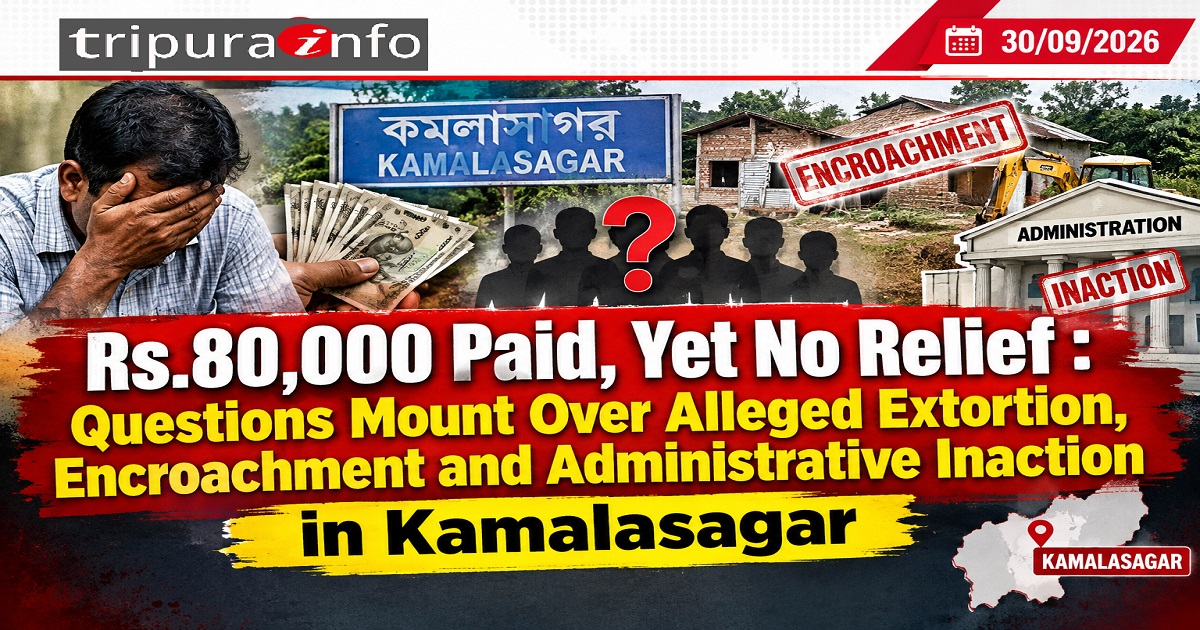 A reported incident involving an economically vulnerable woman in the Kamalasagar area has raised wider questions about the response of the police and district administration to allegations against elected representatives and politically connected individuals.
According to the report provided by a local journalist, a woman identified as Dipa Sarkar allegedly paid Rs.80,000 after being assured that she would be provided a bhiti (homestead plot) at Kamalasagar Kashba Kali Temple Market Complex. The report further alleges that she was subsequently asked to pay another Rs.90,000 and that the money was handed over. It also alleges that, nearly two years later, while the woman was away with her ailing daughter for medical treatment, a politically connected individual allegedly broke open the lock of her shop and removed goods from it.
The report names Piyush Chowdhury in connection with the alleged incident and refers to a local MLA and panchayat-level functionaries. These are allegations reported in the newspaper too, but there is no police investigation and statements from the persons named.
The larger question: What happens when no FIR is registered?
The episode raises a fundamental question about access to justice: if a person alleges a cognisable offence but the police do not register an FIR, and the district administration does not initiate action because there is no written complaint, what mechanism remains available to protect the alleged poor victim?
The appropriate question, therefore, is not simply whether a particular political leader should be punished, but whether the same legal and administrative standards are being applied to everyone, irrespective of political position or influence.
Social media evidence and the accountability question
In Tripura, allegations involving public representatives and political leaders are frequently circulated through Facebook, YouTube, Instagram and other open platforms. In some cases, videos, audio recordings, photographs and live-streamed footage are claimed to document the alleged incidents.
However, the existence of a video or social-media post by itself does not establish criminal liability. Such material needs to be authenticated, examined in context and, where appropriate, investigated by the competent authority.
At the same time, if credible material appears to show a possible offence involving public money, government property, coercion, assault, illegal occupation or abuse of official position, the obvious public-interest question is whether the competent authorities should examine it rather than simply ignore it.
Another concern raised by the controversy is the perception that police action can sometimes be swift when ordinary citizens are accused of offences or when their social-media posts become controversial, while allegations against politically influential persons may appear to move more slowly.
That perception itself can damage public confidence in institutions.
The principle should be straightforward: a citizen should not receive weaker protection because they are poor, politically unconnected or unable to approach powerful institutions, while political influence should not provide immunity from investigation.
If an allegation is false, an impartial investigation can establish that. If evidence supports the allegation, the law can take its course.
What if nobody goes to court?
This leads to perhaps the most important question raised by the incident:
If the police do not register a case, the district administration does not initiate an inquiry, and the alleged victim is unable or unwilling to approach the court, does that mean allegations involving elected representatives or politically connected persons will simply remain without investigation?
The answer cannot depend on the political status of the person against whom an allegation is made.
For a democratic administration, accountability mechanisms should work through documented complaints, independent verification, departmental inquiries, police investigation and judicial oversight wherever necessary. Neither social-media allegations nor political accusations should automatically be treated as proven facts—but neither should credible allegations be dismissed merely because the accused is politically influential.
The Kamalasagar incident therefore deserves scrutiny not merely as an individual dispute, but as a test of whether law-enforcement and administrative accountability in Tripura operate equally for ordinary citizens and those holding political power.
more news...