NIT Agartala Recruitment Under Fire: Only 3 of 42 Posts Reserved, OBC Share Stands at Just 7.14% Against 27%, Central Norm Violated
By Our Correspondent
Agartala, September 30, 2026
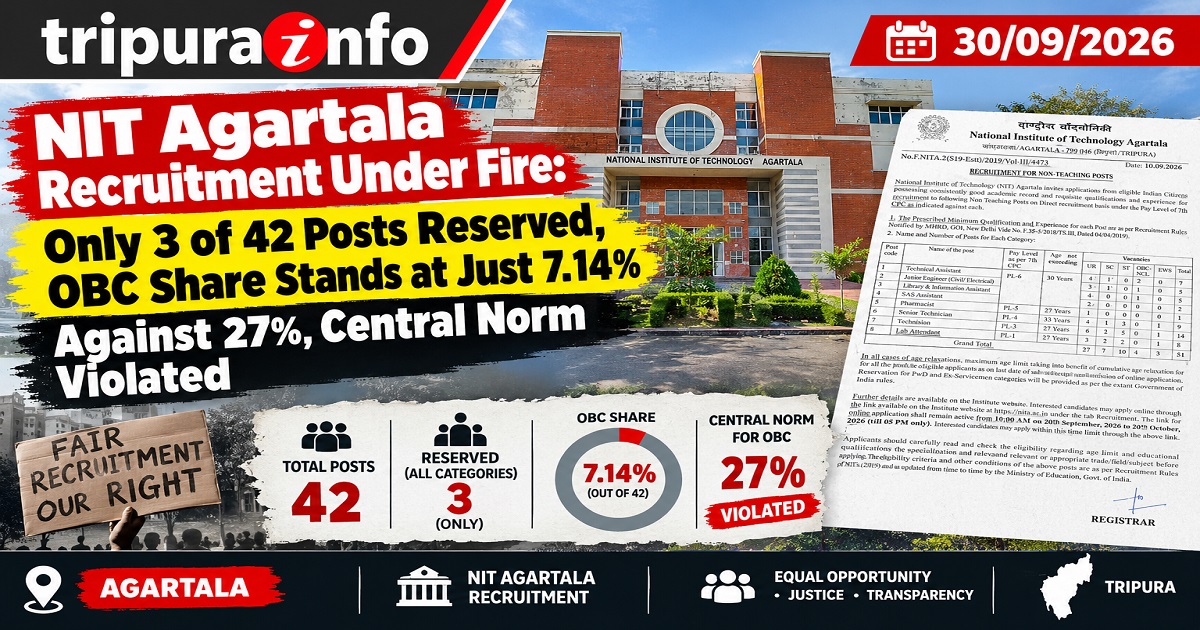 The recruitment process for non-teaching posts at the National Institute of Technology (NIT), Agartala, has come under serious scrutiny over the manner in which reservation has been reflected in the vacancy table, particularly the alleged denial of the prescribed 27 per cent OBC reservation in direct recruitment, along with other questions relating to transparency, selection methodology and equal opportunity.
The recruitment document examined by Tripurainfo.com contains a vacancy table showing 42 posts, comprising 27 Unreserved, 7 Scheduled Caste, 2 Scheduled Tribe, 3 OBC and 3 EWS vacancies.
On the face of this table, only 3 of 42 posts-7.14 per cent, have been earmarked for OBC candidates, substantially below the 27 per cent reservation prescribed by the Central Government for direct recruitment through open competition on an all-India basis.
The Department of Personnel and Training states that, for direct recruitment on an all-India basis by open competition, reservation is 15 per cent for SC, 7.5 per cent for ST and 27 per cent for OBC. DoPT also specifically states that reservation applies to direct recruitment in all groups of posts. This makes the OBC allocation shown in the NIT Agartala document a major issue requiring an immediate explanation from the Institute. If the 42 vacancies constitute an all-India open-competition direct recruitment exercise to which the 27 per cent OBC rule applies, three OBC vacancies represent only 7.14 per cent of the advertised posts, leaving a substantial apparent shortfall from the prescribed entitlement.
The recruitment document, as circulated, does not display the underlying roster points against each post. It provides the category-wise vacancy numbers but does not enable an applicant to independently verify how the OBC vacancies were derived from the sanctioned cadre and roster. That lack of visible roster information assumes importance because the Supreme Court has repeatedly insisted that public employment procedures must comply with Articles 14 and 16 and that recruitment conditions cannot be altered or applied arbitrarily. In its February 10, 2025 judgment in Amrit Yadav v. State of Jharkhand, the Supreme Court dealt specifically with defects in a public recruitment process and emphasised transparency in advertisements and selection procedures.
The issue becomes even more significant because the NIT document itself incorporates the NIT Recruitment Rules, 2019, which prescribe different recruitment ratios for different posts. The rules reproduced in the document show, for example, that Technical Assistant posts are subject to a 75 per cent direct-recruitment and 25 per cent promotion structure, while Senior Technician posts are divided between direct recruitment and promotion, and Lab Attendant posts are prescribed for 100 per cent direct recruitment.
The reservation calculation therefore needs to be demonstrated against the appropriate sanctioned cadre and applicable roster rather than merely against an aggregated vacancy figure.
Another serious concern arises from the selection procedure itself. Clause 36 of the recruitment document establishes tie-breaking criteria based initially on marks in Part A and then date of birth, but provides that where a tie remains after those criteria, it will be resolved "at the discretion of the Institute." Such an open-ended residual discretion raises a legitimate question about whether every candidate is being subjected to a completely predetermined and objectively verifiable selection mechanism. In a competitive public recruitment process, candidates ordinarily need to know in advance the complete criteria by which a final selection will be determined.
The document also raises questions regarding the examination syllabus for several Group C posts. For Junior Engineer, Library and Information Assistant, Office Attendant/Lab Attendant, Pharmacist and Senior Technician and other posts, the examination material repeatedly states that the Numerical Ability component will be similar to the compulsory mathematics paper of the Madhyamik/Matriculation Examination of the Tripura Board of Secondary Education.
The document does not, however, expressly state that only Tripura residents or Tripura Board candidates are eligible. Therefore, the Tripura Board reference by itself cannot be conclusively characterised as an illegal domicile quota. Nevertheless, where a Central Government institution conducts recruitment open beyond the State, the decision to benchmark an examination component specifically against a State Board's syllabus requires a clear justification, particularly if it creates a differential advantage for candidates educated under that board.
The document does contain several provisions apparently intended to follow Central Government recruitment policy. It expressly states that no interview will be conducted for Group B or Group C posts, referring to the DoPT Office Memorandum dated December 29, 2015, and provides for selection through a Computer Based Test, subject to applicable skill tests.
The document also provides fee exemption for PwD candidates and refers to Government of India rules concerning reservation and concessions. But those provisions do not answer the fundamental question over the actual reservation roster. The principal demand emerging from the controversy is therefore for NIT Agartala to place in the public domain the complete post-based reservation roster, sanctioned strength, vacancy position, carried-forward vacancies, category-wise roster points and the calculation by which only three OBC posts were advertised.
The issue is particularly important because DoPT itself distinguishes between all-India open competition and Group C recruitment that normally attracts candidates from a particular locality or region. For the latter, OBC reservation is generally fixed according to the OBC population of the concerned State/UT, subject to a maximum of 27 per cent. Thus, NIT Agartala should make clear which precise recruitment category applies to these posts, all-India open competition or recruitment normally attracting candidates from a locality/region—and identify the corresponding reservation rule and roster.
more news...