TTAADC Village Committee Polls: Final Data Shows 81.01% Turnout, Women Outvote Men at Polling Booths
By Our Correspondent
Agartala, September 29, 2026
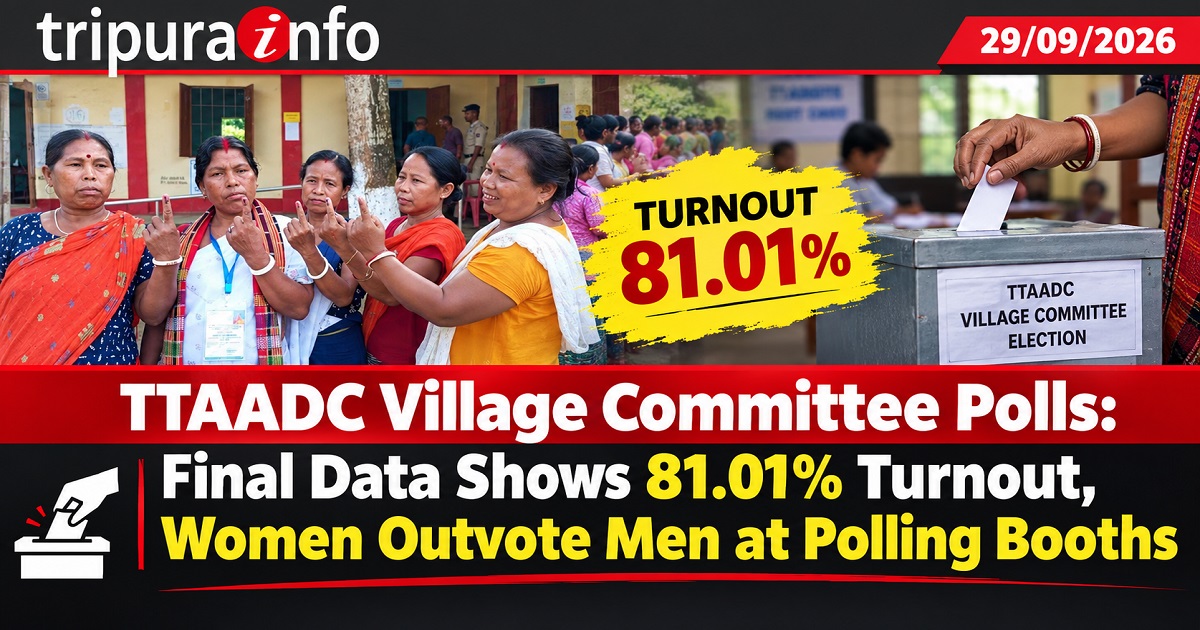 The final block-wise polling data for the 2026 TTAADC Village Committee elections shows that 5,33,242 voters cast their votes out of 6,58,247 voters assigned to polling stations, producing an overall turnout of 81.01 per cent.
The detailed Presiding Officer Diary figures reveal a notable gender pattern: female voters recorded an 81.80 per cent turnout, compared with 80.21 per cent among male voters. In absolute numbers, 2,70,610 women voted against 2,62,632 men, meaning 7,978 more women than men exercised their franchise. The figures are contained in the final block-wise report dated September 29, 2026.
The final figures also show considerable variation among the 44 blocks covered by the report. Manu block in Dhalai recorded the highest number of votes cast, with 52,062 votes, comprising 25,330 male and 26,732 female voters. At the other end of the scale, Kalyanpur block in Khowai recorded the lowest number of votes cast, at just 388, including 192 male and 196 female voters.
The contrast becomes even more interesting when turnout percentages rather than the absolute number of votes are examined. Satchand in South Tripura registered the highest overall turnout at 89.25 per cent, with male turnout at 88.70 per cent and female turnout at an impressive 89.81 per cent. Poangbari recorded the highest female turnout in the entire report at 90.34 per cent, while its male turnout was 87.83 per cent.
On the other hand, Damcherra in North Tripura recorded the lowest overall turnout at 69.42 per cent. Its male turnout was only 67.64 per cent, while female turnout stood at 71.15 per cent. Thus, even in the block with the lowest overall participation, women turned out at a higher rate than men.
The gender gap is visible across much of the polling data. Of the state's 6,58,247 voters assigned to polling stations, 3,27,445 were male and 3,30,801 were female. While the numerical difference in the assigned electorate was relatively modest, the final votes cast show a more pronounced difference, with women accounting for 2,70,610 votes compared with 2,62,632 votes cast by men.
The final figures show particularly high participation in several South Tripura blocks. Besides Satchand's 89.25 per cent, Jolaibari recorded 86.68 per cent, Rupaichari 87.37 per cent, Poangbari 89.06 per cent, and Hrishyamukh 86.21 per cent. South Tripura therefore emerges as an area with consistently high participation across several blocks.
Unakoti also recorded comparatively strong participation. Kumarghat registered 85.58 per cent, Chandipur 85.13 per cent and Pecharthal 83.46 per cent, while Gournagar recorded 84.06 per cent.
In Dhalai, Ganganagar recorded 86.02 per cent turnout and Raishyabari 86.38 per cent, while Dumbornagar registered 82.51 per cent.
However, the large electorate of Manu made it the state's clear leader in the absolute number of votes cast, despite its overall turnout percentage being 80.45 per cent.
Gomati's Karbook also stands out, recording 28,561 votes, the third-highest block total in the report, with an overall turnout of 84.51 per cent. Dasda in North Tripura recorded 30,504 votes, making it the second-highest block in terms of absolute votes cast, although its turnout percentage was only 72.56 per cent because of its much larger electorate.
Highest and lowest block figures
In terms of absolute votes cast, the five largest blocks were Manu – 52,062; Dasda – 30,504; Karbook – 28,561; Pecharthal – 27,978; and Dumburnagar – 27,720.
At the other end, the smallest voting totals were recorded in Kalyanpur – 388; Kalacherra – 862; BC Nagar – 1,004; Jampuijala – 1,184; and Rajnagar – 1,339.
There is an important distinction here: the block with the largest number of votes is not necessarily the block with the highest turnout percentage. Manu, for example, recorded the largest absolute vote count at 52,062, but its turnout was 80.45 per cent. By contrast, Satchand had only 19,200 votes cast but achieved an overall turnout of 89.25 per cent. This reflects the very different sizes of the electorates in different blocks.
Another striking feature is the performance of female voters. Women recorded a higher turnout than men in most of the larger blocks, including Manu (82.33% female versus 78.55% male), Dasda (73.89% versus 71.22%), Karbook (85.45% versus 83.57%), Pecharthal (83.68% versus 83.24%) and Dumburnagar (82.96% versus 82.07%).
However, the pattern was not universal. Some blocks saw higher male participation, including Padmabil, where male turnout was 84.26 per cent against 75.38 per cent among women, and Jampuijala, where male turnout was 83.05 per cent compared with 80.16 per cent female turnout.
The data also highlights some exceptionally wide gender gaps. In Kalacherra, female turnout was 83.88 per cent compared with only 68.21 per cent among men, a difference of 15.67 percentage points. In Gournagar, female turnout was 88.19 per cent compared with 79.92 per cent among men.
Conversely, Padmabil recorded a male advantage of nearly nine percentage points.
Overall, the final report paints a picture of strong voter participation, substantial block-to-block variation and a clear female participation advantage. While the statewide turnout stood at 81.01 per cent, the block-level figures ranged from 69.42 per cent in Damcherra to 89.25 per cent in Satchand, a gap of nearly 20 percentage points.
The final data also places the earlier polling-day estimates in perspective. Reports during polling had put turnout around 79–80 per cent in the afternoon, with voting continuing at some stations after the scheduled closing time as voters who were already in queues were allowed to cast their ballots.
The final Presiding Officer Diary compilation now records the overall figure at 81.01 per cent.
In short, the numbers tell three distinct stories: Manu generated the largest volume of votes, Satchand recorded the highest participation rate, and women collectively turned out at a higher rate than men across the polling areas covered by the final report.
more news...