Drug Trafficking Route Under Scrutiny in Tripura: Questions Raised Over Churaibari Seizures and Enforcement Beyond Entry Points
By Our Correspondent
Agartala, September 27, 2026
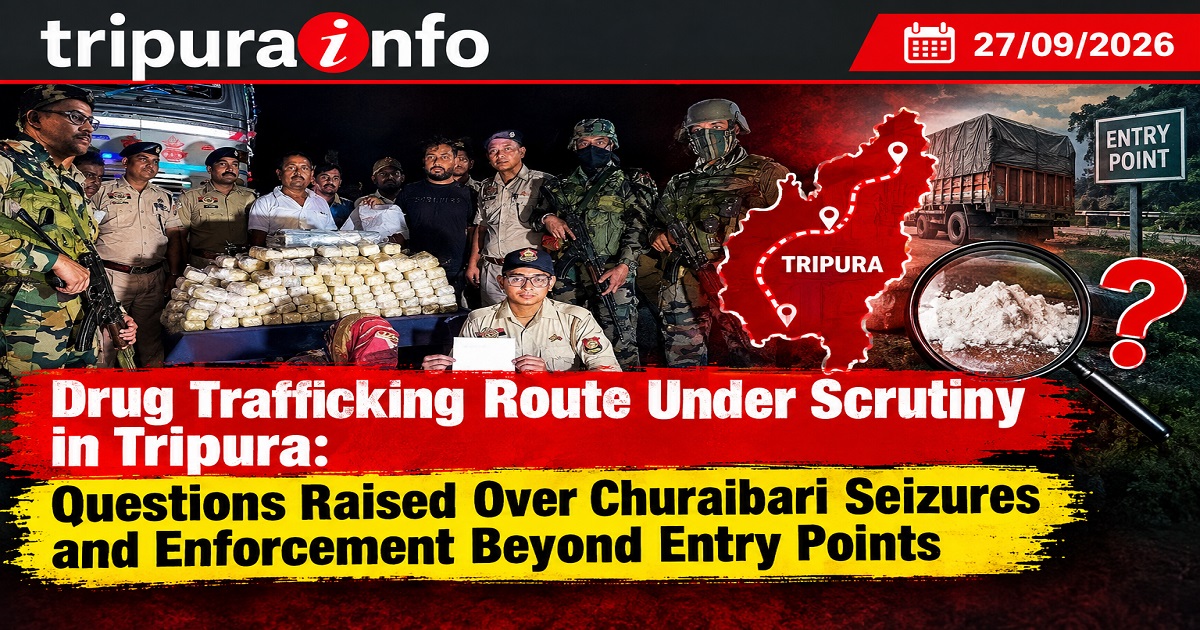 The recent series of major narcotics seizures in and around Tripura has once again brought the State’s drug-trafficking routes, enforcement mechanisms and the role of local-level prevention efforts under sharp public scrutiny.
The exact total quantity of drugs detained by different enforcement agencies during the recent period is yet to be consolidated. However, several major seizures have highlighted the movement of narcotic consignments through Tripura after entering from Assam via the Churaibari border route. In one of the most significant recent operations, nearly five lakh Yaba tablets were recovered from a truck at Panisagar by ED officials after the vehicle had reportedly entered Tripura through Churaibari and was travelling towards Agartala.
At the same time, available enforcement records show that drug consignments have also been intercepted at locations inside Tripura. For example, the NCB and Tripura Police recovered about 8.039 kg of methamphetamine tablets from a dumper near Bishramganj on September 3, while another joint operation at Jolaibari resulted in the seizure of around 8 kg of Yaba tablets.
These seizures raise an important question: how extensive is the drug movement network after narcotic consignments cross Tripura’s entry points, and how effectively are enforcement agencies monitoring the entire route up to Agartala and other destinations?
There is particular public concern over routes passing through areas such as Teliamura, Jirania, Mohanpur, Bishalgarh, Kamalasagar, Boxanagar and Sonamura. Claims that significant consignments routinely pass through these areas without detection.
The political dimension of the issue is also attracting attention. Questions are being raised over whether elected representatives at the local level are sufficiently active in creating public awareness against drug abuse and illegal narcotics activities in their respective constituencies. There are also allegations that some political or local actors have accepted money from persons allegedly involved in the drug trade in the name of football matches or other social programmes.
The questions are particularly relevant because the State Government has repeatedly declared its commitment to making Tripura drug-free. Chief Minister Prof. (Dr.) Manik Saha has called for a stricter and coordinated approach involving the police and civil administration and has said that special task forces could be constituted where necessary. He has also directed intensified surveillance and patrolling in crime-prone areas and around educational institutions.
The State Government has also promoted wider public participation in the anti-drug campaign. In August, the “Nasha Mukt Yuva for Viksit Bharat Sankalp Abhiyan” was launched in Tripura with participation from students, teachers, volunteers and government officials. Yet the scale of recent seizures indicates that the challenge remains substantial. On September 15, coordinated operations involving the DRI, and Assam Rifles reportedly resulted in the interception of several large narcotics consignments in Tripura and Assam. The Directorate of Revenue Intelligence described the wider operation as a major breakthrough against an inter-state methamphetamine trafficking network.
The issue therefore goes beyond the seizure of individual vehicles or consignments. If narcotics are entering through established corridors, enforcement agencies may need to examine the entire supply chain—from the source and entry point, through transport corridors and intermediate storage locations, to distributors and intended recipients in Agartala and elsewhere.
There is also a need for greater transparency regarding the number of consignments intercepted at different points of the State. Publishing district-wise and police-station-wise seizure data, including the origin, route, destination, quantity, type of narcotic and status of investigation, could help the public understand where the principal trafficking routes actually exist.
The recent seizures have demonstrated that intelligence-based operations can disrupt large consignments. The recovery of nearly five lakh Yaba tablets at Panisagar alone shows the enormous scale at which organised trafficking networks may operate.
The larger question now is whether enforcement can move beyond intercepting individual consignments and identify the kingpins, financiers, transporters, local distributors and networks operating behind the trade.
For a State repeatedly declaring its objective of becoming “drug-free,” the effectiveness of that campaign will ultimately depend not only on the quantity of narcotics seized, but also on the extent to which trafficking networks are dismantled, illegal cultivation is prevented, vulnerable communities are protected and sustained public awareness reaches every locality.
more news...