Tripura Sets October 31 Deadline for Statewide Digital Health Transformation
By Our Correspondent
Agartala, September 26, 2026
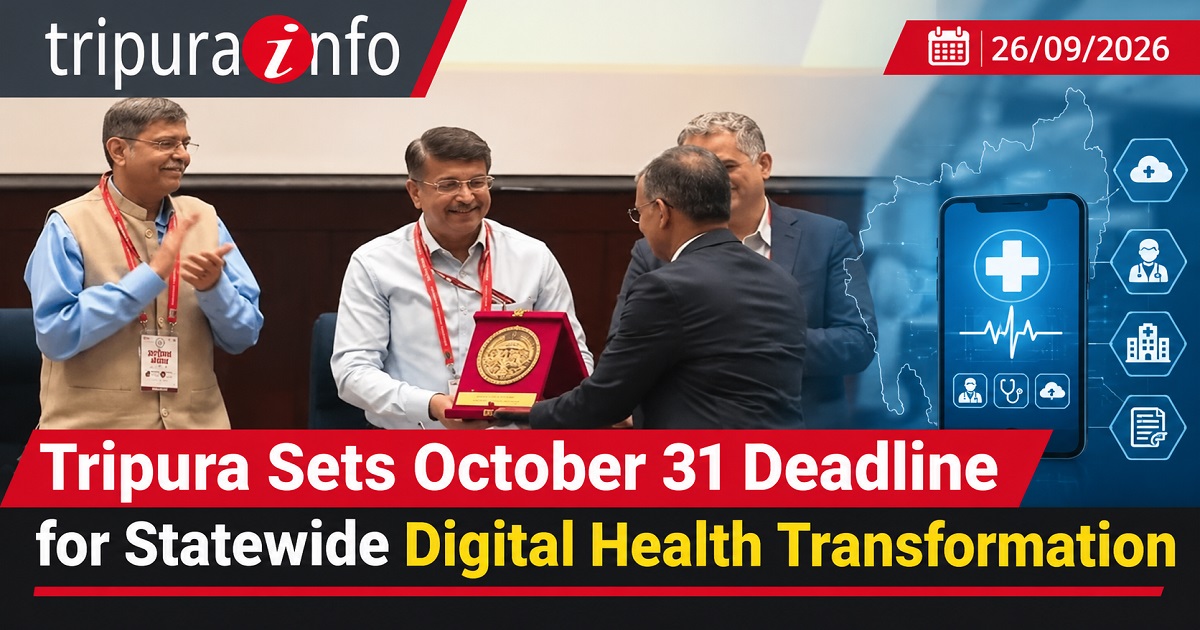 Tripura has set an ambitious target of completing its statewide digital health transformation by October 31, 2026, with the government working towards creating an integrated, interoperable and citizen-centric healthcare ecosystem across the state.
The roadmap was highlighted by Gitte Kiran Gitte, IAS, Secretary of the Health and Family Welfare Department, Government of Tripura, during a panel discussion on digital transformation in healthcare at Arogya Manthan 2026, held at Vigyan Bhavan in New Delhi on September 25.
The event was organised to mark eight years of Ayushman Bharat–Pradhan Mantri Jan Arogya Yojana (AB-PMJAY) and five years of the Ayushman Bharat Digital Mission (ABDM). Union Minister JP Nadda attended the programme as the chief guest, while Dr Sunil Kumar Barnwal, Chief Executive Officer of the National Health Authority, along with other senior officials and dignitaries, was also present.
During the discussion, Gitte presented Tripura's experience in implementing an Integrated Health Management Information System (I-HMIS) and outlined the state's future roadmap for digital healthcare. He said the objective is to move beyond fragmented and paper-based healthcare services towards a connected digital health ecosystem in which citizens, doctors, nurses, health facilities, pharmacies, laboratories and different health programmes can function within an integrated information framework.
The I-HMIS is being positioned as the core operational system, while the Ayushman Bharat Digital Mission will provide the interoperability framework for secure and seamless exchange of health information between different systems. Gitte emphasised that the objective of I-HMIS is not simply to computerise hospital registration, but to establish a comprehensive digital platform capable of supporting healthcare delivery, information management and evidence-based decision-making across the state.
The proposed digital system is expected to facilitate electronic health records, better utilisation of healthcare resources, reduction in patient waiting time, improved emergency services, automation of processes, real-time reporting, data analysis, decision support and stronger grievance redressal mechanisms.
Tripura's digital health transformation is being extended across the state's healthcare network, including district hospitals, sub-divisional hospitals, community health centres, primary health centres and health sub-centres. Alongside the deployment of digital systems, the government is working on network connectivity, equipment, training and capacity building to ensure that digital transformation results in effective use of technology at the grassroots level.
Gitte also highlighted important components of the Ayushman Bharat Digital Mission, including ABHA (Ayushman Bharat Health Account), the Health Facility Registry, Healthcare Professional Registry, interoperable health records and consent-based exchange of health information.
For citizens, the digital transformation is expected to facilitate digital registration, ABHA-based identification, digital prescriptions, laboratory reports and electronic health records while reducing dependence on paper-based documentation. It is also expected to improve continuity of medical information when patients receive treatment at different healthcare facilities.
Another important issue discussed during the session was the need for standardisation and interoperability in digital healthcare. Gitte explained that the use of common standards can establish a shared information framework among hospitals, laboratories, pharmacies and different health programmes, enabling more efficient exchange of health information.
An interoperable digital system could also provide policymakers with a near real-time picture of healthcare delivery and programme implementation across the state. For a relatively small state like Tripura, such interoperability could reduce the need for separate digital systems for individual healthcare programmes and institutions while creating a common technological foundation for future applications involving data analytics, dashboards, clinical decision-support systems and artificial intelligence-based healthcare services.
Gitte stressed that the success of digital health transformation should not be measured merely by the number of healthcare facilities brought under a digital platform. The real measure, he said, would be the effective and meaningful use of the digital system by healthcare professionals in their everyday work.
In this regard, the Tripura government is placing particular emphasis on training and capacity building of healthcare workers. Initiatives to enhance digital health skills are being undertaken across all eight districts of the state so that healthcare personnel can effectively use the new systems and integrate them into routine service delivery.
The state has set October 31, 2026, as the target for completing its digital health transformation programme.
more news...