CAG–ICSSR Colloquium in Agartala Brings Public Finances, Audit and Waste Management Closer to Citizens
By Our Correspondent
Agartala, September 24, 2026
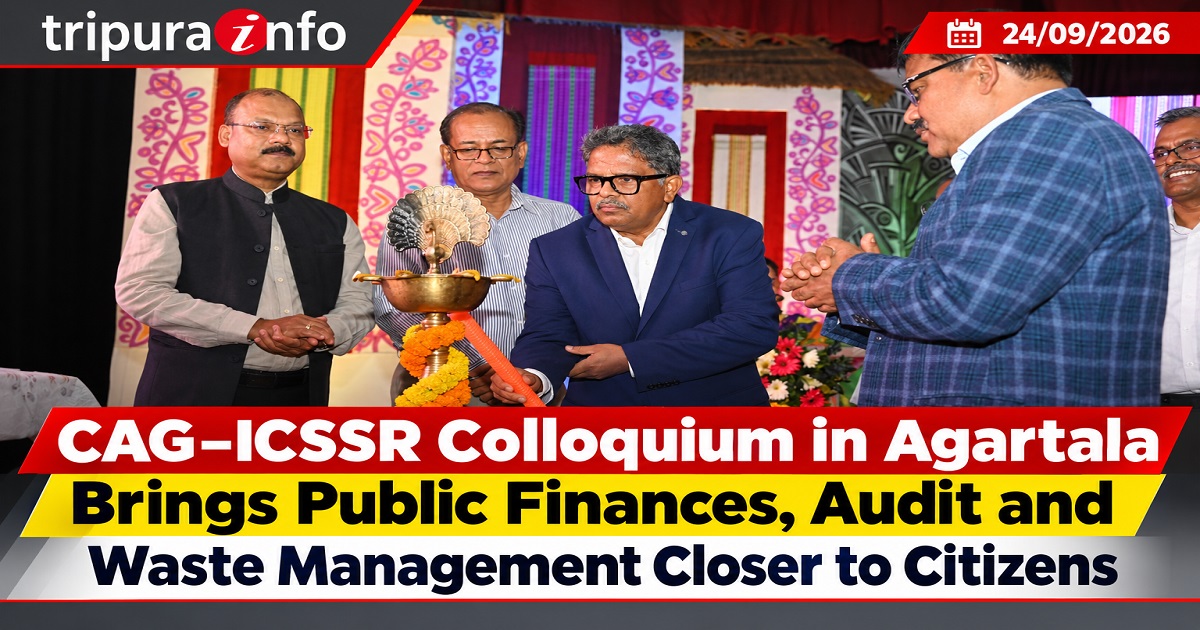 In an effort to make government finances, public auditing and civic responsibilities more accessible to ordinary citizens, the Comptroller and Auditor General of India (CAG), in collaboration with the Indian Council of Social Science Research (ICSSR), organised a state-level academic colloquium at the MBB Auditorium of Tripura University on Thursday.
The programme brought together senior audit officials, university authorities, academics, research scholars and more than 800 students from Tripura University and colleges across the state. The central objective was to translate complex government financial and audit-related information into language that students and citizens could understand and relate to their everyday lives.
The formal proceedings began with the ceremonial lighting of the lamp, followed by a welcome address by Shri Ranendu Sarkar, IAAS, Accountant General (A&E), Tripura. Prof. S. K. Nayak, Council Member of ICSSR, delivered the opening remarks, while Prof. Debabrata Das, Vice-Chancellor of Tripura University, addressed the gathering as the Chief Guest.
Key presentations were delivered by Shri Shailendra Vikram Singh, IAAS, Principal Accountant General (Audit), Tripura; Shri K. Vigneshwaran, IAAS, Senior Deputy Accountant General (Audit); and Prof. Paramita Saha of the Department of Economics, Tripura University.
Dr. Abhinav Piyush, Deputy Director, ICSSR, outlined the CAG–ICSSR research article competition for students and research scholars. The programme concluded with a vote of thanks by Ms. Tanushree Biswas, IAAS, Senior Deputy Accountant General (A&E), Tripura, followed by the National Anthem.
Focus on Tripura's Public Finances
One of the major themes of the colloquium was understanding the state's finances and the manner in which public money is collected, allocated and spent.
The audit officials explained that government finances have a direct bearing on citizens' everyday lives, from infrastructure and education to healthcare and welfare programmes. The discussions highlighted Tripura's dependence on financial allocations and grants from the Central Government for several development and welfare activities.
The presentations also emphasised the importance of directing public expenditure towards durable capital assets, including infrastructure, school buildings and healthcare facilities, which can generate long-term public benefits.
Responsible debt management was another important issue discussed. While borrowing can enable governments to finance development projects and infrastructure, the officials stressed the need for prudent debt management so that debt servicing and interest obligations do not create an excessive burden on future public finances.
Waste Management Becomes a Major Civic Issue
The second major theme centred on solid waste management in Tripura's urban areas.
The discussions covered the state's 20 Urban Local Bodies, including the Agartala Municipal Corporation, Municipal Councils and Nagar Panchayats. The presentations emphasised that simply collecting waste from households cannot by itself ensure clean and healthy urban environments.
According to the discussions, collected waste needs to be scientifically processed instead of being allowed to accumulate in open dumping areas. Effective waste management, therefore, requires infrastructure for composting, recycling and processing of different categories of waste.
Particular emphasis was placed on segregation of waste at source. Households were encouraged to separate wet or biodegradable kitchen waste from dry waste such as plastic, paper and metal before handing it over to municipal or authorised waste collectors.
The colloquium also highlighted the need for urban local bodies to strengthen infrastructure, including composting facilities, plastic-processing units and appropriate waste-transport vehicles. Such facilities, the presentations stressed, are essential for reducing environmental contamination and improving urban sanitation.
The role of citizens was also highlighted, with speakers emphasising that maintaining clean neighbourhoods requires cooperation between residents and municipal authorities. Payment of applicable user charges was also discussed as a means of supporting the sustainability of municipal services.
Research Opportunity for Students
Another important component of the programme was the CAG–ICSSR Research Article Competition, aimed at encouraging undergraduate, postgraduate and PhD scholars to engage with audit reports and examine issues relating to public finance, governance and accountability.
The organisers announced that the deadline for submission of research articles has been extended to September 30, 2026, providing students and researchers in Tripura additional time to participate.
The initiative is intended to encourage young researchers to study public audit findings and develop independent research perspectives on governance and public expenditure. Selected research works will receive recognition at state and national-level forums.
Public Audit and Democratic Accountability
The colloquium also sought to underline the wider significance of public audit beyond conventional accounting and financial scrutiny.
Audit reports can provide citizens with information on how public funds are utilised and highlight areas where implementation, financial management or service delivery may require improvement. Such scrutiny covers a wide range of public services, including education, healthcare, infrastructure, municipal sanitation and welfare programmes.
The organisers presented public audit as an important component of democratic accountability, enabling citizens, researchers and policymakers to examine how government resources are being utilised.
Participation from Across Tripura
The event witnessed participation exceeding 800 people, including university leadership, heads of departments, senior faculty members, doctoral research scholars and undergraduate and postgraduate students.
Students and academics participated from Tripura University (Suryamaninagar campus), MBB College, BBMC College, Ramthakur College, Holy Cross College and several affiliated degree colleges across the state.
Officers, audit specialists and research personnel from the offices of the Principal Accountant General (Audit), Tripura, and Accountant General (A&E), Tripura, also attended the programme.
The organisers said the colloquium was aimed at creating greater public understanding of government finances and audit findings while encouraging students and citizens to take a more informed interest in public expenditure, municipal services and governance.
more news...