Tripura High Court Holds Accused Must Be Heard Before Cognizance Taken Under Section 223 BNSS, Sets Aside CJM Order
By Our Correspondent
Agartala, September 24, 2026
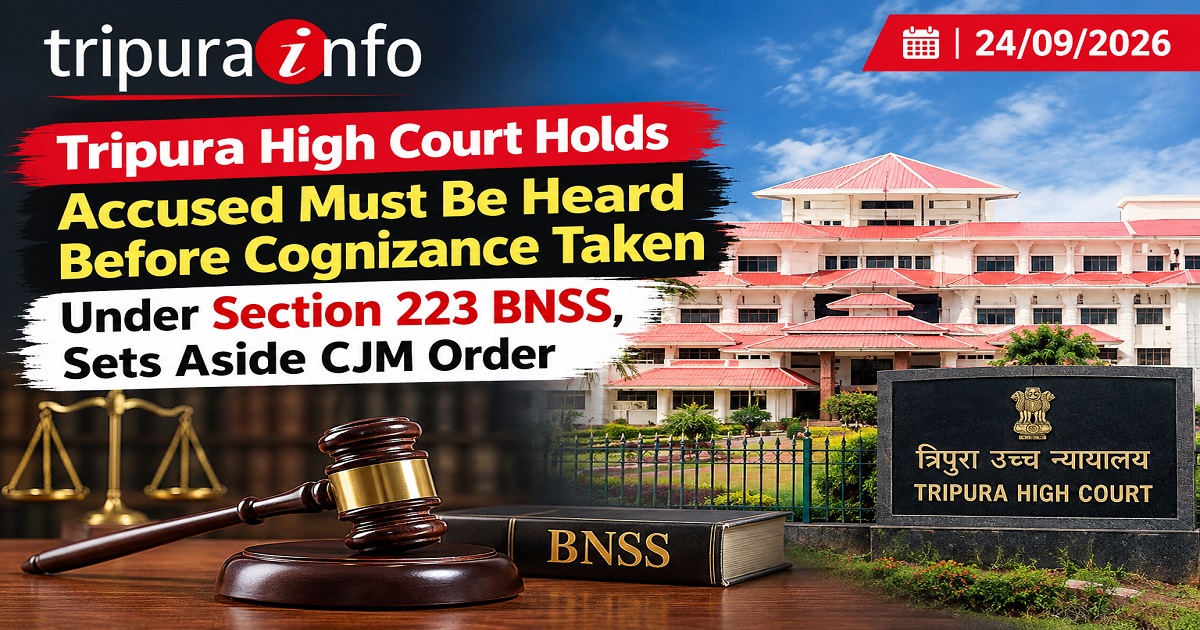 The High Court of Tripura has delivered an important judgment on the procedure to be followed by Magistrates while taking cognizance of offences on the basis of a complaint, holding that under Section 223 of the Bharatiya Nagarik Suraksha Sanhita (BNSS), 2023, the accused must be given an opportunity of being heard before cognizance is taken.
In a significant ruling, the High Court set aside an order passed by the Chief Judicial Magistrate (CJM), West Tripura, Agartala, in a complaint case instituted by Kotak Mahindra Bank Ltd., observing that a Magistrate cannot take cognizance of an offence on a complaint without first providing the accused an opportunity of hearing as mandated under the newly introduced provision of the BNSS.
The judgment was delivered by Hon’ble Mr. Justice Biswajit Palit in Criminal Petition No. 33 of 2026, Sri Dipankar Majumder and another vs. The State of Tripura and another. The judgment and order were pronounced on September 7, 2026, following the hearing held on September 1, 2026. The order has been marked “Yes” for reporting by the High Court.
The petition was filed by Sri Dipankar Majumder, son of Late Sunil Chandra Majumder, and Smt. Maitri Majumder, both residents of Chandrapur, Agartala.
The respondents were The State of Tripura and Kotak Mahindra Bank Ltd., represented through its authorised person, having its branch address at Camac Street, Kolkata.
Advocate Kushal Deb appeared for the petitioners, while Additional Public Prosecutor Soumyadeep Saha represented the State. The judgment records that learned counsel had appeared on behalf of respondent No. 2 on July 10, 2026; however, no counsel appearing for Kotak Mahindra Bank was present when the matter was actually heard. The name of that counsel is not recorded in the judgment.
The dispute originated with a complaint petition filed by Kotak Mahindra Bank Ltd. before the Court of the learned CJM, West Tripura, Agartala, on July 12, 2024, against Dipankar Majumder, Maitri Majumder and others.
The complaint invoked Sections 61(2), 314, 316, 318, 320, 321, 323 and 324 of the Bharatiya Nyaya Sanhita (BNS).
According to the petitioners, the CJM, on the very day the complaint was filed, directly took cognizance of the alleged offences without first providing the accused persons an opportunity of being heard. The CJM also transferred the matter on the same day to the Court of the Judicial Magistrate First Class, Court No. 3, Agartala.
The petitioners subsequently approached the High Court under Section 528 of the BNSS, seeking quashing of the CJM's order dated July 12, 2024.
A central issue before Justice Biswajit Palit was whether the procedure followed by the CJM complied with the newly introduced provisions of the BNSS.
The Court noted that the complaint was filed on July 12, 2024, after the BNSS came into force on July 1, 2024.
The High Court examined the transition from the erstwhile Code of Criminal Procedure, 1973 (CrPC) to the BNSS and specifically compared Section 200 of the CrPC with Section 223 of the BNSS.
While Section 200 of the CrPC dealt with examination of the complainant and witnesses when a Magistrate took cognizance of a complaint, Section 223 of the BNSS contains an additional proviso expressly providing that a Magistrate shall not take cognizance of an offence without giving the accused an opportunity of being heard.
Justice Biswajit Palit observed that the words newly inserted into Section 223 of the BNSS create a mandatory requirement for the Magistrate.
According to the judgment, before taking cognizance of an offence on the basis of a complaint, the Magistrate must first provide an opportunity to the accused to be heard. Thereafter, the Magistrate can proceed in accordance with the statutory procedure governing cognizance and examination of the complainant and witnesses, wherever applicable.
The Court specifically noted that this requirement was introduced under the BNSS, which came into force on July 1, 2024.
The High Court therefore treated the date on which the complaint was filed as significant because the complaint in the present case was instituted after the new criminal procedural law had already come into operation.
Appearing for the petitioners, Advocate Kushal Deb relied upon the Supreme Court judgment in Kushal Kumar Agarwal vs. Directorate of Enforcement, reported in 2025 Supreme (SC) 919.
The High Court referred to the Supreme Court's interpretation that Section 223 of the BNSS corresponds broadly to Section 200 of the CrPC but contains a significant additional proviso requiring an opportunity of hearing to the accused before cognizance is taken.
The Supreme Court, as referred to by the High Court, had held that where such an opportunity had not been provided, an order taking cognizance could not stand on that ground. The State opposed the petition.
Additional Public Prosecutor Soumyadeep Saha argued that there was no illegality or irregularity in the CJM's order because the CJM had not recorded the statements of the complainant or witnesses and had instead transferred the matter to another court for disposal.
On that basis, the State contended that there was no sufficient ground at that stage for interference by the High Court and sought dismissal of the criminal petition.
The State relied upon two Supreme Court decisions - Raghubans Dubey vs. State of Bihar, reported in 1967 SCC OnLine SC 3, and State of West Bengal vs. Manmal Bhutoria & Others, reported in (1977) 3 SCC 440, in support of its contention regarding the legality of the procedure adopted by the CJM.
Justice Biswajit Palit considered the authorities relied upon by both sides but found that the decisions cited by the State did not correspond to the factual and legal position arising in the present case.
The Court placed particular emphasis on the fact that the complaint was filed on July 12, 2024, after the BNSS had already come into force on July 1.
The judgment states that from the commencement of the BNSS, when a complaint is filed before a Magistrate, the accused must be given an opportunity of being heard before cognizance is taken, in accordance with Section 223.
In a significant observation, the High Court held that where, after July 1, 2024, a Magistrate takes cognizance of an offence on a complaint without providing the accused an opportunity of hearing as required under Section 223 BNSS, such an order would be bad in law and would amount to an abuse of the process of the Court and an action without jurisdiction.
The Court reached this conclusion after examining the statutory language of Section 223 BNSS and the Supreme Court's interpretation of the newly introduced procedural safeguard.
Allowing the criminal petition, the High Court set aside the order dated July 12, 2024, passed by the learned CJM, West Tripura, Agartala.
The matter was remanded to the CJM, West Tripura, Agartala, with a direction to hear the matter afresh and proceed in accordance with Section 223 of the BNSS on the complaint filed by respondent No. 2, Kotak Mahindra Bank Ltd.
The High Court further directed both parties to appear before the CJM, West Tripura, Agartala, on September 22, 2026.
more news...