Congress Questions “Agartala-Centric” Development, Seeks Accountability for Dharmanagar and Kailashahar
By Our Correspondent
Agartala, September 23, 2026
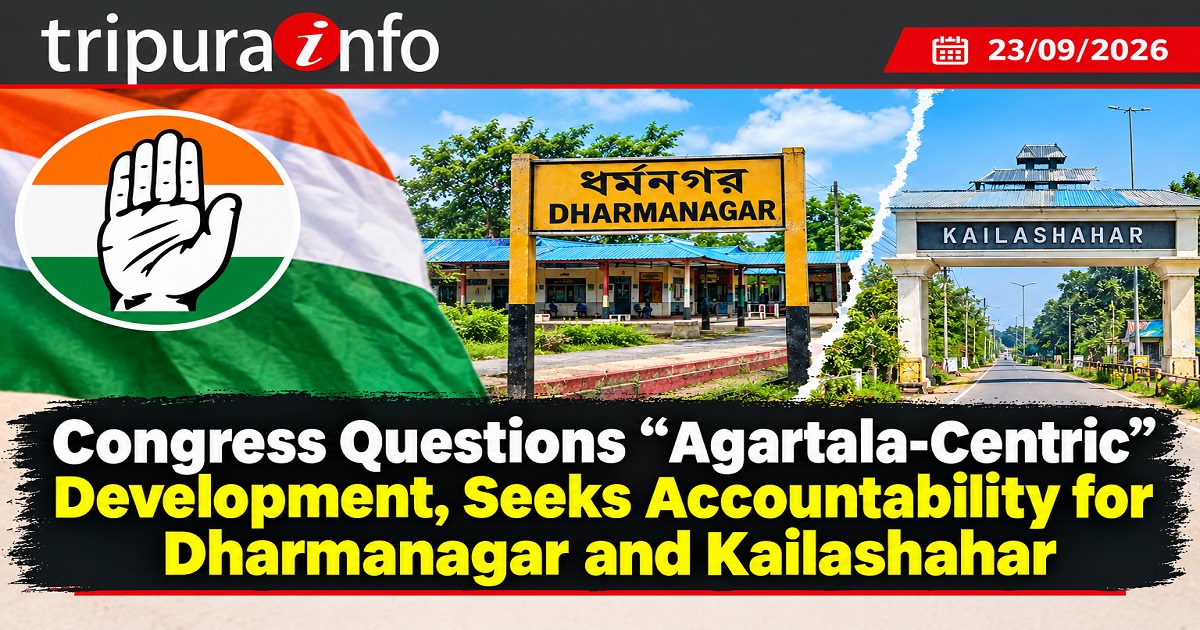 A fresh political debate has erupted in Tripura over the geographical distribution, pace and quality of development works across the state, with the Congress alleging that major urban development initiatives under the BJP government have remained largely concentrated in Agartala while important district towns such as Dharmanagar and Kailashahar have not witnessed comparable visible transformation.
The issue came into sharper focus following a press conference organised by the Dharmanagar District Congress on September 22, where party leaders questioned the government’s claims regarding development in the town and demanded project-wise details of sanctioned funds, expenditure, physical progress and completion deadlines. The Congress argued that citizens should be able to assess development through completed and functional infrastructure rather than through announcements, promises and inauguration ceremonies.
The Congress has particularly questioned the status of several projects announced for Dharmanagar, including drinking-water infrastructure, the proposed market building, road repairs, drainage, street lighting, traffic management and municipal services. The party has demanded that the administration make public the amount sanctioned for each project, the amount already spent, the current stage of construction and the expected date of completion.
The party has also raised questions over the proposed drinking-water infrastructure and sought clarity on when the under-construction water treatment plant will become operational and how many households are expected to receive regular piped-water supply after commissioning. Similar questions have been raised regarding the proposed market building, particularly its construction cost, completion schedule, parking facilities, fire-safety arrangements and the proposed rehabilitation of existing traders.
Road connectivity has emerged as another major point of criticism. Congress leaders have alleged that several roads in and around Dharmanagar continue to require attention and that temporary repairs cannot be treated as a permanent solution. They have demanded a clear road-repair programme identifying the roads to be taken up, the nature of the proposed work and the timeline for completion. The party has also questioned the condition of drainage, street lighting, traffic management and cleanliness in the town and called for a comprehensive long-term urban development plan for Dharmanagar.
The Congress has maintained that it does not oppose development projects initiated during either the present or previous governments. Rather, its argument is that incomplete projects should be completed within clearly defined timelines and that the public should be given transparent information about their progress. The party has therefore called for publication of a comprehensive list of incomplete projects, their present status and their expected completion dates.
The Dharmanagar controversy has also revived the larger political argument over whether development in Tripura has become too Agartala-centric. Congress leaders have alleged that since the BJP came to power in 2018, major visible urban transformation has been concentrated around the capital, while Dharmanagar and Kailashahar have not received development of a comparable scale.
Udaipur, meanwhile, is being cited as a contrasting example of how heritage and tourism-related infrastructure can receive substantial attention. The Tripura Sundari Temple at Udaipur, popularly known as Matabari, is one of the state’s most important religious and cultural landmarks and is officially recognised as one of the 51 Shakti Peethas. The Gomati district administration also describes Udaipur as the “lake city”, noting its historic lakes including Kalyan Sagar, Bijoy Sagar, Jagannath Dighi and Amarsagar.
The redevelopment of the Tripura Sundari Temple complex has significantly changed the surroundings of the historic shrine. Under the PRASHAD scheme, the project included facilities such as a food court, multipurpose halls, Bhog and Prasad Ghar, modern toilets, improved water and sewage infrastructure, drainage, landscaping, illumination, solar power facilities and other visitor amenities. The Union government has also highlighted the development of a 51 Shakti Peethas Park featuring replicas representing the sacred sites.
This development has strengthened Udaipur’s position as a religious-tourism destination, although questions have simultaneously been raised locally about how future urban expansion should be balanced with the preservation of the city’s lakes and natural environment.
Particular controversy has surrounded the reported proposal to develop a satellite township in the Sukh Sagar area by filling or reclaiming the waterbody. Critics have expressed concern that any such development could have implications for Udaipur’s traditional identity as the “lake city” and for the ecological role of its waterbodies. The issue has consequently become part of a wider debate over whether urban expansion should come at the cost of existing natural water resources.
The comparison being drawn by the Congress is therefore not simply between individual projects but between different approaches to urban development. While Udaipur has seen significant attention around its heritage and tourism infrastructure, and Agartala has witnessed several large urban projects, Congress leaders argue that district headquarters such as Dharmanagar and Kailashahar also require comprehensive urban-development strategies covering roads, drainage, drinking water, healthcare, markets, public spaces, traffic management and municipal services.
The controversy has gained further momentum following the September 22 inauguration of two major Agartala projects by Chief Minister Dr. Manik Saha, the Haora Riverfront Development Project and the newly developed Airport Road under the Agartala Smart City Mission. The Chief Minister described the Haora Riverfront as an important step towards making Agartala greener, cleaner, more modern and more liveable, while emphasising the historical and cultural importance of the Haora River.
The Haora Riverfront project has been developed along the river near the Battala area and combines riverbank protection, green areas, recreational facilities, fitness infrastructure and civic amenities. Government-related reporting has placed the project cost at approximately Rs.96 crore, while other reports have described it as a project of around Rs.100 crore that took several years to complete.
However, the timing and nature of the inauguration have become a political issue, with the Congress alleging that some components of major projects are still incomplete even when the projects are formally inaugurated. The party has questioned whether all finishing works and promised components have been completed and whether citizens are receiving the full facilities originally envisaged under the projects.
Airport Road has become a particular point of concern in this regard. According to the allegations raised by critics, portions of the roadside footpaths still require finishing work, including installation of tiles in some areas. Questions have also been raised about drainage manholes located along pedestrian pathways and whether all such openings have been properly secured. If pedestrian infrastructure remains incomplete, the issue could have particular significance for elderly people, children and persons with disabilities.
The Congress has also questioned whether the underground utility infrastructure planned along Airport Road has been completed in full. Water pipelines, electricity-related infrastructure and gas or other utility lines are expected to be coordinated with road construction in a modern urban corridor. Any subsequent excavation for laying utilities could potentially damage newly constructed roads and footpaths, making proper coordination between agencies important.
Accessibility has emerged as another concern. While the Airport Road project is intended to represent a modern urban road corridor, critics have questioned whether the footpaths are presently suitable for wheelchair users and whether dedicated cycling infrastructure has been adequately provided. The issue goes beyond beautification, they argue, because modern urban infrastructure is increasingly expected to incorporate universal accessibility and safe pedestrian movement.
Similar questions have been raised regarding the Haora Riverfront. While the project has been presented as an environmental and public-space initiative, critics have pointed to proposed components such as bird habitats, natural forest areas and nature-trail facilities and questioned whether all of these components have actually been completed.
At the inauguration, the government highlighted the transformation of an area previously used for dumping waste into a cleaner and more attractive public space. The stated objective of the project includes protecting the Haora River while creating recreational and citizen-friendly facilities.
more news...