TTAADC Land Rights Debate: What the 2002 ‘Sunil Deb’ Judgment Says Amid Tripartite Agreement Controversy
By Our Correspondent
Agartala, September 22, 2026
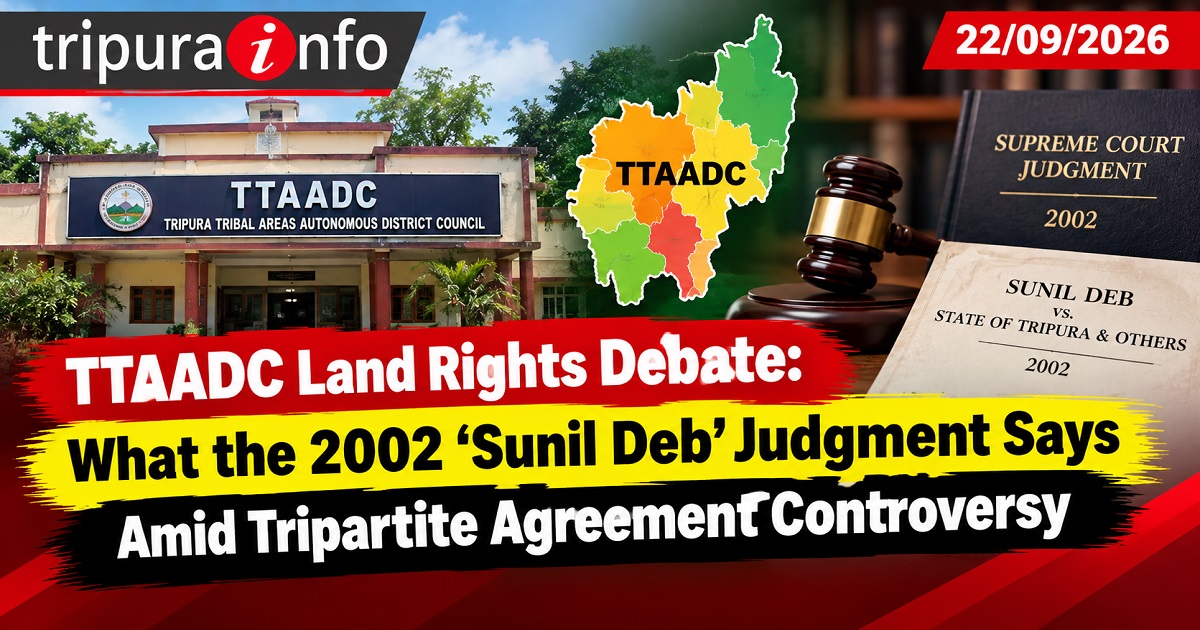 Former Law Principal Secretary Datamohan Jamatia’s Tripurainfo Podcast discussion brings renewed focus on the constitutional limits of ADC land powers and the demand for direct Central funding in Tripura. The continuing debate over the implementation of the March 2, 2024 Tripartite Agreement involving the Government of India, the Government of Tripura and TIPRA/TIPRA Motha has brought the constitutional powers of the Tripura Tribal Areas Autonomous District Council (TTAADC) into renewed focus, particularly over the contentious issues of land rights, land administration and direct funding from the Union Government.
The legal dimensions of the controversy were discussed in detail by Datamohan Jamatia, former Principal Secretary of the Tripura Law Department and former Chief Legal Advisor to the TTAADC, during a Tripurainfo Podcast on direct funding and land rights of the Autonomous District Council.
Against this backdrop, a significant judgment delivered by the Gauhati High Court more than two decades ago has acquired renewed relevance. In Sunil Deb vs State of Tripura and Others, decided on February 25, 2002, Justice BB Deb examined whether Section 187 of the Tripura Land Revenue and Land Reforms Act, 1960 (TLR & LR Act) applies within the territorial jurisdiction of the TTAADC.
The judgment is particularly important because it addressed the relationship between State land legislation and the special constitutional framework of the Sixth Schedule. The Court ultimately held that Section 187 of the TLR & LR Act applied throughout Tripura, including the TTAADC area, and that a separate public notification by the District Council under Paragraph 12AA(a) of the Sixth Schedule was not necessary for the provision to operate there.
The case arose from disputes concerning the restoration of land belonging to members of the Scheduled Tribes which had been transferred to non-tribal persons allegedly in violation of Section 187. The provision places restrictions on the transfer of land belonging to members of Scheduled Tribes and, subject to the conditions prescribed by law, requires prior written permission of the competent authority when such land is transferred to a non-tribal person. The law also provides specified exceptions for certain mortgages involving government, banks, cooperative societies and notified financial institutions.
The importance of Section 187 in the present debate lies in the fact that the provision is not merely a restriction on future transactions. The legislation also contains a mechanism for restoration of land where transfers made on or after January 1, 1969 were found to have violated the statutory restrictions. Under Section 187(3)(a), a specially empowered Revenue Officer may act either on his own motion or on an application and, after providing the transferee an opportunity of being heard, order the transferee or a person claiming under the transferee to be ejected.
The constitutional challenge in the 2002 case centred on the Sixth Schedule, particularly Paragraph 3(1)(a) and Paragraph 12AA(a). The petitioners argued that because the Sixth Schedule gives the District Council legislative authority over specified matters concerning land, State legislation relating to those subjects could not automatically operate inside the ADC area without the procedure contemplated under Paragraph 12AA(a).
The Court, however, examined the precise nature of the land-related powers granted to the District Council. Paragraph 3(1)(a) gives the ADC authority to make laws concerning matters such as the allotment, occupation and use of land for agricultural, residential, grazing and other purposes. The Court considered whether those powers could be equated with an unrestricted legislative authority over the transfer of land.
The judgment drew a significant constitutional distinction between occupation and use of land on one hand and transfer or alienation of land on the other. The Court observed that Paragraph 3(1)(a) of the Sixth Schedule specifically refers to allotment, occupation and use, but does not expressly include transfer of land. The Constitution separately deals with transfer and alienation of property through the relevant entries of the Seventh Schedule.
That distinction became central to the Court's reasoning. The existence of ADC authority over allotment, occupation and use of land did not mean that every State law dealing with transfer of land automatically ceased to operate within the autonomous area.
The Gauhati High Court consequently held that Section 187 of the TLR & LR Act, including the relevant amended provisions, was applicable throughout Tripura, including the TTAADC area. The Court rejected the contention that an additional notification from the District Council under Paragraph 12AA(a) was required before Section 187 could be applies within the ADC.
This finding has acquired fresh relevance because the present political demand for enhanced TTAADC land rights goes beyond the specific question considered by the High Court in 2002.
The phrase “land rights” in the present political discourse can encompass several different concepts, including control over allotment, occupation, land use, conversion, pattas, land records, transfer, restoration and administration. These powers do not necessarily have the same constitutional basis. The Sixth Schedule already provides the ADC with important powers concerning allotment, occupation and use of land, while Section 187 provides statutory protection against certain prohibited transfers of tribal land.
The present controversy is therefore not simply whether the TTAADC has constitutional powers relating to land. It clearly does. The more fundamental question is whether the powers now being demanded under the Tripartite Agreement go beyond the existing constitutional and statutory framework and, if so, what legal mechanism would be necessary to implement them.
This distinction is particularly important in view of the March 2, 2024 Tripartite Agreement. The agreement between the Union Government, the Tripura Government and TIPRA was intended to address issues concerning the indigenous people of Tripura, including land and political rights, economic development, identity, culture and language. The Government of India had stated that a Joint Working Group or Committee would work out and implement mutually agreed points in a time-bound manner.
Since then, demands associated with the agreement have included greater empowerment of the TTAADC, enhanced authority over land and land administration, stronger protection of indigenous land, and direct financial support from the Union Government. Tipra Motha leaders have repeatedly linked these demands with the broader question of implementing the agreement.
It is here that the observations of Datamohan Jamatia during the Tripurainfo Podcast become significant. As a former senior official of the State Law Department and former Chief Legal Advisor to the TTAADC, Jamatia's analysis places the present political demands within the existing constitutional structure and raises the question of how far the Sixth Schedule can accommodate an expanded role for the ADC without corresponding changes in law.
The demand for greater land powers cannot therefore be assessed only by reference to the political language of the Tripartite Agreement. The precise power proposed to be transferred to the TTAADC would have to be identified first. A power to regulate land use is legally different from a power to issue pattas, and both are different from a power to regulate or authorise transfer of ownership. Similarly, restoration of illegally transferred tribal land is different from establishing a new system under which the ADC exercises comprehensive control over all land transactions within its territory.
The 2002 Sunil Deb judgment provides an important judicial reference point in making these distinctions. It confirms that the existence of the Sixth Schedule did not, by itself, make Section 187 of the TLR & LR Act inapplicable inside the ADC. At the same time, the judgment did not determine the much broader question of whether the TTAADC could in the future be given additional land powers through an appropriate legislative or constitutional process.
This principle decided in the judgement is completely in resonance with the five judges bench judgement of the supreme court ( AIR 1972 SC 787 ( para 11, 14, 15 and 16) in which it was held that the words, “ allotment, occupation and use of land” appeared in para3(1)(a) of the sixth schedule donot cover or extend the power to the ADC to make land law by which it can transfer any land , specially, khas land. Supreme court’s judgement is binding not only to the ADC, but also to State Govt and central Govt under article141 of the constitution.
more news...