Former BJP State President Ranajay Deb Warns of Legal Action Over Any Tripartite Accord Implementation That Harms Interests of Any Community
By Our Correspondent
Agartala, September 20, 2026
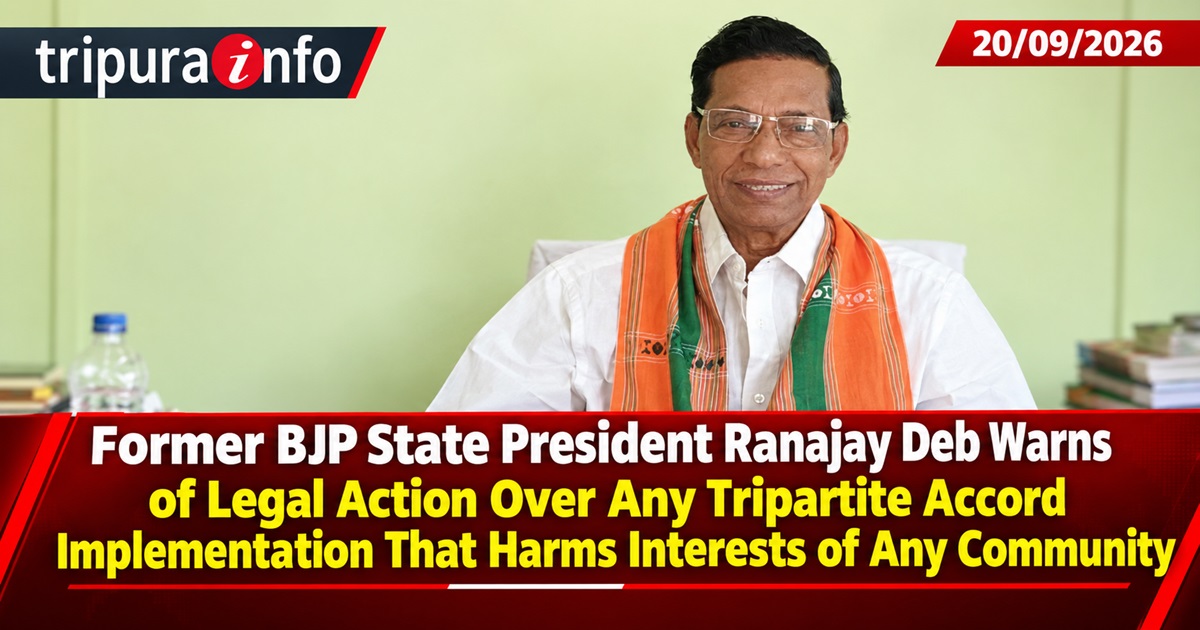 Former Tripura BJP state president Ranajay Deb has raised strong objections over the implementation of the March 2, 2024 tripartite agreement between the Government of India, the Government of Tripura and TIPRA, particularly on questions relating to land rights and the proposed strengthening of the Tripura Tribal Areas Autonomous District Council (TTAADC).
In a Facebook post on Sunday night, Deb said that while the agreement had been presented as a framework for addressing the concerns of Tripura's indigenous population, its implementation involved complex constitutional, legal and social questions.
Most significantly, he warned that he would approach the court if any provision of the agreement were implemented in a manner that, in his view, harmed the interests of any community or society in the ADC areas.
“If any agreement is implemented in the ADC at the cost of the interests of any community or society, I will personally approach the Hon’ble Court. Rest be assured,” Deb wrote.
The tripartite agreement was signed in New Delhi on March 2, 2024, in the presence of Union Home Minister Amit Shah, Tripura Chief Minister Manik Saha and TIPRA founder Pradyot Kishore Debbarma. According to the Union Home Ministry, the agreement covers issues concerning the indigenous people of Tripura, including history, land and political rights, economic development, identity, culture and language. A Joint Working Group/Committee was subsequently constituted to work out and implement mutually agreed points in a time-bound manner.
However, more than two years after the agreement, differences and uncertainty over several major components remain a subject of political and administrative debate in Tripura.
A high-level meeting was held in New Delhi on September 4, 2026, involving Union Home Minister Amit Shah, Chief Minister Manik Saha, TIPRA Motha founder Pradyot Kishore Debbarma and BJP's Northeast coordinator Sambit Patra. Reports following the meeting said that the agreement would be implemented in phases, with particular attention to indigenous identity and land rights.
Pradyot Kishore has subsequently stated that commitments were made concerning land rights and direct funding to the ADC. Those claims have become an important part of the current political debate, although the publicly available 2024 agreement itself does not spell out a specific mechanism for direct central funding to the ADC. The original government statement instead speaks broadly about resolving the identified issues through a Joint Working Group/Committee.
Deb referred to an interview conducted by Tripurainfo.com with Datamohan Jamatia, former Principal Secretary of the Tripura Law Department and former Chief Legal Advisor to the TTAADC, regarding the legal implications of land rights and direct funding.
According to Jamatia's explanation in that interview, the issues cannot simply be resolved through an executive or political decision because they involve the constitutional framework governing the ADC, the Sixth Schedule and existing land legislation.
The Sixth Schedule provides the constitutional framework for the administration of tribal areas in Assam, Meghalaya, Tripura and Mizoram.
A major point raised by Ranajay Deb concerns the large number of Bengali and other non-tribal families who have lived in areas falling under the ADC for several decades.
He questioned what would happen to families who have been residing there for 70 or 80 years and whether their existing land rights and interests would be adequately protected if major changes were introduced.
Deb also argued that the development of the hill areas has involved contributions from people belonging to different communities and stressed the need to consider the interests of all residents while implementing any agreement.
In his remarks, Deb also offered a historical perspective on the development of Tripura's tribal population. He said he first came to Tripura in 1969, while his family had arrived in the state in 1962, and recalled the difficult socio-economic conditions he had witnessed among tribal communities at that time.
He pointed to the emergence of tribal judges, lawyers, senior government officers, teachers, headmasters, engineers and other professionals as evidence of the social progress achieved over the decades.
At the same time, he argued that the ADC areas still face substantial developmental challenges, particularly in relation to industries, businesses, infrastructure and investment.
Deb said he wants the ADC areas to develop rapidly and emphasised peaceful coexistence among all communities.
The controversy has now moved beyond a political disagreement and increasingly involves questions of constitutional authority, land ownership, administrative powers and financial arrangements.
The original 2024 agreement expressly covers land and political rights, economic development, identity, culture and language, but the precise legal mechanism through which each commitment will be implemented remains central to the ongoing debate.
The question of direct funding to the TTAADC is particularly significant because it raises issues about the existing constitutional and financial structure governing the Autonomous District Council. Pradyot Kishore has publicly claimed that direct funding was part of the recent discussions, while the Union government's publicly available description of the 2024 accord does not provide details of such a funding mechanism.
Against this backdrop, Ranajay Deb's warning to approach the court has added another dimension to the debate, particularly over how any future decision will balance the demands of indigenous communities with the rights and interests of other long-settled residents of the ADC areas.
more news...