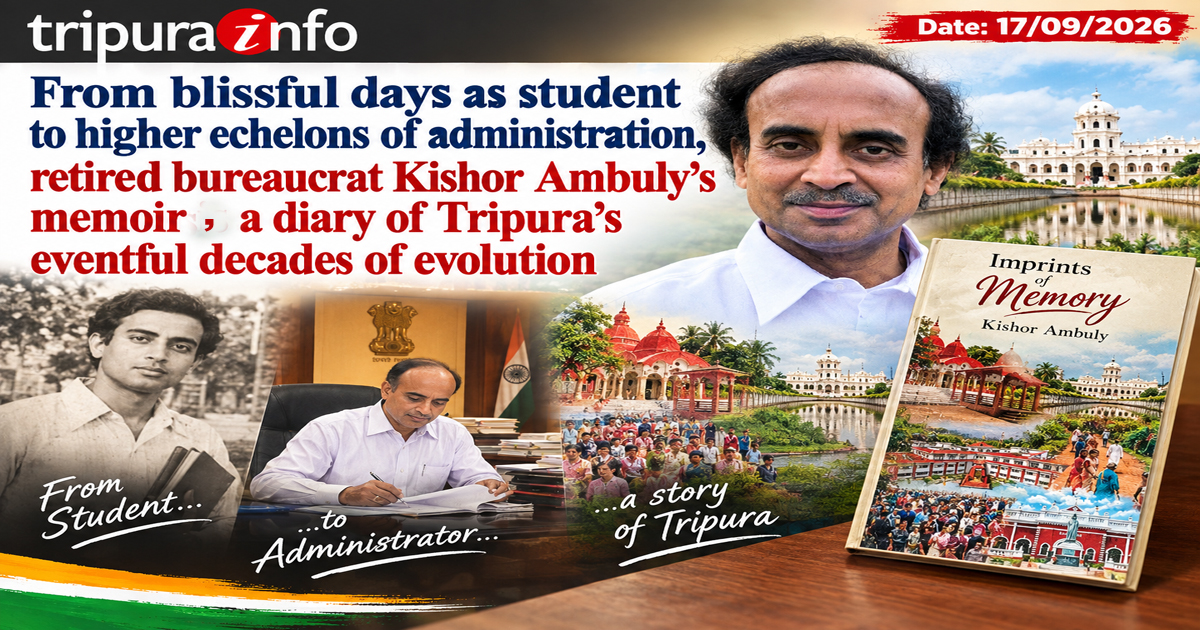
From blissful days as student to higher echelons of administration, retired bureaucrat Kishor Ambuly’s memoir , a diary of Tripura’s eventful decades of evolution
By Our Correspondent
Agartala, September 17, 2026
 “ I am not afraid of tomorrow, for I have seen yesterday and I love today” commented celebrated Russian travelogue writer Alexander Vassilieff , the author of ‘An Epic Journey : From Russia to Australia’. This pithily sums up the supposed attitude of authors who write memoirs , often with ‘emotion recollected in tranquility’. But memoirs, more often than not , sparks controversies when they are penned by politicians who once occupied high pedestal of power.
But in the instant case ‘Imprints of Memory’, a brief memoir of retired bureaucrat and former secretary of the state government Kishor Ambuly strikes a contrast : Ambuly had been in high echelons of power but never courted controversy in his long career. His memoir penned in fluent simplicity also narrates only his reminiscences of his life as a student and administrator,bereft of any complication and controversy .
He had been like a boy next door residing with his family in an area of Agartala now known as Rabindra Pally that had a sprawling pond in front. It was in his early boyhood that he encountered with his family the fury of natural calamity in the form of the devastating flood of 1956. Within a short time the Ambuly family shifted to what is now the eastern side of the Palace Compound area where also he was close to water as a large pond was a perennial source of joy and solace to the inhabitants all around. His schooling in the now-defunct ‘Maitree Bharati’ school within the premise of the Buddist monastery in Kunjaban area and later in Umakanta Academy under the benign tutelage of legendary headmaster, late Shitikantha Sengupta also make interesting reading, introducing readers to a brief period of nostalgia.
As a meritorious student he had cleared the school leaving exam with success and obtained graduation with honours in English from the state’s fabled MBB college. No elaboration is provided in the memoir about Ambuly’s days in the Calcutta university as a masters student except his pleasure trips to different parts of West Bengal, Jharkhand , Bhilai and Bhopal in Madhya Pradesh. But this is more than made up by a capitulation of his experience in service career which he had embarked upon initially as a translator in the court before becoming a TCS officer in 1981. In the course of his service in the administration as a TCS officer he had a truly varied experience of the hilly interiors of the state including places as remote as Ghorakappa in Sabroom, locations in Kanchanpur bordering the Chittagong hill-tracts of Bangladesh and the poverty-stricken habitations of Dhalai district.
The author had secured promotion to the elite rank of Indian Administrative Service (IAS) and rose to become a secretary in the administration before retiring from service after a period of extension. What, however, is remarkable is that Ambuly seems to have consciously tried to keep clear of many a controversy to which he was a direct witness like the humiliation heaped on his senior colleague Nepal Sinha as SDM (Sadar) in the run-up to the controversial assembly election in 1988. But that perhaps is right, as an administrator is not supposed to be opinionated. After bidding farewell to his clean career in the administration Ambuly continues to work as a Group Advisor to the ILS hospital.
The ‘Imprints of Memory’ authored by Ambuly is sleekly produced spanning 67 pages and smartly printed book , published by the famous Miharika Publishers. Ambuly is right in his final assessment in the ‘Epilogue’ of his memoir that ‘gains far outweigh what could not be achieved’ in his long career in the administration . This is perhaps a stimulating note of optimism for the current crop of cadre-service administrators who feel frustrated by what they can not do and what they are asked to do-often against conscience and better sense.
more news...