Non-Tribal Residents of TTAADC Areas Seek Protection of Land Rights, Submit Appeal to Tripura Chief Minister
By Our Correspondent
Agartala, September 16, 2026
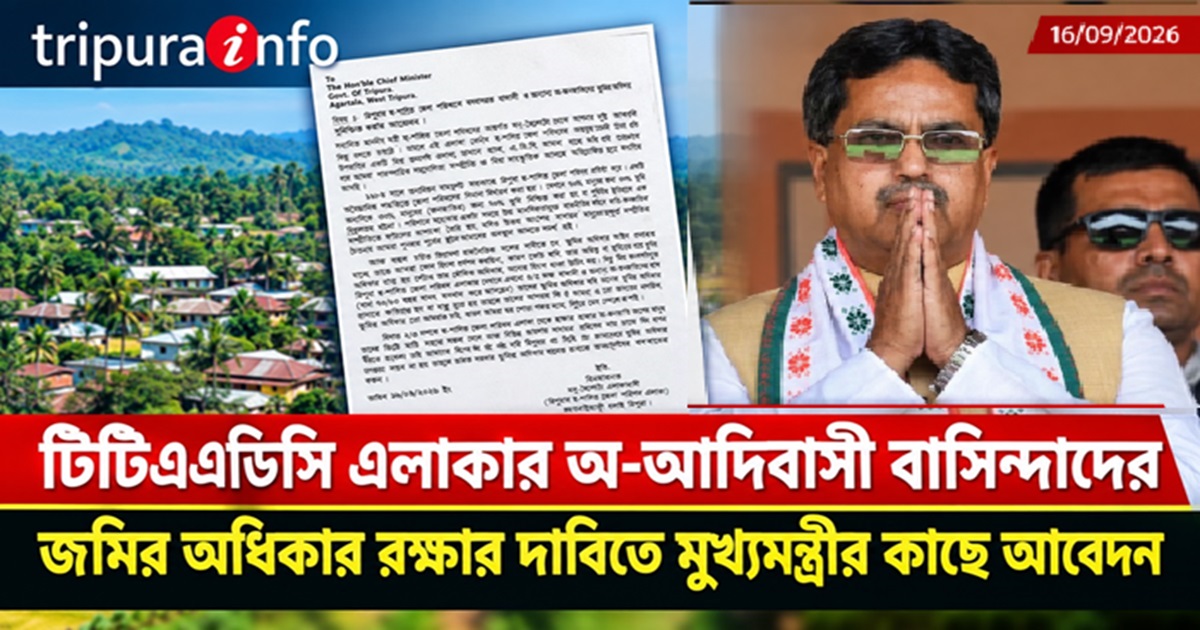 A group of residents from the Manu–Chailengta area under the Tripura Tribal Areas Autonomous District Council (TTAADC) has appealed to the Tripura Chief Minister to ensure the land rights of Bengali and other non-tribal residents living within the ADC areas, amid the ongoing debate over greater land powers for the indigenous population.
In a representation dated September 16, 2026, addressed to the Chief Minister of Tripura, the residents said they were drawing the government's attention to the situation of people living in mixed-population areas under the TTAADC. A copy of the representation has also been marked to the Union Home Minister.
The petitioners, identifying themselves as residents of the Manu–Chailengta area, said their locality is both part of the autonomous district and a mixed-population area where tribal and non-tribal communities have lived together for decades.
They claimed that many families have been residing in the area for 70–80 years, maintaining what they described as traditional cooperation, communal harmony and a mixed cultural environment.
The representation also refers to the historical establishment of the Tripura Autonomous District Council and argues that the demographic composition of several ADC areas makes the question of land rights particularly sensitive.
The residents said they have no objection to legal measures intended to protect the legitimate land rights of indigenous communities. However, they expressed concern that any new land-rights framework should not adversely affect the lawful land rights of non-tribal residents who have been living in the ADC areas for several decades.
The petition states that if land rights are granted or transferred in a manner that affects the existing rights of Bengali and other non-tribal residents, questions could arise regarding the status and security of long-settled families.
The petitioners emphasised that they too are citizens of India and said they seek protection of their lawful rights over their homes and land.
The representation further claims that around four to five lakh Bengali and other non-tribal people are living in the mixed-population areas of the TTAADC and that many of them have been residing there for 70–80 years.
According to the petitioners, a significant number of people from non-tribal communities who had once received land through earlier settlement processes are now living in circumstances similar to ordinary wage earners.
They therefore requested that their historical residence and existing land-related rights be taken into consideration before any new arrangement concerning land within the ADC is implemented.
The petitioners have made it clear that their appeal is not against protection of tribal land rights. Instead, they have urged the state and central governments to ensure that protection of indigenous land rights and protection of legitimate non-tribal land rights are addressed together.
They appealed to the governments to formulate any future legal or administrative mechanism in a manner that protects the rights of both communities and prevents uncertainty among long-settled residents.
The representation comes at a time when the question of land rights within the TTAADC has become a major issue in Tripura's political and constitutional discourse. The Sixth Schedule gives autonomous district councils law-making powers concerning, among other matters, the allotment, occupation and use of land, subject to constitutional provisions and the Governor's assent to laws made under the Schedule.
The land question has gained further prominence ahead of the TTAADC Village Committee elections scheduled for September 28, 2026. Tipra Motha founder Pradyot Kishore Debbarma has publicly made written assurances on indigenous land rights a key issue in discussions surrounding the elections.
The Centre, the Tripura government and Tipra Motha have also been discussing implementation of the 2024 tripartite agreement, with land rights and direct funding identified as one of the major issues requiring consideration. A senior Tipra Motha MLA Ranjit Debbarma recently said that amendments to the Tripura Land Revenue and Land Reforms Act, 1960 may be required to strengthen protection of tribal land within the Sixth Schedule areas.
Against this backdrop, the latest representation from Manu–Chailengta residents brings another dimension into the debate: how any expanded land-rights regime can protect indigenous interests while also safeguarding the lawful rights of long-settled non-tribal residents in mixed-population areas.
The residents have therefore urged both the Tripura and Union governments to consider their concerns while framing any future legislation, policy or administrative arrangement concerning land rights in the TTAADC areas.
more news...