Tripura’s Water and Power Crisis Raises Questions, Residents in Several Parts of the Capital have also Complained
By Our Correspondent
Agartala, September 15, 2026
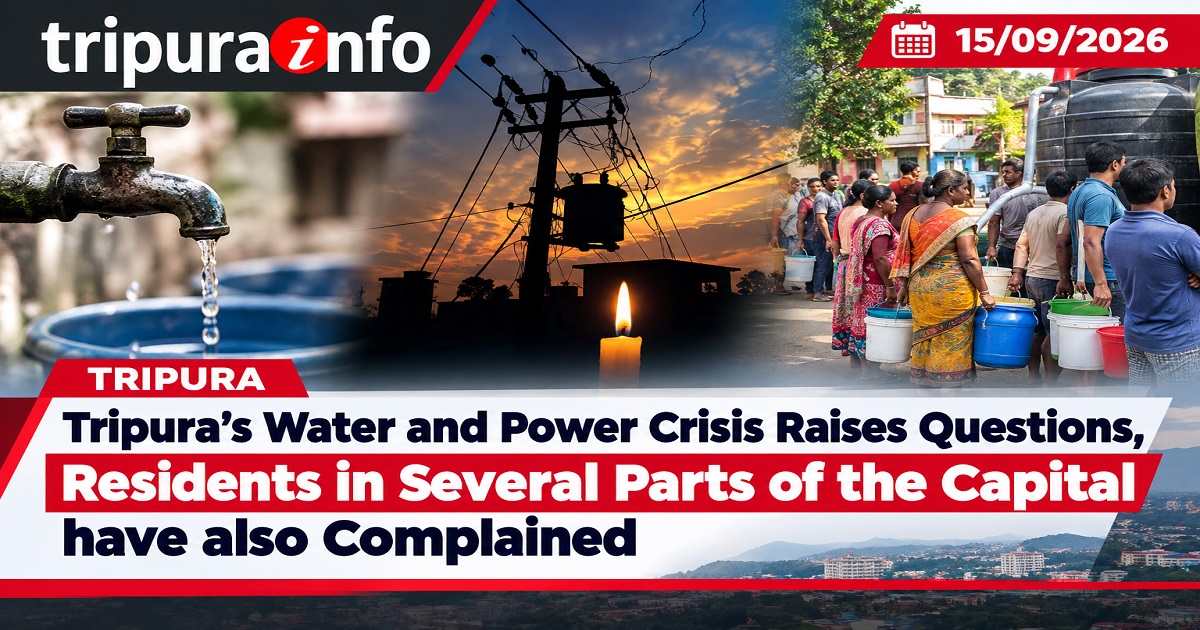 Statements made in the Tripura Legislative Assembly by Chief Minister and Power Minister Manik Saha have triggered questions over the gap between the government’s official assessment of electricity and drinking-water availability and the difficulties reportedly being faced by residents across the state.
According to the government’s position presented in the Assembly, Tripura is not facing a regular load-shedding crisis, while drinking-water supply has also improved significantly through modern infrastructure and pipeline connections. The government has maintained that electricity infrastructure has been expanded and that a large number of households, including those in rural areas, have access to power connections. Similarly, under various drinking-water supply projects, pipeline connections have reportedly been extended to a substantial number of households.
However, the situation described by many residents on the ground appears considerably different. Complaints about interruptions in electricity supply and irregular drinking-water availability continue to emerge from different parts of the state. Residents in several localities claim that power cuts and fluctuations have become a recurring problem, while drinking water does not always reach households according to a predictable schedule.
The issue is particularly significant because uninterrupted electricity and reliable drinking-water supply are among the most basic civic services. For ordinary households, the question is not simply whether a power connection or a pipeline connection technically exists, but whether electricity and water are actually available when they are needed.
In several areas, residents reportedly have to wait for water supply and, in some cases, store water in advance because the timing of supply remains uncertain. When water does not arrive at the expected time, families are compelled to make alternative arrangements or depend on other sources. The situation can become particularly difficult for elderly people, children and working families whose daily routines depend heavily on predictable access to water.
Similar concerns have been raised regarding electricity. Although the government may not classify the interruptions as conventional or scheduled “load-shedding”, frequent outages, voltage fluctuations or interruptions caused by technical problems can have a similar impact on ordinary consumers. From the perspective of a household, school, shop or small business, the distinction between formal load-shedding and repeated unscheduled power interruptions offers little relief when electricity is unavailable for essential activities.
The contradiction becomes even more striking in the case of Agartala, the state capital and a city that has been developed under the Smart City framework. Residents in several parts of the capital have also complained about interruptions in electricity supply and irregularities in essential civic services. If consumers in the state capital itself continue to experience difficulties in obtaining uninterrupted electricity and reliable water supply, questions naturally arise about the effectiveness of the infrastructure and service-delivery mechanisms in more remote and rural areas.
The controversy, therefore, is not necessarily about whether infrastructure has been created. The more important question is whether the infrastructure is functioning consistently and delivering the promised services to consumers.
The government’s claim regarding pipeline water connections also requires examination from this perspective. A household having a pipeline connection does not automatically mean that it receives adequate drinking water every day. Similarly, having an electricity connection does not necessarily guarantee uninterrupted power supply. The actual frequency, duration and geographical distribution of service interruptions are therefore crucial indicators of the quality of public service delivery.
Residents have increasingly sought greater transparency from the authorities on this issue. If water supply is interrupted in a particular locality, people want to know the reason for the disruption, how long it is expected to continue and when normal supply will resume. Likewise, when electricity supply is interrupted, consumers need clear information about whether the cause is a technical fault, maintenance work, transformer failure, damage to transmission infrastructure or another operational problem.
The absence of timely information can itself intensify public frustration. When consumers do not know why a service has stopped or when it will return, uncertainty becomes a larger problem than the interruption itself.
The issue also raises questions about the distinction between government statistics and citizens’ actual experience. Official figures may show the expansion of electricity coverage and household tap-water connections, but the ultimate test of these schemes is whether citizens receive regular, dependable and adequate services.
Tripura’s modernisation programmes, including the Smart City initiative in Agartala and various drinking-water and power-infrastructure projects, have created expectations among residents for improved civic services. Those expectations are particularly high in urban areas, where people reasonably expect modern infrastructure to translate into reliable day-to-day services.
Against this backdrop, the government may need to undertake a comprehensive, area-wise assessment of electricity and drinking-water supply rather than relying solely on aggregate figures relating to connections and infrastructure. Such an assessment could establish where interruptions are occurring, how frequently they occur, what causes them and how quickly the concerned departments respond.
A transparent public disclosure of locality-wise water-supply schedules, areas facing shortages, power-interruption data, transformer and pipeline-related problems, and the average time required to restore services could help bridge the apparent gap between official claims and public perception.
The larger question is therefore not merely whether Tripura has achieved widespread electricity and pipeline-water connectivity. It is whether those connections are translating into reliable, uninterrupted and predictable services.
more news...