Questions Grow Over Former Tripura University VC and Registrar Deepak Sharma’s Tenure as Labour Order Exposes Rs.45.13 Lakh Wage Dispute
By Our Correspondent
Agartala, September 14, 2026
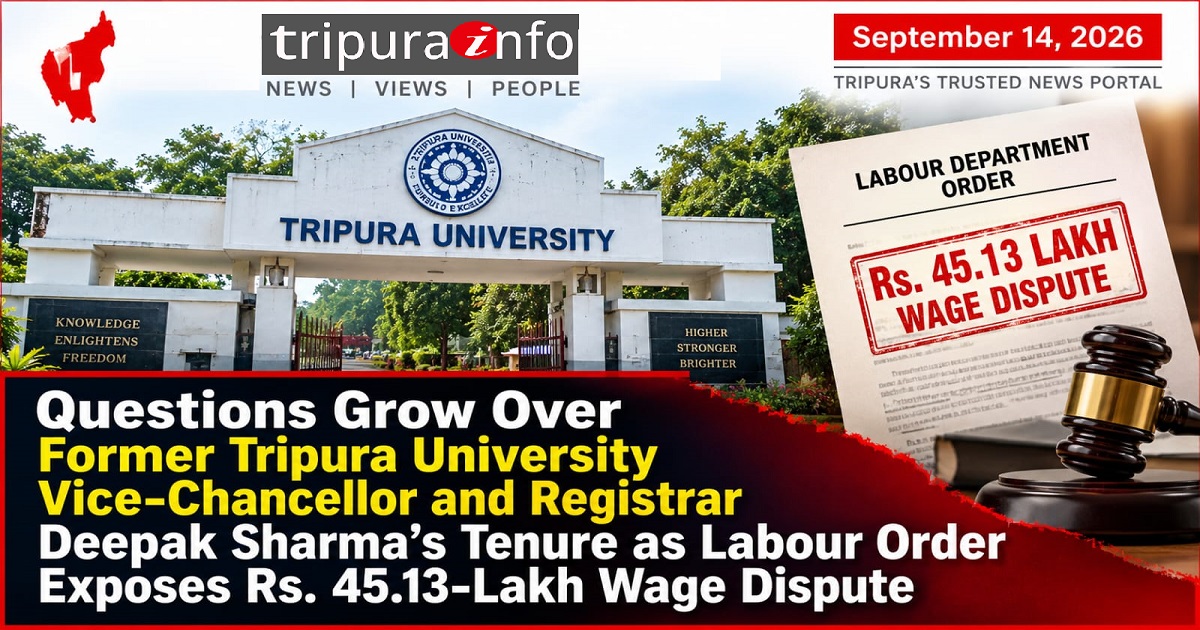 Questions over the functioning of former Tripura University Vice-Chancellor and Registrar Dr. Deepak Sharma are gaining fresh attention following a significant order of the Regional Labour Commissioner (Central), Guwahati, directing payment of Rs.45.13 lakh to 68 outsourced workers of Tripura University towards wage differences and compensation.
The order, passed by Aman Toppo, Regional Labour Commissioner (Central), Guwahati, on August 31, 2026, followed a claim application filed by Shri Debabrata Biswas and others on April 20, 2026, under Section 20(2) of the Minimum Wages Act, 1948. The case was registered as Claim Application No. G/R.06/2026(MW)-RLC.
The case named M/s S Basu Thakur & Co., represented by Shri S. Basu Thakur, Chartered Accountants, as Non-Applicant-I and the Registrar, Tripura University (Central), Suryamaninagar, as Non-Applicant-II. The applicants appeared in person, while Shri Debprasad Majee appeared for the first non-applicant. On behalf of Tripura University, Shri Muneendra Mishra, Deputy Registrar, and Shri Priya Ranjan Kumar, Professor, appeared, with Advocate Shri PP Chakraborty also representing the university side.
The dispute relates to the period from April 1, 2025 to April 1, 2026, during which the applicants alleged that outsourced workers engaged at Tripura University were paid less than the minimum wages applicable under the relevant Central Government notification. The claim included Rs.35,40,732 towards the difference in minimum wages and Rs. 4,74,096 towards overtime wages.
The contractor, however, maintained before the Labour Authority that payments had been made according to the rates notified by the Government of Tripura under the terms of the contract awarded by the university. The contractor also referred to correspondence with the university regarding enhancement of wages for outsourced employees in accordance with Central Government rates and stated that it would make the higher payments if the university provided the necessary funds.
After hearing the parties and examining the documents placed before it, the Regional Labour Commissioner held that the concerned workers were entitled to their due wages and compensation. The authority observed that the workers had not received their due wages for the relevant period and that the delay had caused financial hardship and monetary loss to them.
The order contains detailed worker-wise calculations covering skilled, semi-skilled and unskilled categories. After calculating the wage differences and compensation, the authority determined the total amount payable to the workers at Rs.45,13,282, or approximately Rs.45.13 lakh.
The Labour Commissioner also relied upon the Supreme Court judgment in People’s Union for Democratic Rights & Others v. Union of India & Others, referring to the constitutional significance of minimum-wage protection and the Supreme Court's observation regarding labour performed for remuneration below the prescribed minimum wage.
In the operative portion of the order, the Labour Commissioner directed the university authority to pay the awarded amount directly into the bank accounts of the concerned workers within 30 days of receipt of the order. The university has also been directed to submit proof of payment, including transaction reference details, to the applicants and the Labour Authority.
The order has consequently raised a fundamental question about the administrative mechanism at Tripura University: if the workers were legally entitled to the prescribed minimum wages, why were they allegedly paid less, and who was responsible for ensuring that the statutory wage requirements were complied with?
The issue assumes greater significance because the order records that the contractor had earlier communicated with the university regarding enhancement of wages for outsourced employees in line with Central Government rates. This raises questions about the manner in which the university framed, implemented and monitored its outsourcing arrangements and whether adequate mechanisms existed to ensure compliance with labour laws.
The controversy has also brought renewed attention to allegations circulating within the university campus concerning the conduct of former Registrar Dr. Deepak Sharma. It has been alleged that Sharma had demanded money from the complainant in connection with the matter.
more news...