Chief Minister Manik Saha calls for closer BSF-police-administration coordination, replacement of ageing fencing and technology-driven ‘smart border’ surveillance
By Our Correspondent
Agartala, September 13, 2026
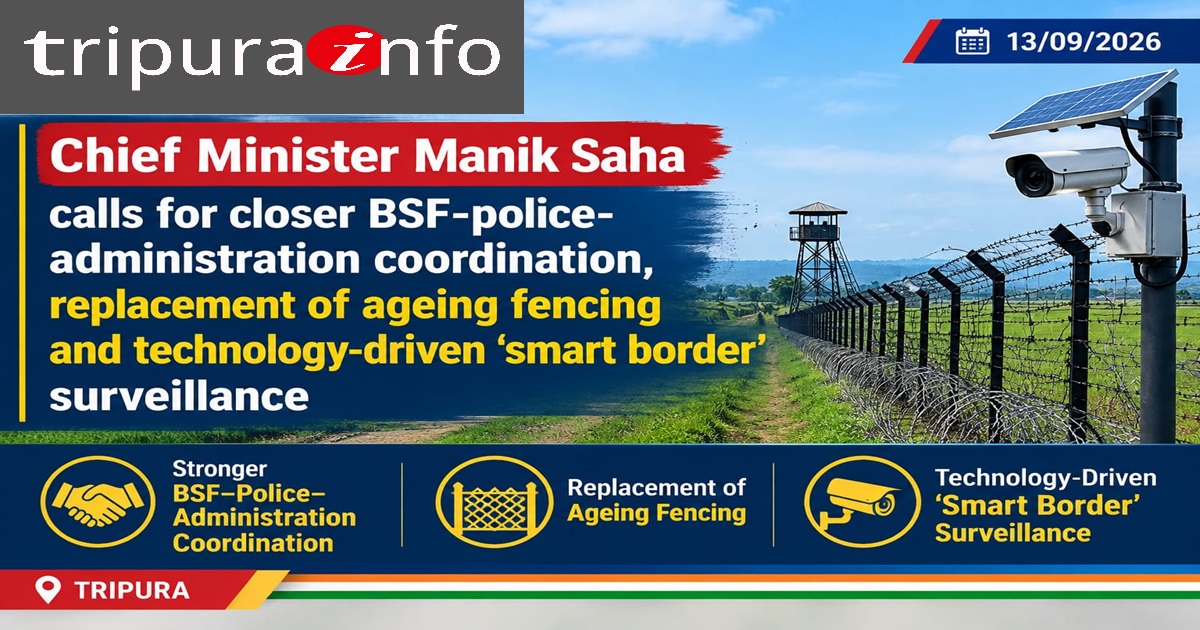 Tripura Chief Minister Prof. Dr. Manik Saha on Sunday proposed a three-tier coordination mechanism involving the Border Security Force (BSF), State police and local civil administration to strengthen efforts against smuggling and other illegal activities along the State’s international border with Bangladesh.
Addressing a voluntary blood donation camp at the BSF Tripura Frontier headquarters at Shalbaga, Dr. Saha said border-related challenges could not be tackled effectively by any single agency and called for closer coordination between security forces, police and the administration at the local level.
The proposed mechanism is aimed at creating a more integrated system in which the BSF’s operational capabilities, the State police’s enforcement network and information available with district and local administration can be brought together for quicker identification of vulnerable areas and coordinated action.
Focus on vulnerable border stretches
Tripura shares an 856-kilometre international border with Bangladesh, making effective surveillance and enforcement a major security and administrative challenge for the State.
Dr. Saha said steps had already been initiated to replace more than 119 kilometres of existing border fencing. The replacement of ageing, damaged or otherwise vulnerable sections of fencing is expected to improve physical security and strengthen control over sensitive stretches of the frontier.
The Chief Minister’s emphasis on fencing comes alongside a broader push towards modernising border management. While physical barriers remain an important component of border security, the State is also looking at technology-driven surveillance to supplement conventional security arrangements.
‘Smart border’ approach
Dr. Saha highlighted the ongoing work under the ‘smart border’ concept, under which modern surveillance technology is expected to play a greater role in monitoring the international frontier.
Technology-based systems, combined with upgraded fencing and enhanced coordination among agencies, could help security personnel detect suspicious movement and respond more rapidly to emerging threats, particularly in difficult or vulnerable stretches.
The approach is significant for Tripura, where sections of the international boundary pass through challenging terrain and areas where civilian settlements are located relatively close to the border.
Three agencies, one coordinated strategy
The proposed three-tier coordination model is intended to address a key challenge in border management: ensuring that information and action move quickly between agencies.
Under the proposed approach, the BSF would continue to play the primary role in securing the international border, while the State police and civil administration would contribute their local intelligence, enforcement capabilities and knowledge of ground-level issues.
Closer institutional coordination could also facilitate the identification of vulnerable stretches, improve information-sharing and enable faster responses to incidents involving smuggling or other illegal cross-border activities.
The move comes amid recurring concerns over smuggling and other unlawful activities in border areas. The State’s extensive international boundary and the varying geographical and demographic conditions along it make sustained coordination particularly important.
Centre-State coordination stressed
The Chief Minister also underlined the importance of cooperation between the Centre and the State in strengthening Tripura’s border-management infrastructure.
Referring to Union Home Minister Amit Shah’s visits to border areas, Dr. Saha said the Centre was aware of the difficulties faced by Tripura and indicated that continued Centre-State coordination would be crucial for addressing issues related to border security, fencing and the prevention of smuggling.
The State Government’s approach, therefore, appears to combine central security assistance with stronger coordination at the State and local levels.
Infrastructure and technology to work together
Officials and security agencies face the challenge of securing a long and geographically diverse border. Merely strengthening fencing may not be sufficient in areas where terrain, population patterns and other local factors complicate surveillance.
The proposed strategy seeks to combine three key elements—stronger physical infrastructure, technology-based surveillance and institutional coordination.
Replacing ageing fencing would strengthen the physical barrier, while smart-border technologies could provide additional surveillance capabilities. At the same time, coordination between the BSF, police and civil administration could ensure that information about local developments reaches the agencies responsible for taking action.
Blood donation appeal
The Chief Minister’s remarks came during an event primarily organised around voluntary blood donation.
With the festive season approaching, Dr. Saha appealed to citizens to donate blood regularly, noting that the requirement for blood at hospitals generally increases during festival periods.
He described voluntary blood donation as both a means of saving lives and an important social responsibility, urging people to participate in donation drives whenever possible.
Integrated border management emerging as priority
The Chief Minister’s proposal signals an emphasis on moving towards a more integrated border-management framework in Tripura, rather than depending solely on conventional security measures.
The proposed three-tier mechanism involving the BSF, State police and local administration, along with the replacement of over 119 km of fencing and the development of a technology-driven ‘smart border’, could provide a broader framework for tackling the State’s persistent border-related challenges.
For Tripura, the effectiveness of the strategy will ultimately depend not only on new infrastructure and technology but also on how efficiently the three agencies share information, coordinate operations and respond to problems at the local level.
The proposed model thus places coordination, modern surveillance and stronger border infrastructure at the centre of the State’s efforts to curb smuggling and reinforce security along its 856-km international frontier.
Clarify the three-tier mechanism’s structure
Reduce repeated border-security points
Use more cautious attribution throughout
more news...