Tripura Government Returns ADC Land Rights Bill Without Approval, TTAADC’s Demand for Expanded Land Powers Remains Unfulfilled
By Our Correspondent
Agartala, September 13, 2026
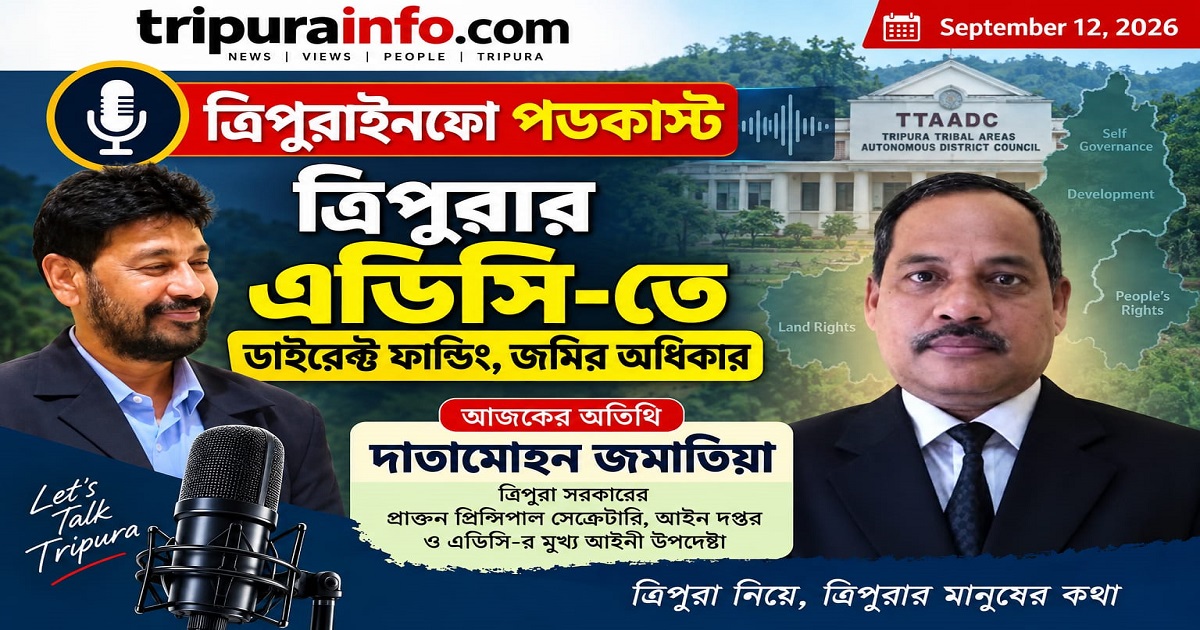 The Tripura government has returned a bill submitted by the Tripura Tribal Areas Autonomous District Council (TTAADC) seeking expanded land rights without approving it, according to Datamohan Jamatia, former Principal Secretary of the Tripura Law Department and former Chief Legal Advisor to the TTAADC.
As a result, one of the key demands of the Tipra Motha Party, granting the ADC broader and more comprehensive control over land rights has not been implemented for now, he said.
Jamatia disclosed the information during a Special Interview on the TripuraInfo Podcast last night. He explained that the issue cannot be resolved solely through political decisions or administrative directives. It is directly linked to the Constitution, the Sixth Schedule and Tripura’s existing land laws.
The demand for Direct Funding for the TTAADC and greater land rights for tribal communities has become one of the most important issues in Tripura politics. With the ADC Village Council elections approaching, Tipra Motha leaders have been strongly highlighting both demands. The party has also claimed that, following discussions with Union Home Minister Amit Shah, full land rights for the ADC and a Direct Funding mechanism will be introduced soon.
However, according to Jamatia’s legal interpretation, several important constitutional and legal limitations stand in the way of implementing these demands under the existing framework.
Jamatia said that Autonomous District Councils have specific legislative and administrative powers under the Sixth Schedule. However, these powers are not unlimited. Laws enacted by the council must remain consistent with the Constitution and applicable central and state laws.
According to him, granting the TTAADC extensive additional powers over land distribution, transfer or ownership beyond the existing framework would require the necessary legal procedures to be followed. Tripura’s existing land laws are also important in this regard.
For this reason, he linked the return of the TTAADC’s land-related bill without state approval to the existing legal framework. In his view, the TTAADC has not been granted comprehensive new land rights as demanded by Tipra Motha.
The former law secretary also explained the demand for providing funds to the TTAADC directly from the Centre, without routing them through the state government.
According to him, the Sixth Schedule currently does not contain any general constitutional provision allowing the TTAADC to receive funds directly from the central government outside the state’s financial structure.
However, this does not mean that central funds cannot reach ADC areas. Funds can be allocated through central schemes, tribal development programmes, specific grants and earmarked or project-based funding. The key legal question is whether such project-based funding can constitutionally be described as “Direct Funding” for the TTAADC.
He said that creating a permanent and separate constitutional Direct Funding mechanism for the TTAADC could require specific legal or constitutional changes, depending on the nature of the proposed arrangement.
The implementation of the tripartite agreement signed on March 2, 2024, between the Government of India, the Tripura government and Tipra Motha is also a major political issue.
The agreement calls for discussions aimed at resolving various issues concerning Tripura’s indigenous people, including their history, land rights, political rights, economic development, identity, culture and language.
According to Jamatia, however, political commitments and the legal measures required to implement those commitments are two separate matters. A political announcement does not automatically become a legal right or constitutional power.
He said that not every issue covered by the tripartite agreement would necessarily require a constitutional amendment.
Jamatia said that several initiatives relating to culture, language, education, research, heritage preservation and tribal welfare can be undertaken within the existing legal and administrative framework.
The central and state governments can provide financial and administrative assistance to TTAADC areas through specific projects, development programmes and welfare schemes. Therefore, implementing every aspect of the agreement would not require a constitutional amendment.
The situation is different when it comes to proposals aimed at substantially expanding the TTAADC’s constitutional powers, granting extensive land rights beyond the existing Sixth Schedule framework or creating a new constitutional Direct Funding mechanism.
According to Jamatia, such fundamental changes cannot be introduced through ordinary administrative orders or government notifications. Depending on the nature of the proposal, amendments to relevant laws, changes to the Sixth Schedule or another constitutional process may be required.
As a result, the central question regarding the demands for land rights and Direct Funding for the TTAADC is now this: Which issues can be implemented under existing laws and administrative powers, and which will require new legislation, legal amendments or constitutional changes?
According to Jamatia’s legal interpretation, the TTAADC has not, under the current circumstances, received comprehensive new land rights or a constitutional Direct Funding mechanism as demanded by Tipra Motha. The future implementation of these two demands will therefore depend on the legal and constitutional course adopted by the central and state governments.
Datamohan Jamatia discussed these issues in detail during the Special Interview on the TripuraInfo Podcast.
more news...