Over Ration Shop Dispute, Allegations of Political Pressure and Defiance of High Court Order Raise Questions Over Rule of Law in Tripura
By Our Correspondent
Agartala, September 12, 2026
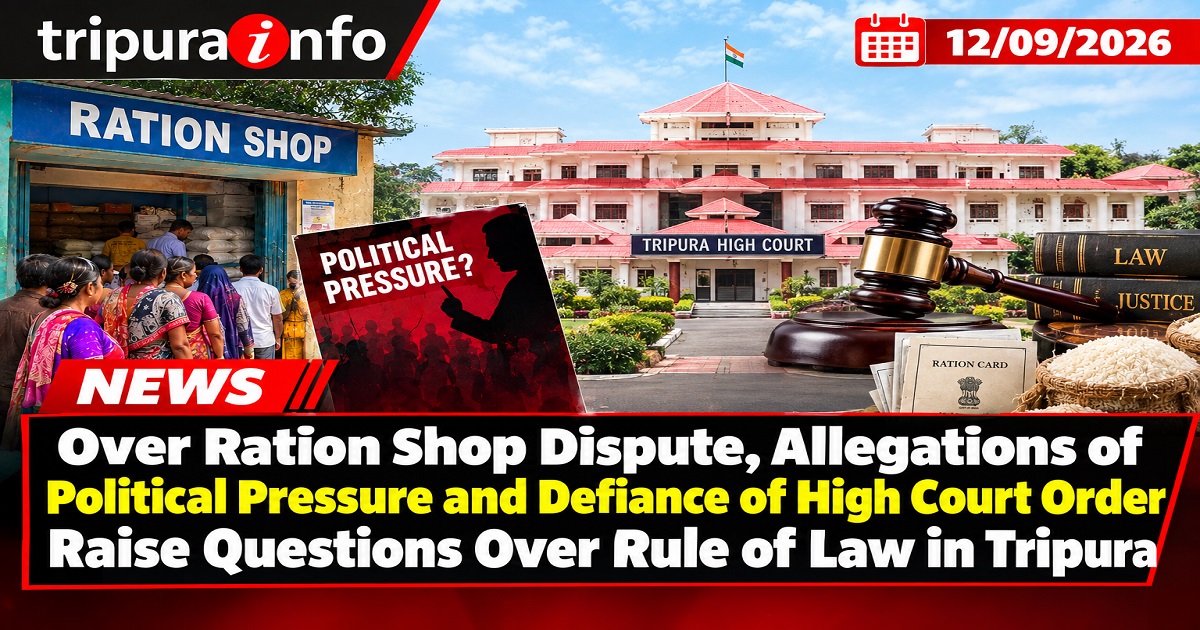 The functioning of Tripura’s Food Department has come under serious scrutiny following a ration shop dispute in which an economically vulnerable family was forced to approach the High Court to secure the benefit of an existing government policy. The case has raised wider questions about administrative accountability, adherence to government decisions and the implementation of judicial orders.
The controversy concerns Ishanpur No. 2 Fair Price Shop under Mohanpur, where the family of deceased ration dealer Anita Debnath sought permission for her eligible family member, Jayanti Debnath, to take over and operate the ration shop. The family reportedly relied on existing government guidelines and the Tripura Government’s 2006 decision, under which an eligible family member of a deceased fair price shop dealer can be considered for appointment, subject to the applicable conditions.
Despite the existence of such provisions, the family’s claim was not resolved administratively, prompting them to approach the Tripura High Court. The central issue before the court was why a family seeking the benefit of an established government policy had to undertake litigation instead of receiving a decision from the concerned department in accordance with the rules.
The role of the Food Department authorities subsequently came under judicial scrutiny. Questions were raised regarding the decisions of Food Department Director Sumit Lodh and the Sub-Divisional Magistrate of Mohanpur, particularly in relation to the implementation of the applicable policy and the court’s directions.
The matter assumed greater significance after the High Court directed the authorities to consider the case in accordance with the State Government’s 2006 decision. However, allegations subsequently emerged that the judicial directions were not properly complied with, resulting in the matter reaching the court again through contempt proceedings.
The episode has now triggered a much larger debate over the manner in which administrative decisions are taken in Tripura. Allegations have been made that the concerned officials yielded to political pressure instead of strictly following the applicable policy and judicial directions.
The case raises a fundamental question: when a government policy already provides a mechanism for an eligible family member of a deceased ration dealer to continue the dealership, why should a poor and vulnerable family have to approach the High Court to obtain what it claims is its legitimate entitlement?
The issue is particularly significant because fair price shops are not merely commercial establishments. For the dealer’s family, the dealership can represent an important source of livelihood, while for beneficiaries it forms part of the public distribution system through which essential food commodities are supplied.
The controversy has also highlighted concerns about administrative accountability. Government officials are expected to exercise their authority within the framework of law, government policies and judicial orders. If an administrative decision is subsequently overturned or requires judicial intervention for implementation, it naturally raises questions about whether the original decision was properly examined before being taken.
The subsequent contempt proceedings have added another dimension to the controversy. If the government or its officials were found unable to comply with a clear judicial direction, it could further undermine public confidence in the effectiveness of administrative governance. The outcome of the contempt proceedings therefore assumes significance beyond the individual ration shop dispute.
more news...