Tripura High Court Flags Serious Irregularities in NH-108B and NH-208, Orders Probe Into Possible Corruption and Collusion
By Our Correspondent
Agartala, September 9, 2026
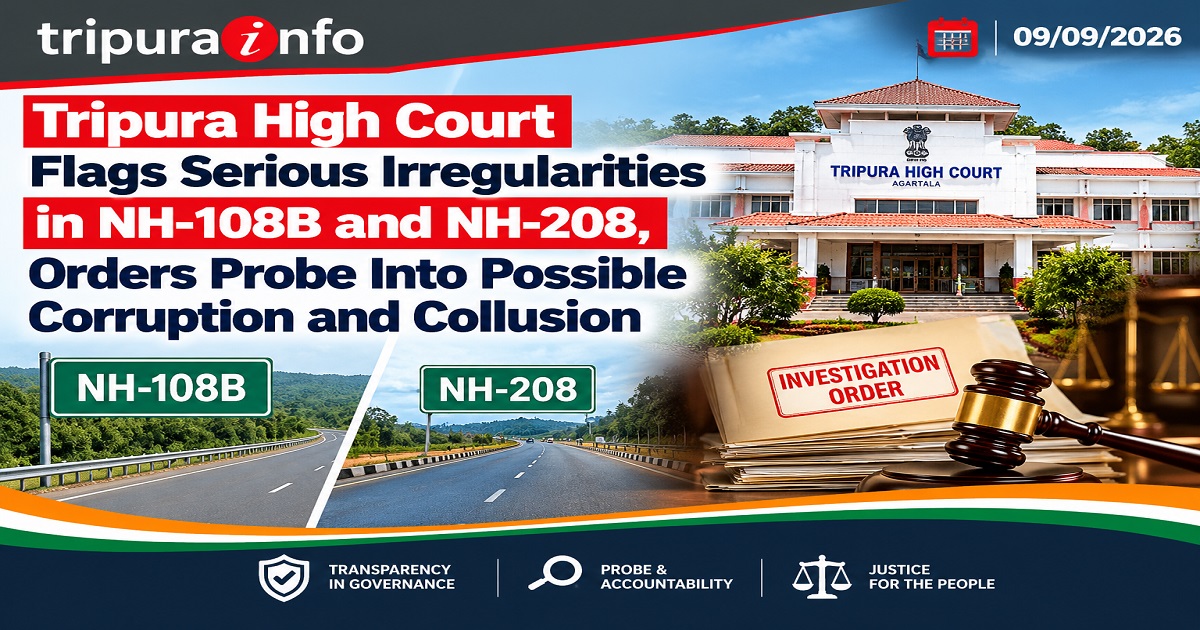 The High Court of Tripura has raised serious concerns over the deteriorating condition of National Highway stretches NH-108B and NH-208, questioning the quality of construction, supervision, contractor selection, maintenance and the functioning of agencies responsible for the projects. In a significant judgment delivered on September 8, 2026, a Division Bench comprising Chief Justice MS Ramachandra Rao and Justice Biswajit Palit directed the Union Government to conduct an inquiry into possible corruption in the selection of contractors by the National Highways & Infrastructure Development Corporation Limited (NHIDCL), possible collusion between NHIDCL officials and EPC contractors, and the alleged use of substandard construction materials.
The judgment was delivered in WP(C)(PIL) No. 06 of 2026, Court on its Own Motion, following newspaper reports highlighting the alarming condition of NH-108B and NH-208, including allegations of substandard construction materials and deterioration and collapse of substantial portions of the highways.
The respondents formally named in the case are the Union of India, represented by the Secretary of the Ministry of Road Transport and Highways (MoRTH), the National Highways Authority of India (NHAI), the Secretary of PWD (National Highways), Government of Tripura, the District Magistrates and Collectors of West Tripura, Dhalai and Khowai districts, the Chief Engineer of PWD (National Highways), Government of Tripura, and NHIDCL.
The Court has clarified, however, that it has not declared any individual NHIDCL officer or EPC contractor guilty or formally named them as accused persons. The observations regarding possible corruption, collusion, inadequate supervision and substandard materials are matters requiring investigation. The Union Government has been directed to determine whether any such impropriety occurred and, if established, initiate appropriate civil and criminal proceedings against those responsible.
One of the strongest concerns expressed by the Bench relates to the Mohanpur–Hezamara–Subalsingh section of NH-108B. The project had been scheduled for completion on August 31, 2025, but material placed before the Court showed that only 51.14 per cent physical progress had been achieved and the contractor had failed to meet a revised milestone.
The Court noted that expenditure on the project exceeded Rs.5 crore per kilometre. Against this backdrop, the Bench questioned whether NHIDCL had exercised adequate care while selecting the EPC contractor or contractors, particularly when a project scheduled for completion in August 2025 remained only about halfway complete nearly a year later.
The Court also raised the possibility of collusion between NHIDCL officials and EPC contractors, particularly in view of what it regarded as considerable leniency towards contractors through repeated extensions.
The Union Government has therefore been directed to investigate whether corruption occurred in the selection of contractors by NHIDCL, whether NHIDCL officials colluded with EPC contractors, whether such alleged collusion resulted in the use of substandard materials, and whether this contributed to the repeated deterioration of the highways.
The inquiry report has been ordered to be submitted to the High Court by December 1, 2026. If corruption or other impropriety is established, appropriate civil and criminal proceedings are to be initiated against the NHIDCL officials and EPC contractors found responsible.
The Bench also expressed serious concern over the Subalsingh–Khowai section of NH-108B, which was completed on May 30, 2024, with a completion certificate subsequently issued in November 2024.
Despite the completion certificate, during the following monsoon the road developed alligator cracking, rutting and complete pavement distress at various locations.
The Court observed that the condition of the road indicated that the work undertaken during execution was probably of poor quality and raised the possibility of inadequate supervision by NHIDCL.
The repeated deterioration during successive monsoons further prompted the Bench to question whether everything was above board in relation to the selection of EPC contractors. The Court questioned whether the contractors possessed the necessary expertise and experience to construct National Highways, particularly when payments exceeding Rs.5 crore per kilometre had been made for the projects.
Similar concerns were raised regarding NH-208, particularly the Khowai/Mahadevtila–Srirampur section. The work was completed on April 17, 2023, but following exceptionally heavy rainfall in August 2024, serious defects appeared, including alligator cracking, rutting and complete pavement distress.
Although correspondence took place between NHIDCL and the EPC contractor, the Court found no satisfactory explanation regarding what had actually been done to improve the road between September 2024 and September 2025.
The Bench described the absence of an adequate explanation as inexplicable and noted that serious road problems had recurred during every monsoon since 2023, including the 2026 monsoon.
The High Court also questioned the nearly one-year delay in obtaining the report of the CSIR-Central Road Research Institute (CRRI). CRRI inspected the affected highway stretches between July 23 and July 27, 2025, but according to NHIDCL's own submission, its report was submitted only on June 23, 2026.
The Bench described the delay as incomprehensible and noted that the Union Government had not provided an explanation for it.
NHIDCL reportedly stated that it had been waiting for the CRRI report for guidance on repairs. The Court questioned why NHIDCL had waited for almost a year when the organisation had its own engineering personnel who could have used their expertise to accelerate repairs before the next monsoon arrived in April 2026.
The High Court also criticised the response of the Tripura Government. Although the State Government informed the Court that NH-108B and NH-208 were under the exclusive management of NHIDCL, the Bench said that while it appreciated the State's candour in placing responsibility on the Union Government and NHIDCL, it wished the State Government had done more to protect residents and highway users. The Court pointed out that after deterioration became apparent during the 2025 monsoon, the State Government could have sought the re-transfer of administrative control of the highways to its PWD department.
According to the Bench, the period between October 1, 2025 and April 30, 2026 provided sufficient time to undertake repairs before the arrival of the next monsoon, but that opportunity was not utilised.
The Court further observed that the State Government could have explored legal action, including criminal proceedings for cheating and negligence in maintenance, against NHIDCL or its contractors, particularly considering the substantial expenditure of more than Rs.5 crore per kilometre.
A major portion of the judgment deals with the findings of the District Legal Services Authority (DLSA), Khowai, which conducted a detailed inspection of several highway stretches. The inspection covered approximately:
30.32 kilometres of NH-208 from Mahadebtila to Manikbhandar;
14 kilometres of NH-108B from Mahadevtila to Mohanbari, Khowai, under Package-3; and
12 kilometres of NH-108B from Mohanbari, Khowai to Mohanpur through Subalsingh and Hezamara under Package-2.
The High Court relied heavily on the DLSA inspection report, observing that it revealed the terrible condition of several stretches and contradicted NHIDCL's claim that adequate measures had been taken to keep the highways safe and motorable.
The chainage-wise inspection recorded a wide range of road and safety deficiencies, with the overwhelming majority of inspected locations classified as high risk.
The deficiencies included deep potholes, widespread pavement cracks, complete pavement damage, rutting and shovelling, road depressions and settlements, broken road edges, blocked shoulders, inadequate drainage, blocked RCC and earthen drains, extensive waterlogging, inadequate or damaged camber, damaged medians and junction islands, missing or obscured kilometre and hectometre stones, missing or faded road markings, damaged culverts, absence of culvert protection, lack of crash barriers, requirements for retaining walls and embankment protection, damaged bridge inspection paths, landslides and unstable hill-cut slopes, inadequate protection on valley and hill sections, muddy roads and deep tyre ruts, incomplete drainage and hill-slope protection works, damaged newly constructed drains, poor maintenance and repair work, road blockages caused by ongoing construction, inadequate temporary arrangements, absence of safety measures at construction sites, bridges under construction showing extremely low progress, and damage to DBM, WMM and CTSB layers.
The DLSA report documented several particularly serious instances of road damage. At one location on NH-208, a damaged stretch extended for approximately 190 metres, while another location had road damage covering approximately 540 metres, accompanied by blocked drains and a requirement for embankment protection.
At several locations, potholes were found to be between one and two feet deep, while other damaged sections extended for hundreds of metres.
The inspection also documented serious landslide risks. At one location, a hill-cut slope measuring approximately 20 to 25 metres had resulted in a landslide and road damage, prompting recommendations for protective measures.
NH-108B Package-3 was similarly found to suffer from extensive maintenance and safety problems. The inspection identified poor maintenance, pavement cracking, potholes, waterlogging, blocked drains, damaged shoulders, missing road markings, inadequate safety measures and widespread pavement distress.
Crash barriers and retaining or protective walls were repeatedly recommended at vulnerable locations.
At several bridges and culverts, barriers were considered necessary because of significant drops from road level. The inspection also found blocked bridge inspection paths and encroachment by mud, vegetation, firewood and other materials.
The findings concerning NH-108B Package-2, particularly the Mohanbari–Mohanpur stretch, were especially severe.
At Km 31+300, the inspection found a broken road edge, absence of a shoulder, damage to a newly constructed drain, a muddy road, deep tyre ruts and a complete absence of safety measures.
Other chainages recorded full road damage, inadequate drainage, incomplete hill-slope protection, muddy surfaces, deep ruts and inadequate safety arrangements.
Further along the same stretch, the inspection identified bridges under construction with less than 10 per cent progress, blocked culverts, damaged DBM and WMM layers, incomplete earthen drains, deep muddy ruts, road blockages and a lack of temporary safety arrangements.
At Km 25+900 to 26+00, traffic was reportedly being diverted onto an old road because of construction of a new bridge. The old road had no proper drainage, numerous potholes and pavement damage, while temporary arrangements and safety measures were absent. Its edges and shoulders were also obscured by silt, debris and vegetation.
The judgment also records several contractual failures concerning an EPC contractor engaged for the Mohanpur–Hezamara–Subalsingh stretch.
According to the material before the Court, the contractor failed to mobilise adequate manpower, machinery and construction materials, failed to meet contractual milestones and achieved only 51.14 per cent physical progress.
NHIDCL issued notices and subsequently issued a suspension notice on July 23, 2026.
The Court examined the sequence of delays, extensions and incomplete works while assessing whether NHIDCL had exercised adequate oversight over the project.
In another stretch, NHIDCL had issued a Risk and Cost Work order valued at Rs.2.19 crore, but the proposed maintenance work could not commence because of contractual complications involving the third-party agency.
The High Court emphasised that NHIDCL, having been entrusted by the Union Government with the development and maintenance of National Highways in Tripura, owes a continuing duty of care to highway users.
According to the Bench, that responsibility does not disappear merely because construction and maintenance activities have been outsourced to EPC contractors.
The Court concluded that NHIDCL had failed to discharge the expected duty of care and stressed that substantial taxpayers' money had been spent on the projects while the poor condition of the highways was placing the lives and safety of travellers at risk.
The Bench also called for a systemic audit of the functioning of NHAI and NHIDCL, observing that there have been frequent reports of National Highways constructed at huge public expense disintegrating even before inauguration, shortly after completion or following the first monsoon.
The observation indicates that the Court's concern extends beyond the specific stretches involved in the PIL and raises broader questions about the institutional systems governing highway construction, contractor selection, quality control, supervision and maintenance.
As part of its directions, the High Court ordered NHIDCL to submit bi-weekly progress reports concerning repair and maintenance of the four identified highway stretches.
The Tripura Government has been directed to explore civil and criminal proceedings against NHIDCL and its EPC contractors in relation to the alleged failure to provide safe and motorable highways and the resulting risks to residents and road users.
After completion of repair work, the Border Roads Organisation (BRO) has been directed to conduct an independent engineering audit of the affected roads and submit its report to the High Court in a sealed cover by January 30, 2027.
NHIDCL and its contractors have been directed to extend full cooperation to the BRO audit.
The Union Government has separately been directed to investigate possible corruption in the selection of contractors and possible collusion between NHIDCL officials and EPC contractors, particularly in relation to the alleged use of substandard materials.
The inquiry report must be submitted to the High Court by December 1, 2026. If corruption or other impropriety is established, appropriate civil and criminal proceedings are to be initiated against the officials, contractors or other persons found responsible.
The matter has been listed for further hearing on September 22, 2026.
more news...