Rs. 250-Crore Tribal Development Package Almost Implemented, Demand to Recognise 1,200 More So-called Returnees Triggers Blockades
By Our Correspondent
Agartala, September 5, 2026
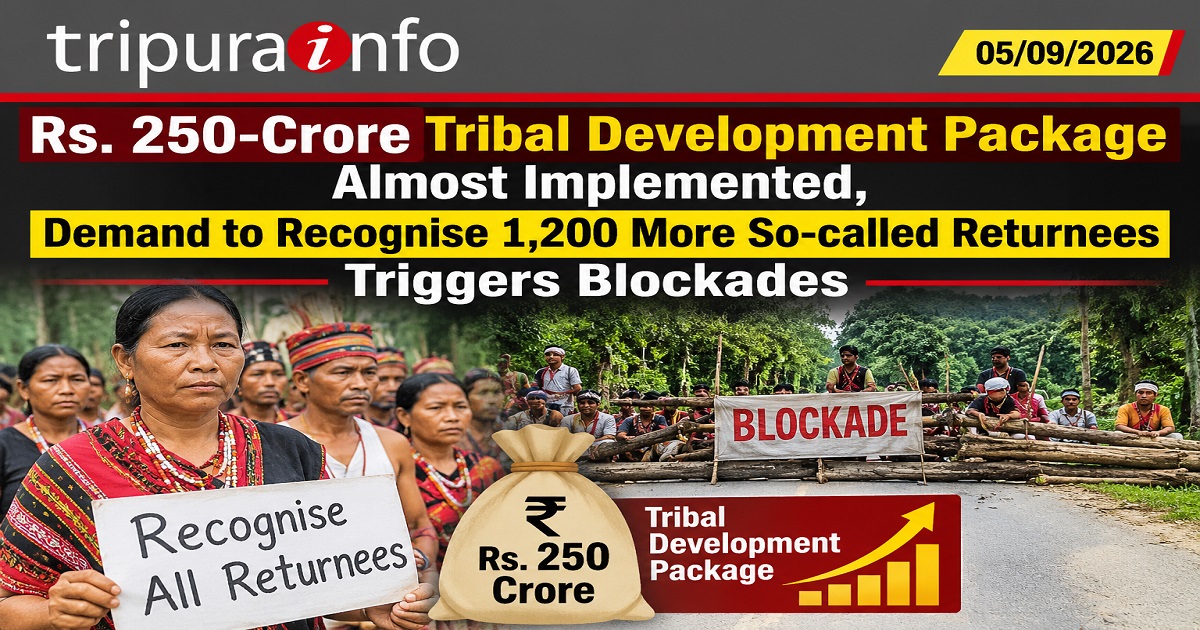 Tripura’s ongoing road and railway blockades over rehabilitation-related demands by surrendered militant groups have brought renewed focus on the implementation of the September 4, 2024 agreement between the Government of India, the Government of Tripura, and the tribal armed groups NLFT and ATTF.
According to sources in the Tribal Welfare Department, and the state government Rs.250-crore special economic development package has already been implemented through various tribal development initiatives for the benefit of the wider tribal population. The department maintains that the package was intended for overall tribal development and was not designed as direct cash assistance to surrendered militants.
The immediate dispute centres on a demand to recognise around 1,200 additional people as “returnees” and extend individual rehabilitation benefits to them.
As per the state government’s position is that such benefits cannot be granted automatically and that the names and credentials of claimants must undergo the verification and screening process prescribed under the 2024 agreement.
Under the agreement, NLFT and ATTF were required to submit their cadre lists to the State Police. The names were then to be scrutinised by a Screening Committee headed by the Head of the Special/Intelligence Branch. The agreement provides that unverified cadres, as well as recycled militants or armed cadres, would not be eligible for rehabilitation benefits.
According to Police Department sources, 92 persons have so far been identified as eligible for the individual rehabilitation package. The department has maintained that any additional claimants would likewise have to establish their eligibility through the prescribed verification process.
The individual rehabilitation package is separate from the Rs. 250-crore tribal development component. For each verified eligible cadre, the agreement provides for a Rs.4 lakh fixed deposit for three years, along with a Rs.6,000 monthly stipend for 36 months, subject to the specified conditions. Other provisions include vocational training, employment assistance, self-employment support, housing assistance under PMAY and possible land-related assistance, subject to eligibility and government rules. Aadhaar biometric registration is also mandatory for receiving the stipulated benefits.
The distinction between the two components has become central to the current agitation. While individual rehabilitation benefits are linked to verified former cadres, the Rs.250-crore package is intended for overall development of tribal communities, with implementation undertaken by the State Government over four years.
The blockades of railway tracks and national highways have meanwhile affected public movement and triggered concern over the wider impact of the agitation. Some observers have also raised questions about the timing of the protest, particularly with the TTAADC Village Council elections approaching.
There are allegations from sections of the political establishment that the agitation could be being used to exert additional pressure on the government at a politically sensitive time. However, such allegations remain contested, while the protesting groups maintain that their demands concern the implementation of rehabilitation commitments and the inclusion of additional eligible returnees.
The September 4, 2024 agreement was signed in New Delhi in the presence of Union Home Minister Amit Shah and Tripura Chief Minister Prof. Dr. Manik Saha. Its implementation is to be monitored through a tripartite mechanism involving the Ministry of Home Affairs, the Government of Tripura, NLFT and ATTF.
The present standoff therefore primarily concerns the verification and possible inclusion of around 1,200 additional claimants as eligible returnees, rather than a fresh distribution of the Rs.250-crore tribal development package. The government maintains that the development package and individual rehabilitation benefits are two separate provisions and must be implemented accordingly.
more news...