Tripura Plans High-Tech Sand Mining Overhaul Without Basic Monitoring Infrastructure: GIS, GPS, Drones and Digital Tracking Yet to Be Put in Place
By Our Correspondent
Agartala, September 4, 2026
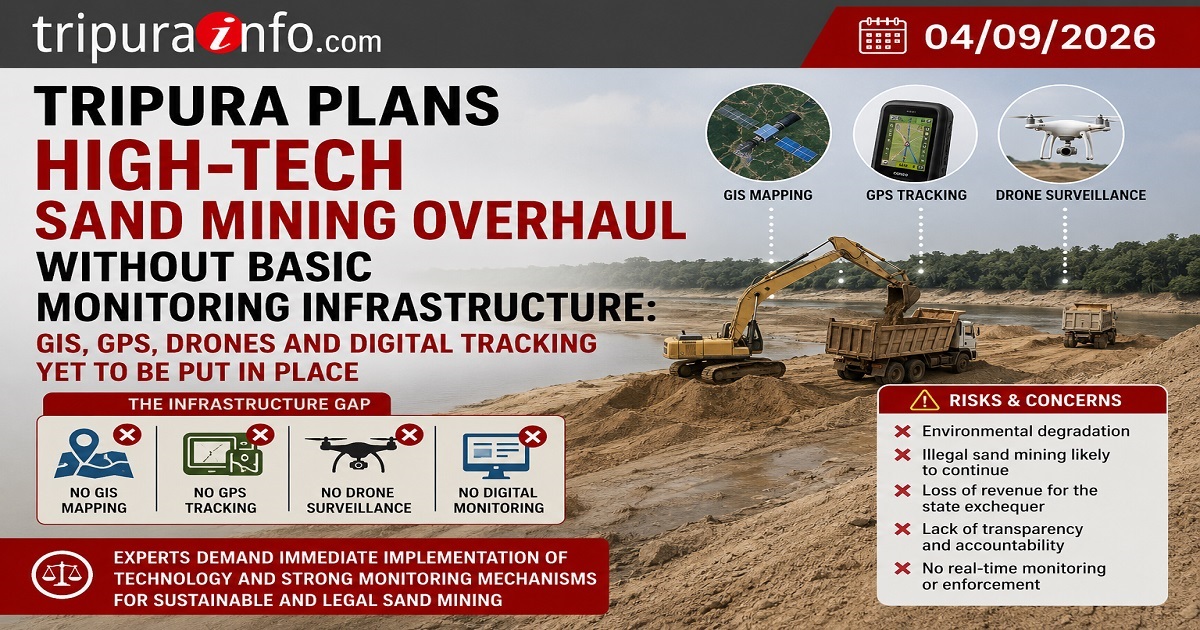 Tripura is considering a major overhaul of its sand-mining regulatory system, with proposals for GIS-based mining blocks, GPS-tracked sand-carrying vehicles, drone surveillance, electronic permits, digital weighbridges and end-to-end digital monitoring. Recently, state government handed over the responsibility of sand mining to state Industries & Commerce Department.
However, experts have questioned whether the State Industries and Commerce Department currently has the basic infrastructure, technical manpower and enforcement facilities required to implement such a high-tech system effectively.
Experts say that while the proposed mechanism appears advanced on paper, most of the essential monitoring facilities, including comprehensive GIS-based block mapping, GPS-linked transportation monitoring, regular drone surveys, electronic weighbridges, CCTV-enabled stockyards and automated extraction-to-dispatch reconciliation, would first have to be established and made operational across the State. According to them, simply introducing new rules or transferring administrative responsibility from the Forest Department to the Industries & Commerce Department cannot by itself guarantee effective regulation of illegal sand mining.
The concern becomes particularly significant in view of the findings of the Comptroller and Auditor General of India (CAG). The CAG's audit of Tripura found serious shortcomings in sand-mining regulation in Unakoti, including the allotment of 56 mining blocks against 52 blocks identified in the District Survey Report, with 30 of the allotted blocks reportedly falling outside the DSR-identified areas. The audit also recorded unauthorised mining at several sites and extensive use of machinery at verified locations.
Experts say these findings demonstrate that Tripura requires stronger field-level monitoring and enforcement, but they caution that a technology-driven system cannot be implemented merely through administrative orders. GPS devices, GIS databases, drones, electronic weighing systems, reliable digital connectivity, trained technical personnel and regular physical inspections would all be necessary for the proposed mechanism to work effectively.
Under the proposed framework, every authorised sand-mining block could be given a unique GIS identity and its exact geographical boundaries digitally recorded. Sand-carrying vehicles could then be linked to electronic permits and GPS tracking systems, allowing authorities to monitor whether vehicles are collecting sand from authorised locations and transporting it to declared destinations. Drone and DGPS surveys could be used before and after the monsoon to assess changes in riverbeds and determine whether extraction remains within scientifically assessed replenishment capacity.
Experts further explain that electronic weighbridges and CCTV systems at stockyards could create a digital record of sand entering and leaving the formal supply chain. An automated reconciliation mechanism could compare the permitted quantity with the quantity extracted and dispatched, with discrepancies generating alerts for inspection. However, they stress that such a system will remain largely theoretical unless the necessary infrastructure and trained manpower are actually available at the mining and stockyard levels.
At the same time, experts have raised concerns about the possible impact of stricter sand-mining regulations on Tripura's construction sector. They say that if existing mining operations are suddenly restricted or suspended before adequate legal sources and alternative construction materials are developed, the State could face a serious shortage of construction sand.
Such a shortage, experts warn, could adversely affect house construction, private building projects, government infrastructure works, roads and other construction activities. If the supply of legally sourced sand falls sharply without adequate alternatives, construction costs could increase and ongoing projects could face delays.
Experts therefore argue that the government should adopt a phased approach rather than imposing an abrupt restriction on sand extraction. Existing mining blocks should first be scientifically assessed and mapped, while replenishment studies and environmental assessments should determine the quantity that can safely be extracted. At the same time, the government should gradually establish GPS monitoring, e-permits, electronic weighing facilities and drone surveillance, initially focusing on high-risk and high-volume mining areas.
Experts also emphasise the need to increase the availability of manufactured sand, commonly known as M-Sand, along with other technically suitable alternatives. According to them, promoting quality-tested alternatives could reduce pressure on river systems while preventing the construction sector from being hit by a sudden shortage of natural sand.
Experts have warned that sand-mining permissions in Tripura must be based on the carrying capacity and natural replenishment potential of individual river stretches rather than simply on the availability of sand deposits. The Supreme Court has observed that unrestricted sand extraction can alter river-bed elevation, stability, depth, velocity, turbidity and sediment transport, adversely affecting aquatic and riparian habitats. These concerns are particularly relevant to Tripura, where CAG findings have already highlighted falling water levels in the Muhuri River and weakening of embankments linked to extraction outside identified stretches. Experts have therefore suggested retaining the Industries & Commerce Department as the nodal authority for mineral administration while establishing a multidisciplinary State Sand Mining Cell and district-level task forces involving Forest, Water Resources, Revenue, Pollution Control, Transport, Police and technical agencies, supported by GIS, drones, GPS tracking and other digital monitoring systems to scientifically regulate mining and curb illegal extraction.
Notably, Tripura Opposition Leader Jitendra Chaudhury on Thursday strongly opposed the state government’s decision to transfer the responsibility of issuing permissions for extracting sand from rivers and streams from the Forest Department to the Industries Department, questioning both the rationale behind the move and its potential impact on the state’s environment.
more news...