Judo Federation of India Names Tripura BJP MLA Antra Sarkar Deb to Head Internal Complaints Committee, Raising Questions Over Conflict of Interest
By Our Correspondent
Agartala, September 4, 2026
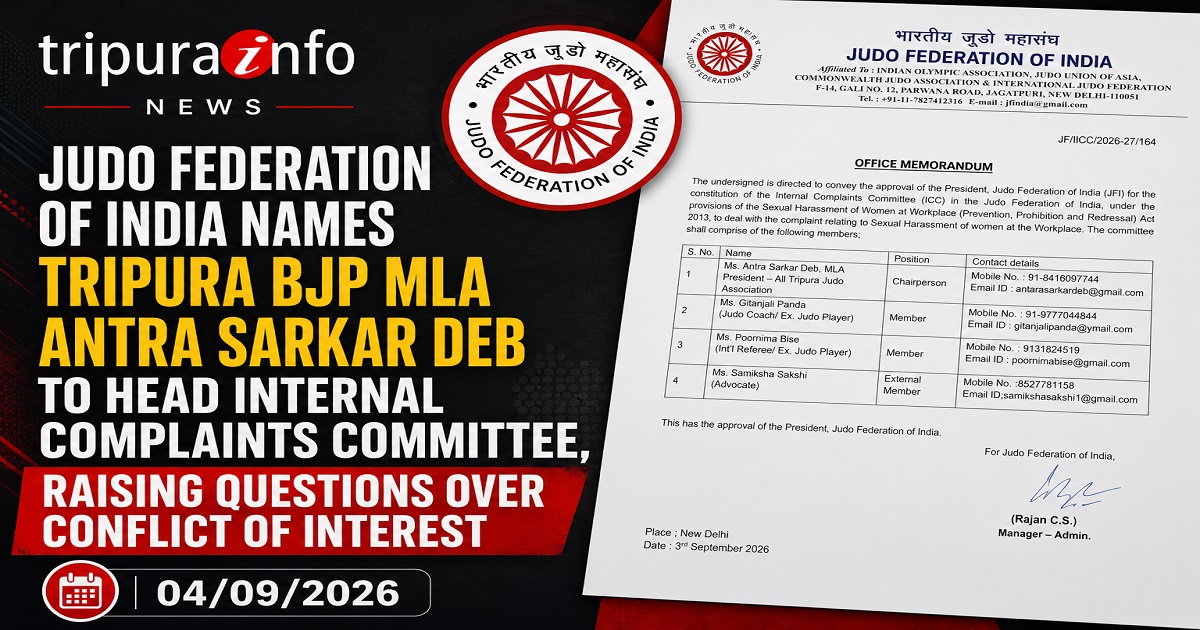 The Judo Federation of India (JFI) has appointed Tripura BJP MLA and President of the All Tripura Judo Association, Antra Sarkar Deb, as the Chairperson of its Internal Complaints Committee (ICC) constituted to deal with complaints of sexual harassment at the workplace.
According to an Office Memorandum issued by the Judo Federation of India on September 3, 2026, the committee has been constituted under the provisions of the Sexual Harassment of Women at Workplace (Prevention, Prohibition and Redressal) Act, 2013. The memorandum states that the appointment has been approved by the President of the Judo Federation of India.
The four-member committee comprises Antra Sarkar Deb as Chairperson, Judo coach and former judoka Gitanjali Panda as a member, international referee and former judoka Poornima Bise as another member, and advocate Samiksha Sakshi as the external member.
The appointment has, however, raised questions over the appropriateness of appointing a serving political representative to a committee dealing with complaints of sexual harassment, particularly because the committee is expected to function with independence and credibility.
Under Section 4 of the POSH Act, an Internal Committee is to include a woman Presiding Officer at a senior level, at least two employee members, and one member from an NGO or association committed to the cause of women or a person familiar with issues relating to sexual harassment. At least half of the total members must be women.
The development is nevertheless likely to trigger a debate over independence, perceived conflict of interest and institutional neutrality. The issue becomes particularly significant because Sarkar Deb is not only a sitting MLA but also heads the state-level judo association.
Questions may therefore arise as to what criteria were applied while selecting her for the position and whether the federation considered her political office while assessing the independence and suitability of the committee's Presiding Officer. The memorandum does not disclose the qualifications or selection process on the basis of which she was chosen.
The matter also comes against a wider backdrop of concerns over the presence of political figures in sports administration. The Supreme Court has, in many cases concerning governance of sports bodies, dealt extensively with compliance with sports-governance norms. In a recent judgment, the Court reiterated provisions requiring key positions in sports associations and organisations to be held by sports persons and referred to a requirement that at least 75% of members of a sports body be eminent sports persons with voting rights.
The Supreme Court has also previously examined the relationship between sports federations and the National Sports Development Code, including questions concerning the composition and election of office-bearers of recognised sports federations.
Against this backdrop, the appointment of a serving legislator to a key position in the national judo federation could invite scrutiny not only from the perspective of the POSH framework but also from the broader principles of good governance and independence in sports administration.
more news...