Tripura Moves Towards Evidence Based Forest Strategy as Experts Flag Ecological Risks of Rubber Monoculture
By Our Correspondent
Agartala, September 3, 2026
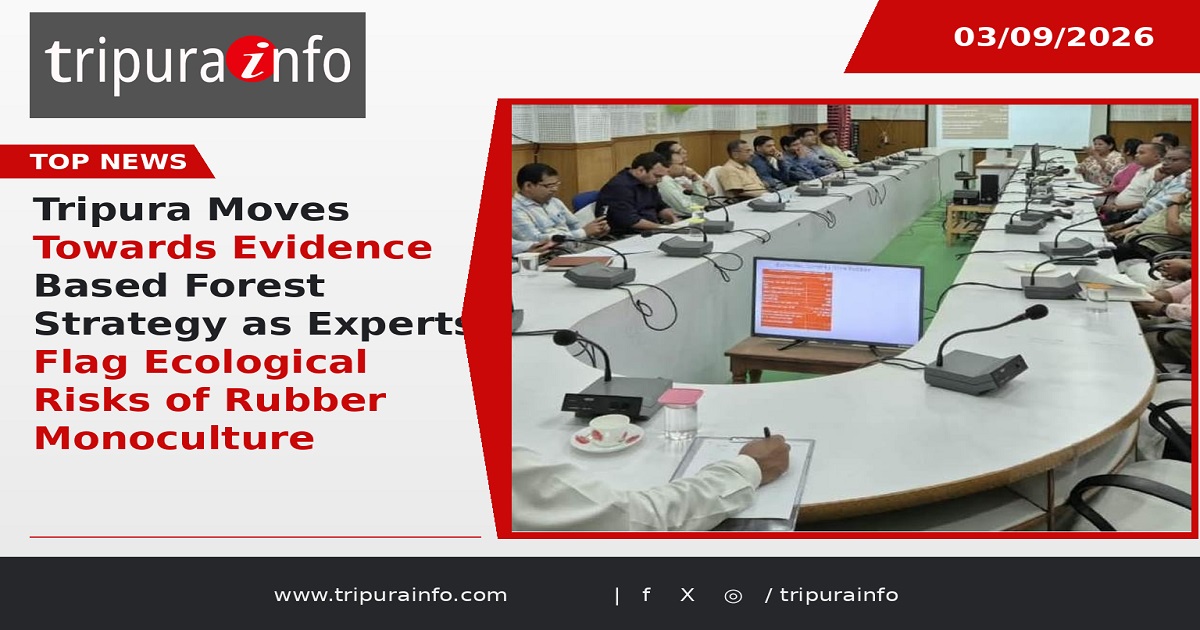 A senior-level meeting to shape Tripura’s proposed Forest Sector Strategy was held at the Forest Headquarters on September 1 under the aegis of the IGDC-CREFLAT Project, with senior Forest Department officials, project representatives and experts examining the ecological, economic and social implications of rubber and other major plantation and horticultural species.
The meeting, chaired by RK Samal, IFS, PCCF Tripura, focused on finding a sustainable balance between forest conservation, biodiversity protection, livelihood requirements and the economic interests of farmers. Particular attention was given to rubber, mango, bamboo, arecanut and other plantation species, with experts stressing that the long-term value of forests must be assessed not only through direct financial returns but also through ecosystem services and environmental costs.
The meeting began with a welcome address by S Prabhu, IFS, CEO & Project Director, IGDC-CREFLAT Project, who underlined the importance of preparing a comprehensive Forest Sector Strategy capable of protecting Tripura’s remaining natural forests while maintaining essential ecosystem services. He urged officials, project management representatives and experts to contribute their field experience and recommendations so that these could be incorporated into the final strategy.
Dr. Sanjeeva Pandey, former PCCF of Himachal Pradesh and an expert with the Rubber Study Team, presented findings from field visits and stakeholder consultations conducted across Dhalai, South Tripura, Gomati, Sepahijala and West Tripura. The study found that rubber is widely regarded by growers as a high-return commercial crop. However, the experts cautioned that extensive rubber monoculture could have consequences for biodiversity, soil fertility and water availability in streams and springs.
The Rubber Study Team recommended that Tripura give priority to protecting its remaining natural forests and avoid further expansion of commercial rubber monoculture. Instead, the team suggested diversified agroforestry models combining rubber with agar, fruit trees and other crops.
The experts also called for stronger agricultural and forestry extension services and better transfer of technologies from research institutions to farmers. Another major recommendation was the formulation of a policy to restrict further expansion of rubber plantations on FRA patta land beyond 1,70,000 hectares, alongside greater convergence between FRA livelihood rights, biodiversity conservation, forest and wildlife protection and land-use planning.
The study also emphasized the promotion of non-land-based and skill-based livelihood opportunities as a means of reducing excessive dependence on rubber cultivation.
The economic dimension of plantation development was examined by Prof. Saudamini Das of the University of Delhi, an expert with the Rubber Study Team. She presented an assessment of the costs and benefits of rubber and other plantation crops, including mango, arecanut and bamboo.
Prof. Das highlighted the difference between the private costs and returns experienced by individual farmers and the wider social and environmental costs that may be borne by society. According to the assessment, a plantation can appear financially attractive when only the farmer’s investment, expenditure and income are considered. However, the overall economic picture can change when wider impacts on soil, water resources, biodiversity, ecosystem services and other environmental externalities are included.
The presentation compared the cost-benefit performance of rubber with mango plantations and arecanut with bamboo, providing an economic basis for assessing plantation choices from both individual and societal perspectives.
Another presentation was made by Dr. Koushik Majumder, Biodiversity Expert with the IGDC-CREFLAT Project, who discussed the potential of Malabar Neem (Melia dubia) as an alternative plantation model. He highlighted its possible ecological, economic and livelihood benefits for farmers and landholders and explained its potential as an alternative to rubber monoculture, including for plantation development on RoFR land, subject to proper assessment and planning.
The proposal generated interest among senior Forest Department officials. PCCF RK Samal and other officials expressed interest in introducing Malabar Neem on a demonstration basis on selected FRA patta and private lands so that its performance and suitability could be assessed under local conditions.
Samal stressed that a comprehensive assessment of the economic and social costs of rubber and other monoculture plantations was necessary, alongside an evaluation of their ecological and environmental implications. He said the findings of the Rubber Study could provide an important evidence base for the proposed Forest Sector Strategy.
He also informed the meeting that relevant issues would be taken up with the concerned Ministers and the Government. The Rubber Study Team was requested to prepare a detailed report covering the economic, social and ecological implications of rubber and other monoculture plantations to assist the Government in making informed policy decisions and planning the long-term management of Tripura’s forests.
The discussions ultimately centred on the need for a balanced approach to plantation development in the state. While recognizing the economic importance of commercial crops and their contribution to rural livelihoods, participants emphasized that plantation policies must also account for biodiversity, soil health, water resources, climate resilience and the ecosystem services provided by natural forests.
more news...