Manushree’s Medical Fundraising Sparks Heated Debate in Tripura Over Transparency and Accountability
By Our Correspondent
Agartala, August 31, 2026
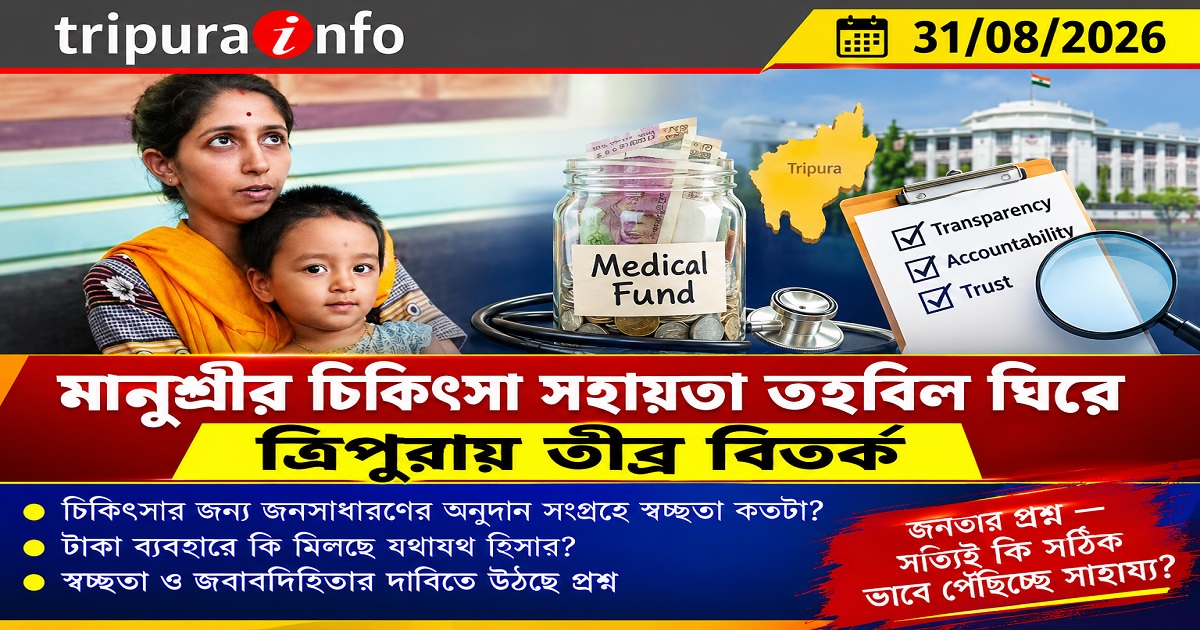 The fundraising campaign launched across Tripura for the treatment of little two years old Manushree, who is reportedly suffering from a serious and rare medical condition, has become the centre of an escalating controversy, with questions being raised over the transparency of the crowdfunding process, the total amount collected, cash donations, online transfers, medical expenses and the utilisation of the funds.
While the primary concern of the public remains Manushree’s urgent treatment and recovery, a growing section of donors and social media users are now demanding greater clarity about how much money has been collected in her name, how much has already been spent, and how much remains available for her treatment.
The controversy intensified following a video message from Raja Saha, who has been expelled from the BJP and was associated with the crowdfunding campaign. In the video, Manushree’s father, Drub Chowdhury, and Raja Saha questioned why people were seeking an account of the money collected for the child’s treatment. They reportedly raised the argument of whether people ask for an account when money is donated to a temple.
The comparison has subsequently triggered another debate on social media. Several people have questioned whether personal donations made at a temple can be equated with a large-scale public fundraising campaign conducted in the name of an ailing child. According to them, when thousands of ordinary people contribute money according to their financial capacity, asking how the money is being collected and spent should not automatically be interpreted as distrust or opposition to the child’s treatment.
Some donors have claimed that they contributed money from their GPF savings, while others reportedly helped after selling personal belongings such as vehicles. There are also claims that people contributed small amounts of Rs.10, Rs.20, Rs.50 or Rs.100 through collection boxes placed at different locations. Some individuals have claimed that they contributed around Rs.1,000 in small instalments at different places.
These donors argue that their questions are not directed against Manushree or her family. Rather, they want to know how the money contributed by ordinary people is being utilised. Questions have also been raised over why regular updates regarding Manushree’s treatment, the progress of her medical condition and the utilisation of the collected funds have not been made publicly available by the family or those coordinating the fundraising campaign.
The issue has reportedly even reached the office of the West Tripura District Magistrate, Dr Vishal Kumar, with several people approaching the administration seeking clarity. However, there has so far been no publicly known comprehensive administrative intervention or officially verified financial statement addressing all the questions surrounding the fundraising campaign.
Another serious allegation circulating on social media is that money collected in Manushree’s name may have been diverted or withdrawn for purposes unrelated to her treatment.
The most contentious issue is the accounting of cash donations. While some information relating to online fundraising has reportedly surfaced, questions remain regarding cash collected from roadsides, markets, clubs, auto stands and other public locations. People seeking transparency say that if hundreds or thousands of individuals have contributed small amounts through physical collection drives, the total amount collected through such channels should also be documented.
At the same time, social media claims about the total collection cannot by themselves be treated as audited or officially verified figures. A reliable assessment would require a complete statement showing the amount received through bank transfers, digital payment platforms, QR codes, collection boxes and cash donations, along with corresponding expenditure records.
Another major source of confusion concerns the projected cost of Manushree’s treatment. Different figures regarding the price of the injection reportedly required for her treatment have circulated on social media. Claims have mentioned amounts ranging from around Rs.10 crore to Rs.18 crore and even approximately Rs.26 crore. There have also been differing statements regarding discounts, down payments and instalment-based payments.
The conflicting figures have prompted several questions among members of the public: What is the actual price of the required medicine or injection? How much has the hospital or treating doctors officially estimated as the total treatment cost? Has any special discount been offered, and if so, under what conditions? How much money has already been deposited with the AIIMS hospital or treatment provider? And how much of the money raised through crowdfunding remains unused?
These questions could potentially be addressed through the publication of relevant medical and financial documents by the family and the concerned medical institution, subject to appropriate protection of Manushree’s personal medical information. A verified treatment estimate, prescription, hospital billing information and a transparent statement of funds received and spent could substantially reduce confusion and speculation.
There are also claims that the amount initially cited as necessary for Manushree’s treatment differs from figures subsequently mentioned in public discussions. However, without an official explanation from the treating hospital, doctors or the family, it would be inappropriate to conclude that any particular figure is false or that the difference necessarily indicates financial irregularity. Treatment plans, drug pricing, discounts, procurement arrangements and payment schedules can change, and these factors need to be established through documentary evidence.
The controversy has also raised a broader question about the mechanism through which crowdfunding for treatment of rare diseases should be conducted. Questions have been raised about whether such large-scale fundraising for a child suffering from a condition such as SMA Type 2 should primarily be coordinated through government hospitals and established institutional mechanisms, rather than through multiple informal collection channels involving individuals and political figures.
According to the concerns being expressed, medical documents and prescriptions were circulated through social media and donations were sought through multiple bank accounts and QR-code-based payment systems.
more news...