NABARD Push for Value Addition, Market Linkages and Tribal Livelihoods Opens New Growth Path for Rural Tripura
By Our Correspondent
Agartala, August 31, 2026
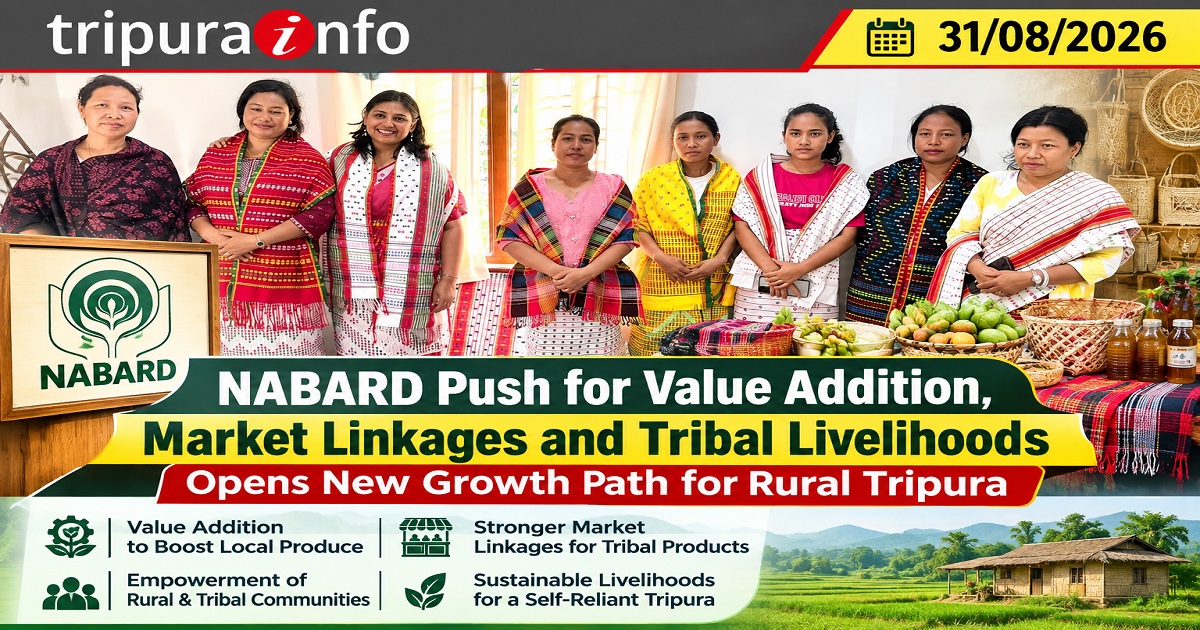 A new roadmap for strengthening Tripura’s rural economy is emerging through a greater focus on value addition, market connectivity, tribal livelihoods, handloom development, financial literacy and rural entrepreneurship. As part of this broader development effort, NABARD General Manager Smt. Tanusri Bhattacharjee undertook an important field visit to Bagma to review the ongoing activities of Bagma Agri Producer Company Limited (BAPCL) and interact directly with farmers, tribal families, weavers and rural entrepreneurs.
During the visit, the NABARD General Manager reviewed several initiatives being implemented through BAPCL, including fisheries, integrated farming, onion cultivation, Custom Hiring Centres (CHCs), poultry farming, mustard oil production, milk collection, rural marketing outlets and innovation and entrepreneurship support activities. Discussions focused on production systems, farmers’ participation, income-generation opportunities and the scope for strengthening marketing channels.
A key message emerging from the visit was that increasing agricultural production alone is not sufficient to substantially improve rural incomes. Greater emphasis needs to be placed on processing, value addition, packaging, branding and market linkages so that farmers can capture a larger share of the value generated from their products. BAPCL, as a farmer-oriented institution, was encouraged to further strengthen its role in organising producers and developing their business and market capabilities.
The visit also covered Bagma and Jalema ADC villages under the Tribal Development Fund (TDF) in Killa Block. By visiting beneficiary households, Smt. Bhattacharjee reviewed activities such as piggery, horticulture and agriculture-based livelihoods and interacted directly with tribal farmers. Their production, income opportunities, challenges and market prospects were discussed in detail.
An important proposal emerging from the field interaction was the formation of a new Farmer Producer Organisation (FPO) involving around 200 farmers under TDF. The possibility of establishing a rural market or gramin haat was also discussed to create opportunities for farmers to sell their produce closer to home. Organising producers and connecting them directly with markets could help reduce dependence on intermediaries while improving farmers’ bargaining power and income prospects.
The development of tribal women’s handloom enterprises was another significant area of focus. Discussions with local weavers explored opportunities to diversify production into risa, pachra, traditional garments, jackets and bags. The proposed formation of a handloom cluster involving around 90 artisans could provide a stronger platform for collective production, skill development, branding and marketing.
To expand the market for traditional products, possibilities such as online marketing, a dedicated outlet for tribal handloom products in Agartala and a raw-material bank were discussed. Particular importance was placed on strengthening the branding, packaging and digital marketing of Tripura’s traditional and GI-recognised products, including Risa, Pachra and Matabari Peda. Such initiatives could help transform traditional skills into sustainable commercial enterprises while preserving Tripura’s cultural heritage.
Financial literacy was also highlighted as an essential component of rural economic development. Through the Moneywise initiative supported by RBI and NABARD, farmers and rural households can be encouraged to make greater use of formal banking services, savings, institutional credit, insurance, digital payments, social-security schemes and investment opportunities. Awareness regarding digital fraud and safe financial practices is equally important as digital financial services expand across rural areas. The initiative aims to extend financial awareness more widely across the state’s 58 blocks.
The Bagma experience demonstrates the potential of an integrated rural development model in which agriculture, livestock, fisheries, food processing, handloom and handicrafts, GI products, digital marketing, entrepreneurship and financial inclusion complement one another. Such an approach can create multiple sources of income and employment rather than leaving rural households dependent on a single economic activity.
For Tripura, the significance of these initiatives extends beyond individual projects. Better producer organisations can improve collective bargaining; local processing can increase the value of agricultural products; rural markets can improve market access; handloom clusters can create employment for women; and financial literacy can strengthen households’ ability to save, invest and use formal financial services.
BAPCL has expressed its commitment to using NABARD’s support and guidance to further strengthen farmer incomes, promote self-reliance among women and tribal artisans, expand markets for local products and encourage rural entrepreneurship. The Bagma initiative therefore offers a promising development pathway for rural Tripura—moving from production to value addition, from skills to enterprise, from local products to wider markets, and from financial awareness to financial empowerment. With stronger institutional coordination and sustained market support, these efforts can contribute meaningfully to building a more diversified, resilient and self-reliant rural economy across the state.
more news...