Opposition Accuses Tripura Ministers of Dodging Questions in Assembly, Ranjit Debbarma Raises Scrutiny Concerns
By Our Correspondent
Agartala, August 29, 2026
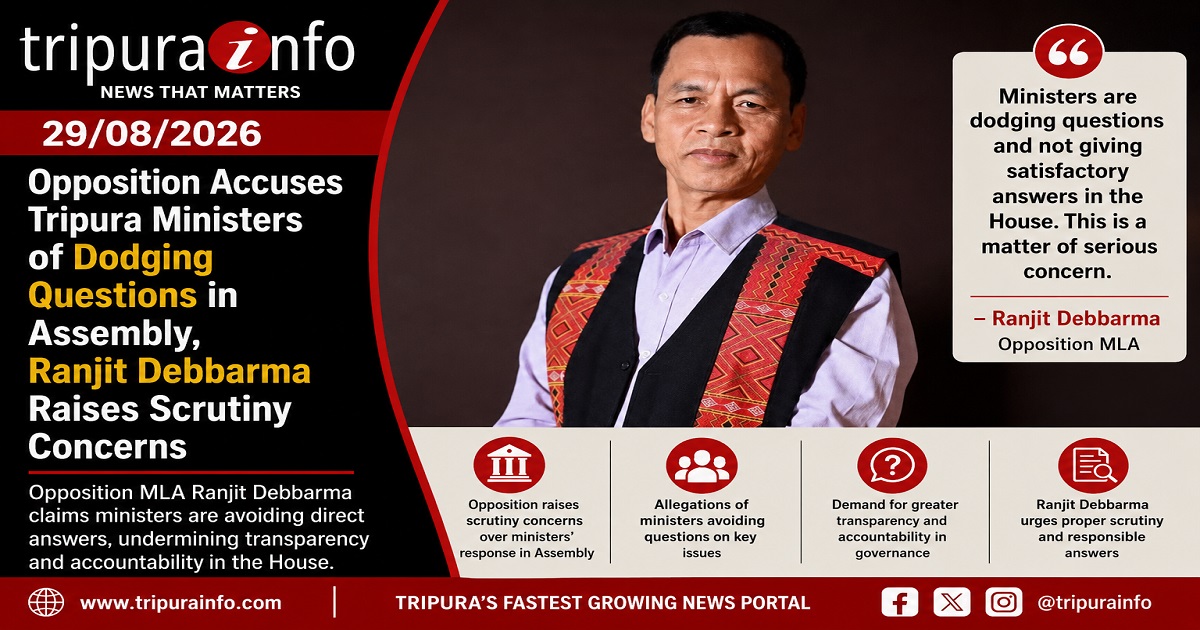 The ongoing session of the Tripura Legislative Assembly has witnessed renewed criticism from opposition legislators over the manner in which ministers are responding to questions raised by MLAs on issues concerning education, recruitment and public administration.
Opposition leaders have alleged that instead of providing direct and specific answers to questions raised on the floor of the House, several ministers are attempting to divert the discussion towards unrelated achievements, schemes or government initiatives. The allegations have been raised by leaders and legislators including Leader of the Opposition Jitendra Chaudhury, Tipra Motha MLA Ranjit Debbarma, Congress MLA Sudip Roy Barman, as well as other opposition members including Dipankar Sen and Gopal Ray.
The issue has become particularly visible during discussions surrounding the implementation of the National Education Policy (NEP) and the introduction of four-year undergraduate programmes in Tripura's general degree colleges.
According to the news report, the state government has implemented NEP in higher education and extended the traditional three-year degree course to four years. Under the new system, students pursuing a four-year programme are expected to undertake research-related or honours-level studies in the later semesters. However, questions have been raised by CPIM MLA Sailendra Chandra Nath over whether colleges currently have adequate numbers of qualified teachers to conduct research-oriented honours courses.
During the Assembly discussion, many other opposition legislators also sought to know what concrete steps the government had taken to ensure that colleges would have sufficient faculty members capable of teaching the fourth-year research-oriented honours curriculum. The issue was directed to Higher Education Minister Kishore Barman.
The report suggests that the response did not directly address all aspects of the question, prompting criticism that the discussion was being shifted towards other government initiatives. The minister reportedly referred to measures taken by the government in higher education and highlighted the establishment of biotechnology clubs in several colleges. Opposition members, however, questioned whether such initiatives could address the immediate shortage of teachers required for fourth-year research and honours programmes.
The concern is significant because, according to the report, the Higher Education Department had informed college authorities that at least two teachers capable of supervising research would be required in colleges offering research-oriented honours programmes. Yet questions remain over whether most colleges have the necessary academic manpower.
The broader issue of teacher recruitment also came under scrutiny. Congress MLA Sudip Roy Barman reportedly pointed to an earlier government assurance regarding the recruitment of 201 assistant professors. He alleged that despite the assurance, recruitment has not been completed and legal complications have emerged. He further referred to another assurance regarding approximately 200 additional appointments, claiming that those recruitments have also not materialised.
Tipra Motha MLA Ranjit Debbarma also raised a separate concern regarding the scrutiny of questions submitted by legislators. Debbarma alleged that the Assembly Secretariat rejects a large number of questions submitted by him during the scrutiny process, preventing those issues from reaching the floor of the House.
Describing the situation as unfortunate, Debbarma questioned the process through which questions submitted by elected representatives are scrutinised and accepted. His allegation has added another dimension to the opposition's broader criticism over the functioning of the Assembly and the ability of legislators to raise issues concerning their constituencies and the wider public.
Opposition legislators argue that elected representatives should be given adequate opportunity to place specific questions before the government and receive clear, fact-based responses from ministers.
The latest controversy has therefore developed into a larger political argument over accountability, transparency and the quality of ministerial answers in the Assembly. Opposition leaders have alleged that when specific questions are raised about vacancies, recruitment, teachers and implementation of government policies, ministers frequently move the discussion towards general descriptions of government achievements rather than giving clear figures, timelines and explanations.
more news...