Tripura Assembly Passes Fourteenth Amendment to Land Revenue and Land Reforms Act, Paving Way for Regulated Use of Tea Garden Land
By Our Correspondent
Agartala, August 28, 2026
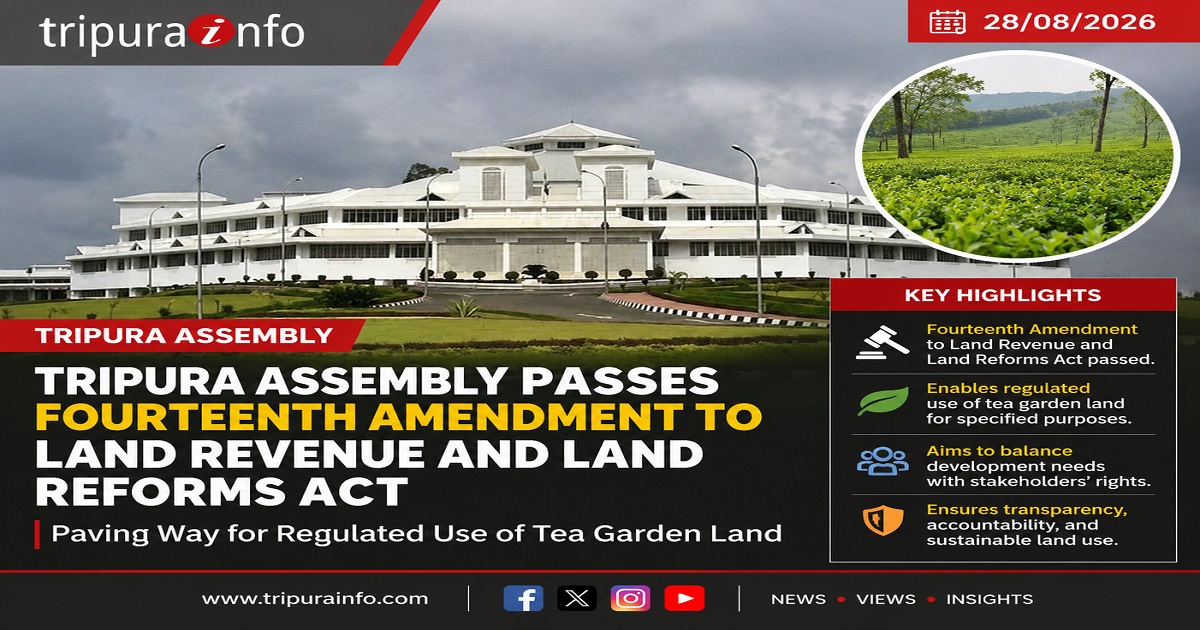 The Tripura Legislative Assembly on Thursday passed the Tripura Land Revenue and Land Reforms (Fourteenth Amendment) Bill, 2026, bringing significant proposed changes to the legal framework governing land records, apartment ownership and the regulated utilisation of tea garden land in the state.
The Bill seeks to amend the Tripura Land Revenue and Land Reforms Act, 1960, with the government describing the proposed changes as measures aimed at improving land-record management, facilitating planned development and enabling productive utilisation of certain tea garden lands while retaining safeguards for the core plantation areas. The 10th session of the 13th Tripura Legislative Assembly commenced on August 27 and is scheduled to continue until August 31.
One of the important provisions concerns land appurtenant to apartment buildings. The amendment proposes inserting a new sub-section under Section 46 of the Act to provide for the recording of land attached to an apartment building jointly and proportionately in the names of all individual flat owners in the Record of Rights (RoR) at the time of mutation.
The proposed provision is intended to bring the land component associated with apartment ownership into the revenue-record system in a clearer and more systematic manner. Instead of leaving the land attached to an apartment building inadequately reflected in individual ownership records, the amendment seeks to ensure that the respective flat owners are jointly recorded in proportion to their ownership.
Another major component of the legislation relates to the regulated utilisation of tea garden land. According to the Statement of Objects and Reasons of the Bill, the amendment to Section 178 is intended to facilitate the use of a limited portion of tea garden land for specified purposes, including Tea Tourism, Integrated Industrial Parks, Integrated Townships and urgent Social Infrastructure Projects.
The government has cited the limited availability of large and contiguous government land parcels suitable for such projects as one of the reasons behind the proposed policy change. The amendment is intended to make strategically located portions of tea garden land available for development while, at the same time, protecting the core tea plantation areas and the overall viability of tea gardens.
The Bill also proposes allowing vacant tea garden land to be utilised for other commercial plantation activities. The stated objective is to convert idle and unproductive land into productive assets, thereby encouraging agricultural diversification and potentially generating additional income for tea gardens.
According to the Statement of Objects and Reasons, the proposed measures are expected to facilitate investment, employment generation, tourism development, agricultural diversification, higher income for tea gardens, value addition and broader economic development in Tripura.
At the same time, the proposed framework contains conditions governing the transfer or handover of land earmarked for specified development purposes. Tea estate owners would be permitted, with prior approval of the Government, to transfer or hand over the permissible area earmarked for Tea Tourism, Integrated Industrial Parks and Integrated Townships to the Government or to private firms, entities, companies, cooperative societies and other eligible organisations for development. Such utilisation would remain subject to the maximum area prescribed under the Act.
The government has therefore sought to strike a balance between land conservation and economic utilisation.
more news...