Tripura University Sets Out Roadmap to Raise Academic and Research Profile Vice-Chancellor Debabrata Das stresses research, innovation, technology-enabled learning and industry collaboration
By Our Correspondent
Agartala, August 28, 2026
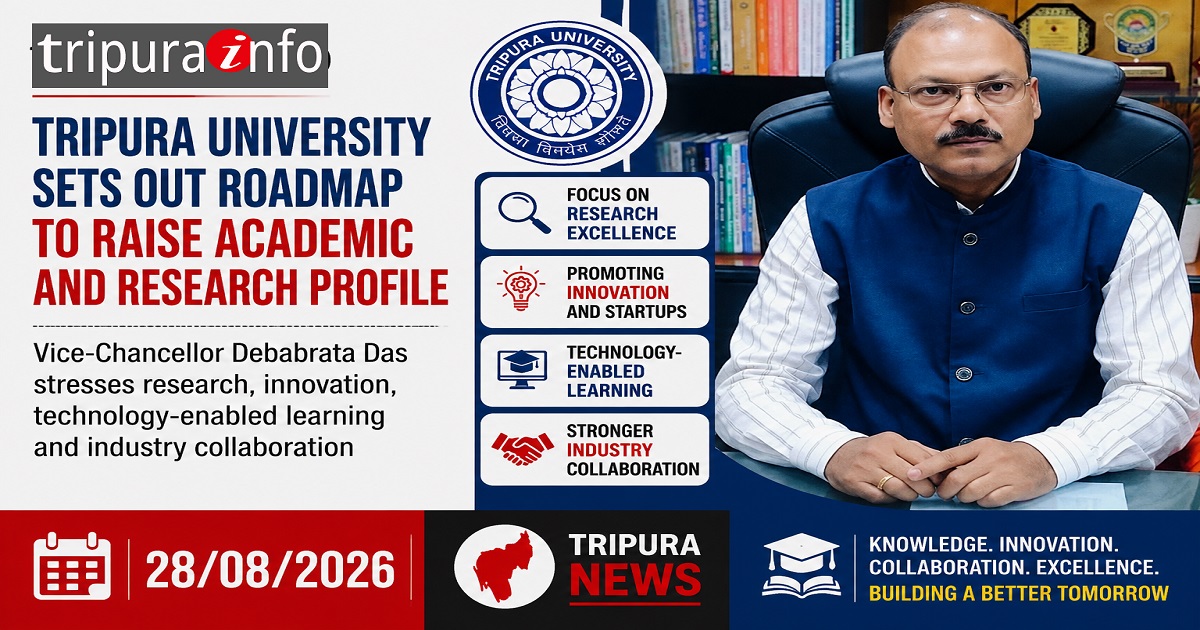 Tripura University will seek to strengthen its position at the national level by placing research, innovation, technology-enabled education and institutional collaboration at the centre of its academic agenda, Vice-Chancellor Prof. Debabrata Das has said.
Addressing teachers, researchers, officials, employees and students at an event held at the Maharaja Bir Bikram Auditorium of the university recently, Prof. Das outlined a broad roadmap aimed at improving the institution's academic standards and strengthening its national and international profile.
“Universities do not merely prepare for the future; they create the future,” Prof. Das said, underlining the need for the university to move beyond its conventional role of providing degrees and emerge as a significant centre of knowledge creation and innovation.
The Vice-Chancellor said research would be treated as a strategic priority. The focus, he said, should not merely be on increasing the number of research papers but on improving the quality and global relevance of research, securing competitive research grants, undertaking interdisciplinary projects, developing patents, expanding consultancy and facilitating technology transfer.
The proposed research agenda includes emerging areas such as artificial intelligence, machine learning, cyber security, biotechnology, healthcare, climate change, sustainability and data analytics, besides the Indian knowledge system.
Prof. Das also emphasised the importance of developing research programmes rooted in the ecological, social and cultural characteristics of the Northeast. Biodiversity conservation, climate change, forest and water-resource management, sustainable agriculture, renewable energy and disaster management could provide important areas of research with direct relevance to Tripura and the wider region, he said.
The university also plans to encourage systematic research into indigenous knowledge, local languages, traditions, culture, traditional healthcare practices and medicinal plants. Such research, according to the Vice-Chancellor, could help preserve local knowledge while giving it wider recognition through scientific documentation and investigation.
The emphasis on research comes at a time when Prof. Das has identified improving academic standards, research output and innovation as key priorities for the university. He assumed charge as the university's Vice-Chancellor in July after the Ministry of Education appointed him to the post, ending a prolonged vacancy in the regular Vice-Chancellor's office.
The proposed changes will also extend to teaching and learning. Prof. Das called for a shift from teacher-centric education towards a student-centric and outcome-based system. Project-based, practical, interdisciplinary and research-oriented learning would be encouraged to improve students' skills and employability.
The Vice-Chancellor stressed that technology and infrastructure could not substitute for an inspiring teacher. Teachers, he said, would have to combine the roles of educators, mentors, researchers and innovators.
Students, too, would be treated as active stakeholders in the university's development. The administration plans to encourage greater participation in research and innovation, entrepreneurship, community service, cultural activities, sports and environmental initiatives.
Another major component of the proposed roadmap is greater collaboration with leading academic and research institutions. Prof. Das said the university would seek stronger links with IITs, IISERs, IISc, central and State universities, national laboratories, government agencies, industries, start-ups and international institutions.
Such partnerships, he said, could open up opportunities for joint research, faculty and student exchanges, academic publications, consultancy and innovation.
The university also plans to make greater use of technology in its administrative and academic functions. The Central Library is proposed to be developed into a technology-enabled research and knowledge-support centre, strengthening access to academic resources for students and researchers.
The roadmap comes against the backdrop of the university's wider effort to improve its academic reputation. At the time of assuming office, Prof. Das had said that strengthening teaching, learning and research would be among his principal priorities and that the institution had an important role in improving the quality of higher education in Tripura.
Tripura University, established in 1987 and subsequently converted into a Central university under the Tripura University Act, 2006, is the State's premier institution for higher education and research.
Prof. Das has called upon teachers, researchers, employees and students to work collectively towards the larger national objective of building a developed India by 2047.
The proposed approach, therefore, seeks to position Tripura University not merely as a degree-awarding institution but as a centre for research, innovation and knowledge creation, with its academic priorities closely linked to the needs and opportunities of Tripura and the Northeast.
more news...