NIT Agartala Students Temporarily Suspend Agitation After Assurances, Serious Hostel and Basic-Facility Concerns Surface
By Our Correspondent
Agartala, August 25, 2026
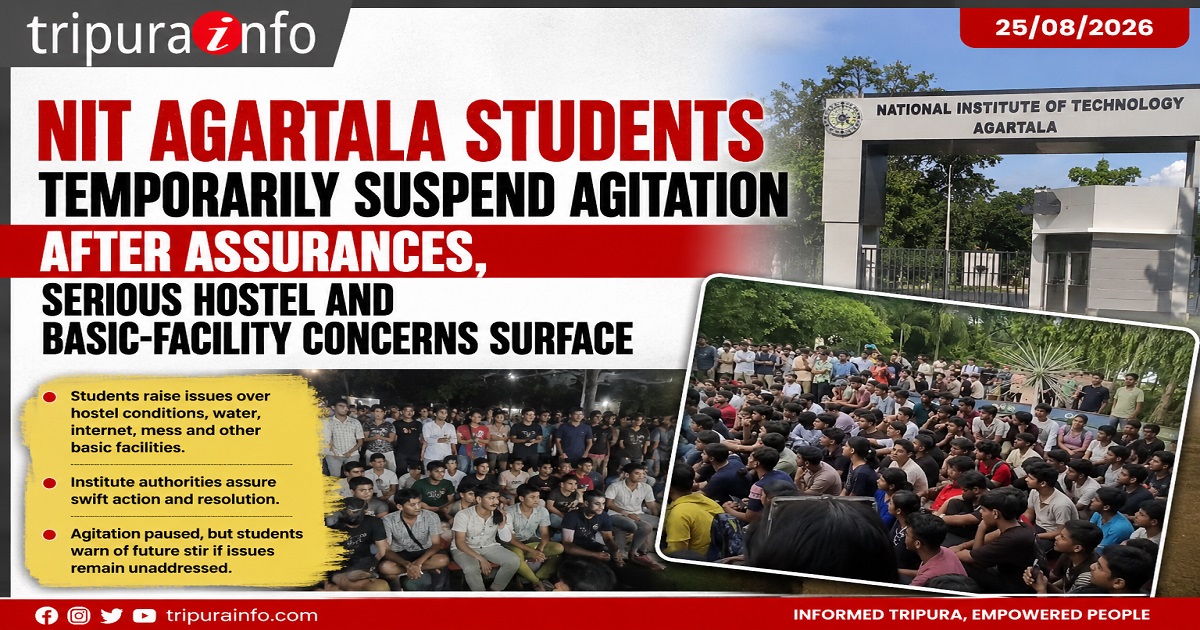 Students of the National Institute of Technology (NIT) Agartala have temporarily suspended their agitation after receiving assurances from persons reportedly close to the present institute director. The decision came after students raised a series of serious grievances concerning food quality, hostel hygiene, internet connectivity, electricity supply, drinking water, hostel restrictions and the overall handling of student concerns.
According to information available from students, the agitation had intensified after repeated complaints over basic facilities remained unresolved. Students subsequently decided to pause the protest for the time being following assurances that their demands and concerns would be addressed.
However, students have reportedly made it clear that the suspension of the agitation should not be interpreted as a withdrawal of their demands. They are expecting concrete action from the institute administration and may reconsider their decision if the assurances are not followed by visible improvements.
Among the most serious concerns raised by students are the quality of food served in the hostels and hygiene conditions, particularly in toilets and other common facilities. Students have described these as fundamental issues that directly affect their health, dignity and daily living conditions.
Concerns regarding hygiene in the girls' hostel have reportedly been particularly serious. Students have called for immediate inspection of hostel facilities and proper maintenance of toilets, washrooms and other common areas.
Internet connectivity has also emerged as a major concern. Students, particularly those staying in some girls' hostels, reportedly face extremely weak mobile signals and unreliable Wi-Fi services. According to a student who requested complete anonymity, the problem has continued for years and has affected coding, online classes, academic work, online assessments, placement preparation, internship applications and virtual interviews.
The student claimed that routers have been installed in some hostel blocks but that the service frequently becomes unavailable, while some blocks allegedly lack adequate Wi-Fi facilities altogether. Students are reportedly not permitted to independently install routers to overcome the problem.
For engineering students preparing for placements and off-campus opportunities, unreliable connectivity can have serious consequences. Online coding tests, assessments, interviews and applications often operate within strict time windows, leaving students with little scope to compensate for an unstable internet connection.
Electricity supply is another major issue raised during the agitation. Students have alleged that prolonged power cuts sometimes continue for several hours, including during weekends and after rainfall. According to complaints received, outages of around six to eight hours have occurred on some occasions.
Students have also alleged that restoration of power is sometimes delayed in girls' hostels even after electricity returns to other parts of the campus. The absence of an adequate backup or generator arrangement for essential services has added to their concerns.
Drinking-water facilities have also reportedly come under criticism. Students claim that several water coolers are either non-functional or poorly maintained, forcing them to move between hostel blocks in search of functioning drinking-water facilities.
Hostel accommodation and food-related concerns have further contributed to student dissatisfaction. There are also allegations of double occupancy in rooms that were originally intended to be single occupancy.
Another contentious issue relates to differences in hostel timings and their enforcement for male and female students. According to complaints raised by students, the girls' hostel entry time is around 7:30 PM, while boys generally have a later deadline of around 10 PM. Students allege that the restrictions on girls are comparatively stringent and that this can affect their ability to use campus facilities such as libraries and better internet connections during the evening.
Students have also raised questions about whether disciplinary rules are applied equally. They have alleged that girls have faced fines or disciplinary action over comparatively minor violations, while incidents involving boys, including alleged fights and property damage, have not always resulted in what students consider comparable or prompt action.
There are also allegations that some female students who returned late under particular circumstances were subjected to inappropriate comments or questioned in a manner they considered humiliating. These allegations, however, require independent verification from the institute administration and the students concerned.
One of the most sensitive issues raised by students is the alleged pressure faced by those who publicly highlight campus problems.
According to an anonymous student communication, a student who posted a social-media status criticising poor network and electricity facilities was allegedly called to the Dean/Warden's office and questioned about the post. Another allegation claims that a video highlighting a campus problem was subsequently removed after pressure was allegedly exerted on the student.
Students say such incidents have created apprehension about speaking publicly about genuine problems. Some reportedly fear disciplinary proceedings or adverse academic consequences if they continue to raise concerns.
Students have stressed that raising concerns about basic facilities should not be treated as misconduct when such concerns are expressed peacefully and without abusive language. They are seeking a mechanism through which grievances can be raised without fear of retaliation.
The role of the institute's administrative leadership has also come under criticism from sections of the student community. Some students have expressed dissatisfaction with the functioning of the Dean Students' Affairs and alleged that sufficient attention has not been given to resolving their concerns. There are also allegations of an internal "lobby culture" influencing administrative functioning.
These allegations remain claims made by students and have not been independently established. The concerned officials and NIT Agartala administration should be given an opportunity to respond to each allegation.
The agitation has also reportedly caused concern among parents and guardians. According to students, once details of the protest and the alleged hostel conditions reached the mass media, guardians became increasingly worried about the living conditions and safety of their children.
For many students, the issue goes beyond individual hostel complaints. They argue that NIT Agartala is a nationally important technical institution and that students admitted after highly competitive entrance examinations should be able to expect reliable basic infrastructure and an academic environment conducive to learning and career development.
One student, who requested anonymity because of fears of possible repercussions, said the problems are particularly disappointing for students who have spent years preparing for admission and now find themselves struggling with basic services.
Students say they are not demanding luxury facilities. Their principal demands, according to the complaints received, include good-quality and hygienically prepared food, clean toilets and hostel facilities, reliable internet connectivity, uninterrupted electricity with adequate backup, functioning drinking-water facilities, fair and transparent hostel rules, and a safe mechanism for raising grievances.
The students' temporary decision to suspend the agitation now places the focus on the institute administration. The immediate question is whether the assurances given to the students will translate into measurable action.
Students are reportedly seeking concrete timelines for resolving the major problems rather than further assurances that the issues will be addressed "soon."
The administration may also need to conduct an independent inspection of hostel food, kitchens, toilets, drinking-water facilities, electricity backup systems and internet infrastructure. A transparent grievance-redressal mechanism, along with clear and uniformly enforced hostel and disciplinary rules, could also help rebuild confidence between students and the administration.
The allegations concerning social-media posts, pressure on students and unequal disciplinary treatment are particularly sensitive and warrant a fair fact-finding process involving students, wardens and institute authorities.
For now, the agitation remains temporarily paused. But students have indicated that the underlying grievances have not disappeared. The coming days will therefore be crucial in determining whether the latest assurances result in genuine improvements or whether the campus once again witnesses renewed student mobilisation.
NIT Agartala administration's response to the allegations and the assurances reportedly given to the protesting students would be important to establish the complete facts.
more news...