NIT Agartala Students Launch Massive Protest Over Basic Facilities, Internet, Power and Administrative Concerns
By Our Correspondent
Agartala, August 25, 2026
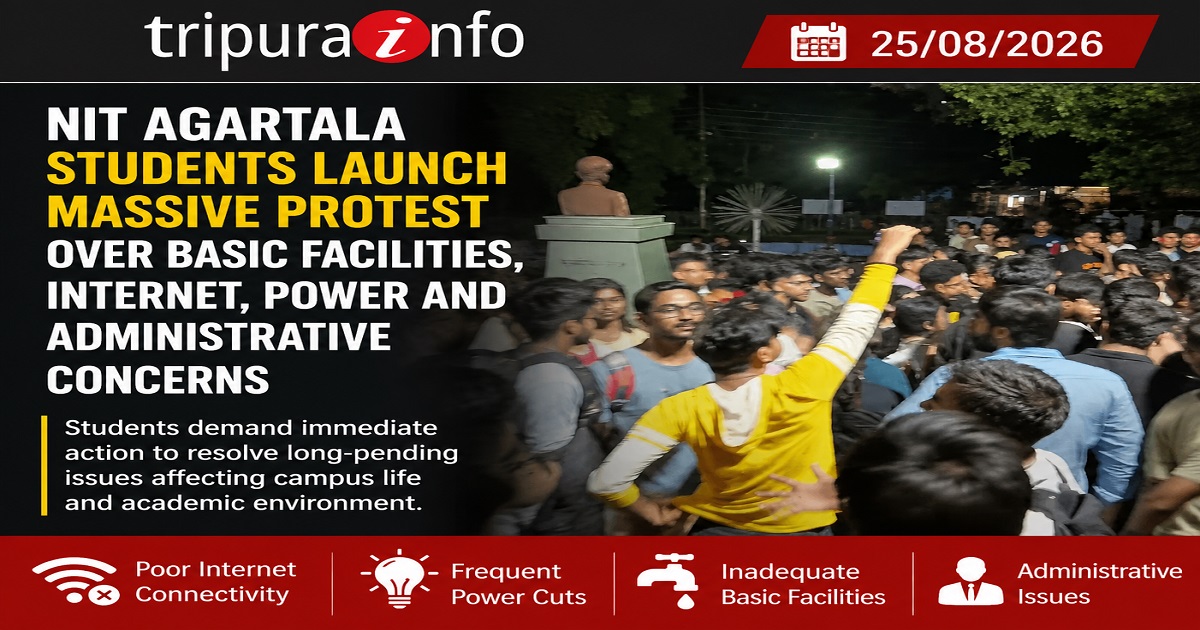 Students of the National Institute of Technology (NIT) Agartala have reportedly launched a major protest that has continued since Monday afternoon, raising a wide range of concerns over basic facilities, internet connectivity, electricity supply, drinking water, placement support and what they describe as shortcomings in the institute's administration.
According to students, the protest is not confined to a single grievance. They allege that several fundamental problems have continued for years despite repeated complaints and assurances that the issues would be addressed.
Afew students, who requested complete anonymity fearing possible repercussions, said students are demanding reliable basic infrastructure and a more responsive administrative system. The student specifically urged that their name, contact details, hostel or block information and any other identifying details not be disclosed.
Among the most serious complaints is the extremely poor internet connectivity, particularly in several girls' hostels.
Students allege that mobile network signals are weak in many parts of the campus, making even basic communication difficult at times. Mobile data is reportedly unreliable for students attempting to connect laptops for academic work, coding, online courses, assessments, placement preparation and interviews.
Although Wi-Fi routers have reportedly been installed in some hostel blocks, students claim that the service frequently stops working, while some blocks allegedly lack adequate Wi-Fi facilities altogether.
According to the student's, the problem has continued for years. Students have repeatedly been told that the situation would be resolved, but they claim that no satisfactory long-term solution has emerged in the form of dependable Wi-Fi infrastructure or improved network connectivity.
Students also allege that they are not permitted to independently install routers to overcome the connectivity problem.
For an engineering institution where online learning, coding platforms, recruitment tests, internship applications and virtual interviews have become integral to academic and professional life, students say unreliable internet can have direct consequences for their careers.
The situation is reportedly particularly difficult for female students because of hostel restrictions that limit their ability to remain in academic spaces late in the evening.
Concerns over electricity and backup power
Frequent and prolonged power cuts are another major grievance.
Students allege that electricity outages sometimes continue for several hours, with instances reportedly lasting around six to eight hours. They claim that outages occur on both weekdays and weekends and can continue for considerable periods even after rainfall has stopped.
Students have also raised concerns about the availability of adequate generator or backup power facilities across all hostel blocks and essential campus areas.
According to students, prolonged power cuts affect studying, charging laptops and mobile phones, online academic work and placement-related activities. Some students further allege that electricity is sometimes restored in certain parts of the campus before the girls' hostels.
The students are demanding dependable backup power arrangements rather than temporary solutions whenever outages occur.
Another contentious issue concerns differences between boys' and girls' hostel timings.
Students claim that girls are generally required to return to their hostels by around 7:30 PM, while boys reportedly have a later return time of around 10 PM. Students further allege that the rules are enforced more strictly in the girls' hostels.
According to the complaint, these restrictions can directly affect academic and career-related activities, particularly when students need to remain in libraries or other academic spaces for internet access, online assessments, coding work, interviews or placement preparation.
The student also alleged that female students have faced disciplinary action or fines for relatively minor violations, including late return during festivals.
At the same time, students have raised questions about whether disciplinary measures have been applied with equal consistency in cases involving male students and alleged fights, physical altercations or property damage.
There are also allegations that some girls who returned late due to particular circumstances were subjected to inappropriate comments concerning their character.
These allegations, however, require independent verification, and students are calling for a transparent examination of whether hostel and disciplinary rules are being applied equally to male and female students.
The complaint also raises concerns about how students are treated when they publicly raise questions about campus facilities.
According to the student, an individual who posted a social-media status criticising poor network and electricity conditions was allegedly called to the office of a Dean or Warden and questioned regarding the post, despite the student allegedly using no abusive or offensive language.
Another allegation concerns a student who reportedly uploaded a video highlighting a campus issue and subsequently removed it after pressure.
Students claim that such incidents have created an atmosphere of apprehension, with some fearing disciplinary proceedings, academic repercussions, debarment or other consequences if they publicly criticise campus conditions.
The students argue that respectfully raising genuine concerns about infrastructure should not expose them to intimidation or academic pressure.
They are therefore seeking an independent investigation into whether students have been called before authorities or pressured because of legitimate criticism of campus facilities.
Drinking water and hostel infrastructure also under scrutiny
Students have also complained about drinking-water facilities.
According to the complaint, several drinking-water coolers are reportedly non-functional or poorly maintained, forcing students to move between hostel blocks in search of functioning facilities.
Other hostel-related concerns reportedly include double occupancy in rooms that students say were originally intended to be single-occupancy rooms, along with complaints relating to food and washroom facilities.
Students argue that these issues, taken individually, may appear to be routine hostel problems, but collectively they contribute to a broader concern over the quality of basic facilities available to students.
Food quality and placement facilities among protest demands
The ongoing protest is also reportedly seeking improvements in food quality and greater attention to placement facilities.
Students want the institute to ensure that food served in hostels meets acceptable standards and that career and placement support is strengthened across disciplines and for students seeking opportunities beyond the campus recruitment process.
They argue that when on-campus opportunities are limited, students must be able to depend on reliable internet, electricity and institutional support to pursue off-campus assessments, internships, interviews and employment opportunities.
Questions raised over administration and appointments
The student complaint also contains strong criticism of the functioning of the institute's present administrative structure.
Students allege that the institute has been "downgrading" under the present Director and Registrar and what they describe as a group of preferred appointees. These are allegations made by the protesting students and have not been independently established.
The complaint further questions the practice of appointing individuals to multiple significant administrative or academic responsibilities.
For instance, students have raised questions about the appointment of board member Debdulal Tripura as Dean, arguing that simultaneously handling responsibilities in different areas could affect administrative effectiveness.
Students have also criticised the selection of wardens and assistant wardens, alleging that in some cases appointments were influenced more by personal loyalty or what they describe as "oiling" than by capability and administrative merit.
These allegations require a response from the institute administration and should be independently verified before being treated as established facts.
Questions over selection of Deans and HoDs
Students have further raised concerns about recent selections of Deans and Heads of Departments.
They allege that in some instances Associate Professors have been given administrative positions over Professors, questioning the criteria and transparency behind such appointments.
The students are demanding clarity regarding the selection process, eligibility criteria, institutional experience and reasons behind recent academic and administrative appointments.
They argue that transparent and merit-based selection is essential for maintaining confidence among both students and faculty members.
Students say this is not simply a "Gen Z" issue
The protesting students reject the suggestion that their concerns should be dismissed as typical complaints of a younger generation.
They argue that reliable internet, electricity, drinking water, food, academic facilities and fair treatment are basic requirements for students of any generation.
For students pursuing engineering and technology education, internet connectivity and uninterrupted electricity are no longer optional conveniences. They are essential academic infrastructure.
"We are not asking for luxury"
The anonymous student said they had worked hard to secure admission to NIT Agartala and expected an environment conducive to education, technological learning and career development.
The student said that after reaching the third year, it is deeply disappointing to continue facing problems involving basic facilities such as internet connectivity, electricity and drinking water.
Students also point out that they pay substantial academic and hostel fees and therefore expect essential infrastructure and services to function reliably.
The central message of the protest, according to students, is that they are not demanding luxury facilities but basic infrastructure necessary to study, participate in placements and build their careers.
Demand for independent investigation
The students have urged the media and concerned authorities to independently investigate the allegations.
They want representatives to speak with students from different hostels and academic years, assess internet connectivity—particularly in the girls' hostels—and examine the frequency and duration of power outages.
They have also called for scrutiny of drinking-water facilities, hostel timings, disciplinary practices, alleged pressure over social-media posts, the removal of videos highlighting campus problems and any claims that students have been threatened with disciplinary or academic consequences for raising genuine concerns.
The students are also seeking an official response from the NIT Agartala administration on each of these issues and details of the measures being taken to address them.
Administration's response awaited
The allegations contained in the students' complaint have not been independently verified, and the institute's response to the specific claims was not included in the material provided for this report.
Given the seriousness of the allegations, a transparent response from NIT Agartala would be important to establish the facts and clarify what corrective measures, if any, are already underway.
The students say their objective is not to create unnecessary controversy but to draw attention to long-standing problems and seek concrete solutions.
As the protest continues, the central question is whether the administration will engage directly with the students, independently examine their complaints and establish a clear timeline for resolving the infrastructure, hostel, academic and administrative concerns being raised.
The student who submitted the complaint has requested strict confidentiality, stating that the identity of the source should not be disclosed to NIT Agartala authorities, staff members or any third party.
more news...