Tripura High Court Orders Family Pension for Divorced Daughter, Emphasises Welfare Objective of Pension Rules
By Our Correspondent
Agartala, August 22, 2026
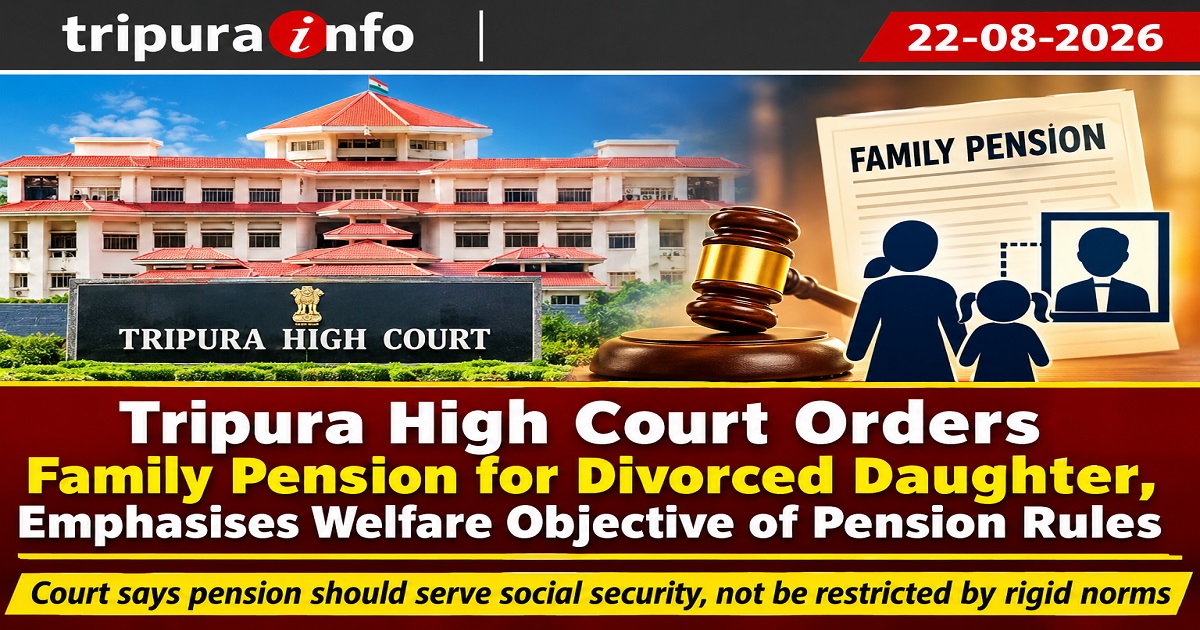 The High Court of Tripura has delivered an important ruling concerning the entitlement of a divorced daughter to family pension after the death of her pensioner parent, holding that the beneficial and welfare-oriented purpose of pension provisions must be kept in view while determining the rights of dependent daughters.
According to the report, a Division Bench comprising Chief Justice MS Ramachandra Rao and Justice Biswajit Palit, while dealing with a writ appeal, disagreed with the restrictive interpretation adopted in an earlier judgment concerning the family-pension claim of Smt. Ujjala Rani Paul and directed the Agartala Municipal Corporation to extend the benefit of family pension in accordance with the applicable rules.
The case arose from the claim of Ujjala Rani Paul, whose father, Late Rash Bihari Paul, had been an employee of the Agartala Municipal Corporation. He retired on October 1, 2004 and subsequently received pension. He died on December 2, 2018, while his wife had already died.
After the death of her father, Ujjala Rani Paul sought family pension. Her marital relationship had broken down and she subsequently obtained a decree of divorce from the competent court. Her claim, however, was not accepted by the municipal authorities, leading her to approach the High Court.
The dispute subsequently centred on the interpretation of the pension rules governing unmarried, widowed and divorced daughters. The petitioner contended that she had remained dependent on her father and that the subsequent grant of a divorce decree should not deprive her of the protective benefit intended for dependent daughters.
The matter had earlier been considered by a Single Judge of the High Court. In the judgment delivered on April 1, 2026, Justice S Datta Purkayastha had dismissed Ujjala Rani Paul's writ petition, holding that under Rule 8 of the Tripura State Civil Services (Revised Pension) Rules, 2017, the claimant was required to satisfy the eligibility conditions at the relevant stage. The Single Judge had observed that at the time of her father's death she was a married daughter separated from her husband, rather than a legally divorced daughter.
The Single Judge had also considered the Government of India's Office Memoranda dated September 11, 2013 and July 19, 2017 concerning family pension for widowed and divorced daughters. The July 19, 2017 clarification provides for family pension in cases where divorce proceedings were initiated during the lifetime of the government servant or pensioner, even if the final decree of divorce was granted after the parent's death, subject to fulfilment of the other eligibility conditions.
The appellate proceedings raised a broader question concerning the interpretation and object of family-pension provisions. The petitioner's side argued that pension rules are social-welfare measures and should not be interpreted mechanically in a manner that defeats their underlying purpose. The emphasis was placed on the financial dependence of the daughter and the circumstances leading to the breakdown of her marriage.
The Division Bench, according to the news report, took a broader welfare-oriented view and held that the amendment bringing divorced daughters within the ambit of family pension was intended as a social-security measure. The objective of the provision, it observed, is to provide financial protection to daughters who are dependent on their deceased parents and may otherwise face economic hardship.
The Court also reportedly rejected the municipal authority's restrictive approach concerning the applicability of pension provisions and criticised the attempt to deny the benefit by relying on an interpretation that did not adequately take into account the purpose behind the amendment.
more news...