Tripura High Court Holds Executive Instructions Cannot Override Statutory CCL Rules, Orders 365-Day Child Care Leave for Woman Teacher
By Our Correspondent
Agartala, August 21, 2026
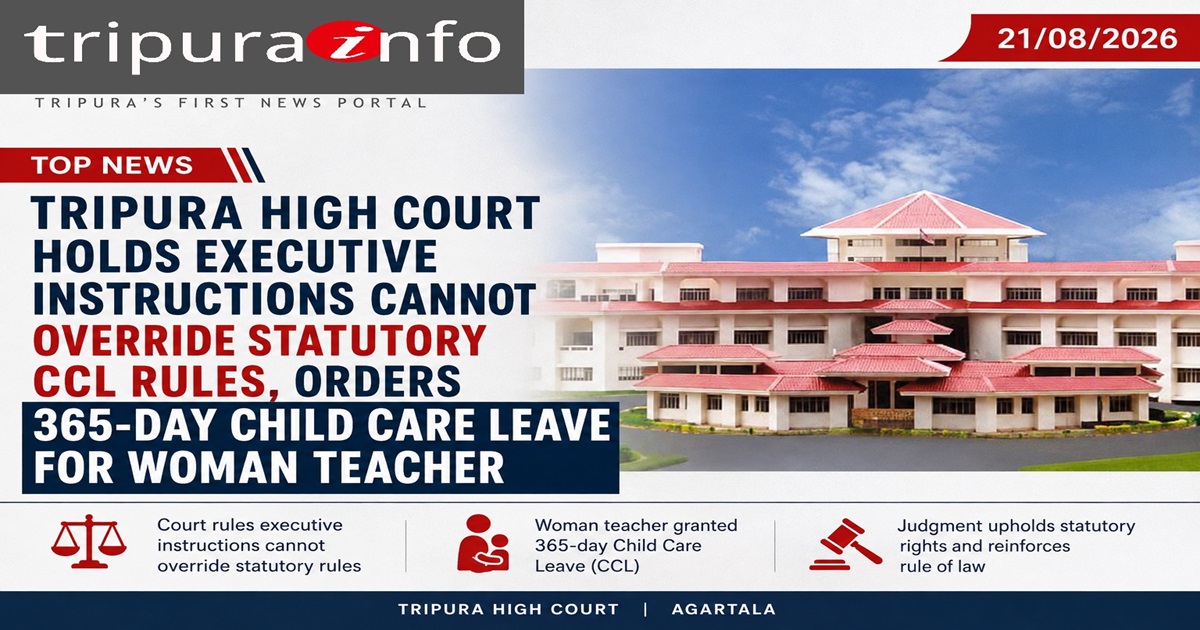 The High Court of Tripura has delivered a significant policy-oriented judgment on Child Care Leave (CCL) for women government employees, holding that while Child Care Leave cannot be claimed as an absolute statutory right and remains subject to sanction by the competent authority, the authority must meaningfully consider the genuine necessity for which such leave is sought. In a major direction, the Court ordered the State authorities to grant 365 days of Child Care Leave to a woman Post Graduate Teacher after finding that her application had not been properly considered or rejected on any cogent and justifiable ground.
The judgment was delivered by Hon’ble Mr. Justice Biswajit Palit on August 14, 2026, in WP(C) No. 597 of 2025, Smt. Tapasi Roy vs. The State of Tripura and Others. The matter was heard on August 7, 2026, and the judgment has been marked fit for reporting.
The petitioner, Smt. Tapasi Roy, wife of Pradeep Kumar Shil and resident of Badharghat, Matripalli, Agartala, is serving as a Post Graduate Teacher (Mathematics) at Sankaracharya Vidyayatan School, Unnayan Sangha, AD Nagar, Agartala, a Grant-in-Aid school. The respondents in the case were the State of Tripura, represented by the Secretary, Education (School) Department, the Additional Secretary, Education (School) Department, the Director of Secondary Education, Government of Tripura and the Headmistress of Sankaracharya Vidyayatan School.
The petitioner was represented by Senior Advocate Purusuttam Roy Barman, assisted by Advocate Samarjit Bhattacharjee and Advocate Kawsik Nath. The State respondents were represented by Advocate General Saktimoy Chakraborty, assisted by Senior Government Advocate Pradyumna Gautam.
The petitioner approached the High Court seeking, among other reliefs, a direction upon the respondents to sanction 365 days of Child Care Leave from January 16, 2026 to January 15, 2027, under Rule 39(C) of the Tripura State Civil Service (Leave) Rules, 1986. She also sought a direction for consideration of her representation dated September 2, 2025, in which she had requested CCL for the same period.
According to the petitioner's case, her only son, Pragyat Prasun, approximately 15 years old, was studying at Kendriya Vidyalaya, JNU, New Delhi. He was then in Class IX and was expected to enter Class X in April 2026 and appear in the Class X Board Examination in 2027.
The petitioner's counsel submitted that the boy required regular schooling, tuition and intensive preparation for the Board examination and, during this crucial period, needed emotional and psychological support from his parents. The petitioner's husband was serving under the Ministry of Home Affairs in a transferable job and, according to the submissions before the Court, was unable to remain available to look after their son.
The Court record also notes that the petitioner's son was suffering from a breathing-related ailment and required frequent oxygen support. A specialised doctor had advised that he be taken to a less humid area or near a sea beach. The child had subsequently been shifted to New Delhi, where his father had earlier been posted.
The petitioner had submitted applications before the Headmistress of Sankaracharya Vidyayatan School on different dates seeking CCL for specified spells. However, according to the judgment, the applications did not receive a substantive response, apart from an endorsement of regret by the school secretary.
She subsequently submitted a detailed representation dated September 2, 2025 to the Director of Secondary Education, requesting 365 days of CCL from January 16, 2026 to January 15, 2027, along with station-leave permission, citing the welfare and educational needs of her minor son ahead of his Board examination. The representation, too, was not acted upon by the respondents.
The petitioner relied upon the 13th Amendment to the Tripura State Civil Service (Leave) Rules, 1986, introduced under the proviso to Article 309 of the Constitution of India, through which Rule 39(C) was inserted by notification dated December 12, 2017.
A major legal issue before the High Court concerned a memorandum dated August 4, 2020, issued by the Additional Secretary, Education (School) Department, which laid down certain criteria for proceeding on Child Care Leave.
Senior Advocate Purusuttam Roy Barman argued that the executive memorandum was inconsistent with the statutory Rule 39(C). The petitioner also relied heavily on an earlier judgment of the High Court in WP(C) No. 600 of 2023, Shibani Das, decided on October 4, 2024.
In that earlier case, the High Court had held that a rule framed under Article 309 has statutory force and cannot be amended or superseded by a Government instruction or administrative order, except where such instruction is merely clarificatory and fills a genuine gap. The Court had observed that executive instructions may supplement a statutory rule but cannot supplant it.
The earlier judgment had consequently declared the August 4, 2020 memorandum inconsistent with Rule 39(C), set it aside and quashed it as void ab initio. The Court had also directed the authorities to grant 327 days of CCL to the petitioner in that case.
The State respondents contested the present petition through their counter-affidavit. Their principal contention was that CCL could not be demanded as a matter of right and that sanction of such leave was within the discretion of the competent authority.
The State further pointed out that the petitioner had availed several spells of leave between 2022 and 2025 and argued that her repeated absence had adversely affected the administration and functioning of the school.
The counter-affidavit recorded that in 2022 the petitioner had approximately 50 days of leave out of 260 working days, in 2023 another 50 days, in 2024 about 146 days, and from January 1 to October 15, 2025, around 116 days. According to the State's calculation, 730 days of CCL had been credited to her, of which 364 days had been utilised up to October 2025, leaving a balance of 366 days.
The State further contended that CCL should be sanctioned only after arrangements were made for substitute teachers so that normal teaching was not disrupted.
Advocate General Saktimoy Chakraborty argued that even assuming the 2020 memorandum was no longer in force, the petitioner could not claim CCL as a matter of right. He submitted that sanction remained within the discretion of the competent authority and that the petitioner had failed to establish a legal right warranting issuance of a writ of mandamus.
The Advocate General relied upon the High Court's decision in Smt. Indrani Das (Sarkar) vs. The State of Tripura and Others, reported in 2026 Legal Eagle 247, and also referred to the Supreme Court judgment in Shesh Mani Shukla vs. District Inspector of Schools, Deoria & Others, reported in (2009) 15 SCC 436, concerning the requirement of establishing a legal right and corresponding legal duty before a writ of mandamus can be issued.
The High Court examined Rule 39(C) in detail. The statutory provision states that a woman Government servant having minor children below 18 years may be granted Child Care Leave by the competent leave-sanctioning authority for a maximum of two years, or 730 days, during the entire service, for taking care of up to two children, including their examination, sickness or other needs.
The Rule also provides that CCL may be availed in more than one spell, is not debited against the leave account and can be combined with other admissible leave.
At the same time, Rule 39(C)(vii) expressly states that CCL cannot be demanded as a matter of right and that an employee cannot proceed on CCL without prior sanction from the competent authority.
Thus, the judgment makes an important distinction: the employee does not possess an automatic right to walk away on CCL, but the competent authority also cannot mechanically refuse or ignore a legitimate CCL request without considering the circumstances that the statutory rule itself recognises.
High Court's reasoning
Justice Biswajit Palit observed that the petitioner's son was studying in New Delhi and preparing for his Board examination, while the record also established that the child was suffering from physical ailments requiring his mother's care and assistance.
The Court noted that although the petitioner had taken leave during 2022–2025, the State respondents had not projected any other substantive ground, apart from relying upon the proposition that CCL was discretionary.
The Court attached particular importance to the earlier Shibani Das judgment, which had already settled the legal position concerning the relationship between Rule 39(C) and the 2020 executive memorandum.
The Court reiterated the principle that rules framed under Article 309 possess statutory force. Executive instructions may supplement such rules where there is a genuine gap, but cannot replace, amend or override them.
One of the most significant aspects of the judgment is the Court's interpretation of the word “discretion.”
The High Court accepted that CCL is not an absolute right and that the competent authority retains the power to grant or refuse such leave. However, the Court made it clear that the authority must also consider the necessity for which CCL is sought.
In the present case, the Court found that the respondents had failed to explain how the administration of the school would actually suffer if the petitioner were granted CCL. The Court observed that the respondents, either in their written statement or during the hearing, had not sufficiently demonstrated such administrative prejudice.
The judgment further records that the leave-sanctioning authority had failed, without cogent reasons, to consider and act upon the petitioner's September 2, 2025 representation.
The Court held that there was no cogent or justifiable reason to refuse CCL merely on the ground that the leave could not be claimed as a statutory right.
Final order: 365 days CCL to be granted
Allowing WP(C) No. 597 of 2025, the High Court directed the respondents to grant Child Care Leave to Smt. Tapasi Roy for 365 days in response to her representation dated September 2, 2025.
The Court ordered that the CCL be granted within one month from the date of the judgment, i.e. the judgment delivered on August 14, 2026. The writ petition was accordingly allowed and any pending application was also disposed of.
more news...