Allegations of Factionalism Surface at NIT Agartala, Faculty Raise Concerns Over IDay Programme, Promotions and Institutional Decline
By Our Correspondent
Agartala, August 21, 2026
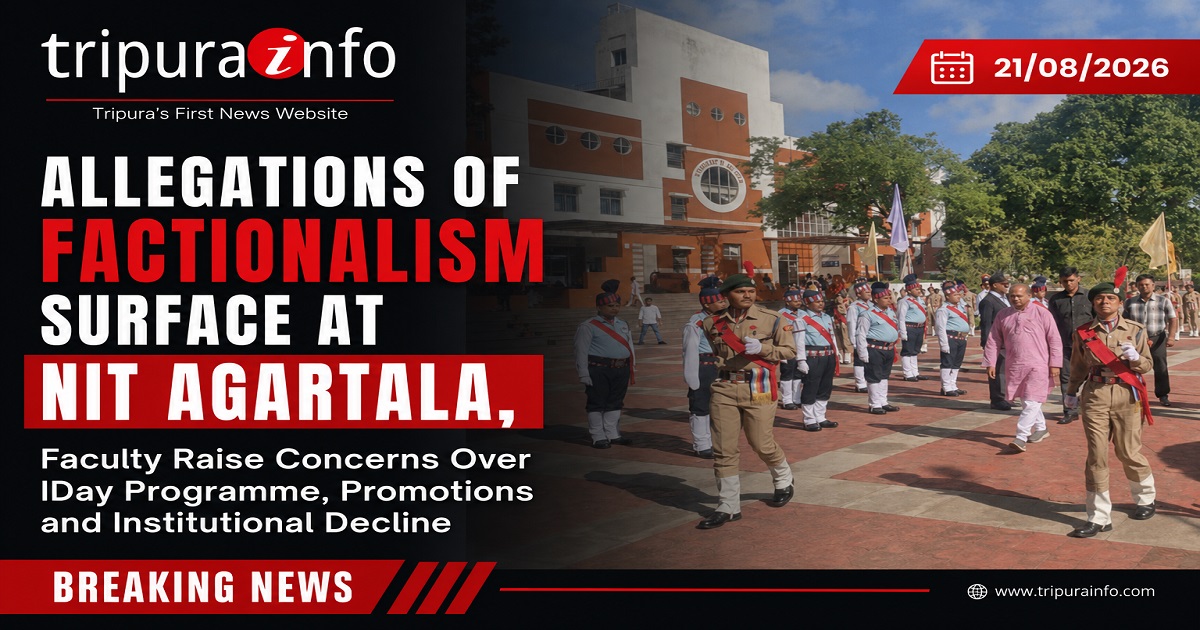 Serious allegations of administrative lapses, factionalism, procedural irregularities and declining academic performance have surfaced at the National Institute of Technology (NIT) Agartala, with a section of faculty members expressing concern over what they describe as the deterioration of institutional standards and the growing marginalisation of Tripura domiciled faculty and students.
NIT Agartala, which was accorded the status of a National Institute of Technology in 2006, was expected to emerge as a centre of excellence in professional education, research and placement opportunities. With 50 per cent of undergraduate seats being shared at the state level, the institute has a particularly important role in providing quality technical education and career opportunities to students from Tripura.
However, according to allegations raised by a section of faculty members, several aspects of the institute's present administration have become a matter of concern. They claim that grievances involving faculty and service-related issues have reached the courts, with around 50 employees reportedly approaching legal forums over various matters. Questions have also reportedly been raised regarding the appointment of the Registrar, with the matter stated to be sub judice before the High Court of Tripura.
One of the latest controversies concerns the Independence Day programme at the institute. Faculty members have alleged that the traditional rendition of Vande Mataram was omitted from this year's Independence Day celebration despite the existence of established government protocols and standard operating procedures concerning such national observances.
According to the allegations, when some senior faculty members raised objections at the venue, they were reportedly told that the programme schedule approved by the competent authority had to be followed irrespective of its contents. The faculty members further allege that they were asked not to raise the issue publicly.
The controversy has assumed greater significance because, according to the complainants, some of the persons involved in the programme's organisation are associated with faculty-related matters that are expected to come before the institute's Board of Governors (BoG). A meeting of the BoG has reportedly been scheduled for August 24, 2026, in Delhi, where matters relating to higher administrative and academic grades and service regularisation are expected to be considered.
Faculty members have also raised questions regarding the service history of one professor, alleging that the person was inducted in 2008 despite questions over the prescribed qualification and experience. They further claim that a 2012 BoG decision had recommended dismissal based on a legal report from an authorised Central Government mechanism, but that disciplinary action was allegedly not pursued for many years. These allegations, however, require verification from official records and responses from the institute and the concerned faculty member.
The extension of the tenure of the present Chairperson of the Board of Governors by the Ministry of Education for another six months has been viewed by the complainants as providing additional time for pending issues to be examined through due process. Faculty members have expressed appreciation for the extension and urged the authorities to use the additional period to review outstanding grievances objectively.
Another major allegation relates to the treatment of Tripura-domiciled faculty members seeking higher administrative positions elsewhere. A section of teachers claims that some faculty members who had played significant roles in developing academic, hostel and administrative infrastructure at NIT Agartala were subsequently denied opportunities to participate in selection processes for leadership positions at other institutions, allegedly because of adverse confidential remarks.
The complainants have further alleged that nepotism and favouritism have become increasingly visible in administrative and academic decision-making. They point to what they describe as a decline in the institute's position in the National Institutional Ranking Framework (NIRF), claiming that NIT Agartala has slipped from earlier positions in the 50-plus or 70-plus range to around the 130-plus range in recent years. Such claims would need to be assessed against the official NIRF rankings for the respective years.
According to the faculty members, the alleged decline has consequences not only for the institute's reputation but also for students, particularly in terms of placement opportunities, research exposure and overall academic development.
Research administration has emerged as another area of concern. Faculty members allege that utilisation of sanctioned research-project funds has fallen considerably and that several Principal Investigators and Co-Principal Investigators have repeatedly requested administrative intervention to ensure timely implementation of projects. They fear that delays in utilisation and completion could affect future research funding and the institute's ability to attract major externally funded projects.
The manner in which Deans and Heads of Departments are allegedly being appointed has also triggered criticism. Faculty members claim that, despite the availability of senior Professors, some administrative positions have recently been entrusted to Associate Professors, resulting in situations where senior Professors are reportedly placed under the supervision of relatively junior faculty members.
The complainants contend that such arrangements are unusual in premier technical institutions and could adversely affect academic hierarchy and institutional functioning. They have demanded that appointments to key academic and administrative posts be made transparently, on the basis of established norms, seniority, academic merit and institutional requirements rather than factional considerations.
Questions have also been raised over the role of the institute administration in dealing with the State Government's nominee to the NIT Board of Governors. Faculty members allege that an explanation was sought from the State Government regarding its nominee, despite the nominee's professional background in both academics and the Central Government's power sector. They have questioned the authority and procedure under which such correspondence was issued and whether the mandatory approval of the Chairperson of the BoG was obtained.
Another allegation concerns recovery of money from an employee's salary following the loss of electronic equipment. Faculty members have questioned whether similar principles are consistently applied when laptops, mobile phones or other valuable electronic equipment belonging to teachers or students are lost within the institute.
The controversy is not entirely new. Faculty members point out that irregularities and allegations of nepotism at NIT Agartala had reportedly been raised in the Tripura Legislative Assembly around two years ago. The Chief Minister, according to the complainants, had acknowledged awareness of issues concerning the institute and assured that the matter was known to the government. The faculty members are now urging the state and central authorities to take follow-up action based on the concerns raised in the Assembly.
The process for promotion to the Higher Administrative Grade (HAG) has also come under scrutiny. Faculty members allege that the deadline for applications was fixed on January 15 this year in a manner that prevented a significant number of eligible candidates from applying. They claim that an extension of approximately 20 days could have allowed around 15 additional Tripura-domiciled faculty members to become eligible for consideration. The allegation requires examination against the official notification, eligibility rules and application records.
The recently introduced biometric attendance system has generated another round of dissatisfaction among faculty members. According to them, the system was introduced with the stated objective of improving discipline, while the administration had also indicated that flexible working arrangements of eight hours would be considered. Faculty members, however, claim that subsequent instructions requiring them to report by 10 am have effectively undermined the concept of flexible working hours.
They argue that a faculty member scheduled to conduct a practical class at 3 pm may reasonably need to work later into the evening, particularly in laboratories and research facilities. Under a genuinely flexible system, they contend, a teacher could work from the afternoon into the evening while completing the required working hours.
Faculty members have also complained about alleged technical problems with biometric machines and the difficulties of marking attendance across a sprawling campus of more than 350 acres. They fear that an excessive focus on attendance compliance could eventually undermine the institute's primary objectives of teaching, research, laboratory development and innovation.
The complainants argue that if administrative procedures begin to prioritise physical attendance over academic productivity, research output and teaching quality, the long-term consequence could be further deterioration in the institute's overall performance.
At the heart of the controversy is a demand for an independent and transparent review of the functioning of NIT Agartala. Faculty members say that the institute's Director and Registrar must ensure that administrative decisions are based on the NIT Act, applicable statutes, government regulations and established institutional practices rather than personal preferences or factional considerations.
more news...