TTAADC Regularises Contractual Computer Assistants as LDCs, Raising Questions Over Selective Treatment of Contractual Employees
By Our Correspondent
Agartala, August 17, 2026
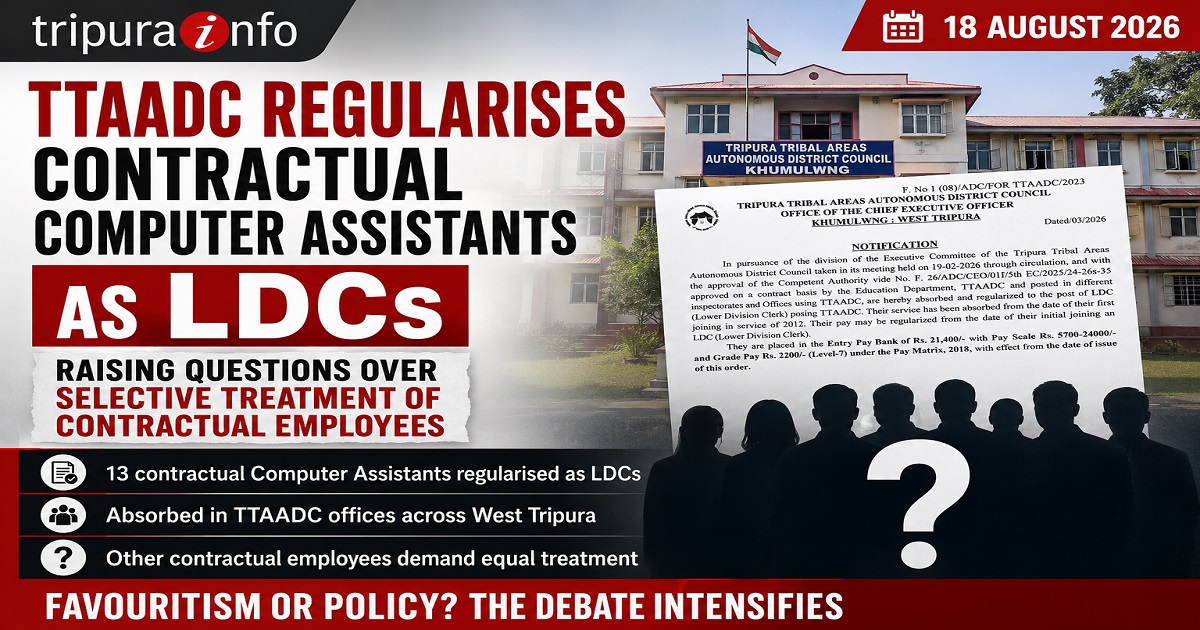 At a time when Tipra Motha founder Pradyot Kishore Debbarma has been repeatedly advocating greater autonomy, accountability and transparency in the functioning of the Tripura Tribal Areas Autonomous District Council (TTAADC), a recent administrative order has raised fresh questions over the Council’s recruitment and regularisation practices.
A notification issued by the Office of the Chief Executive Officer, TTAADC, Khumulwng, states that 13 Computer Assistants who had been appointed on a contractual basis by the TTAADC Education Department and posted in different inspection and officers’ offices have been absorbed and regularized against the post of Lower Division Clerk (LDC).
According to the notification, the employees’ contractual service has been absorbed from the date of their first joining in 2012, and their pay has been regularised from the date of their initial joining as LDC. They have been placed in the Entry Pay Bank of Rs 21,400, with a pay scale of Rs 5,700–24,000 and Grade Pay of Rs 2,200, corresponding to Level-7 under the Pay Matrix, 2018.
The order, dated March 5, 2026, further directs the employees to report to their new positions as LDCs at their respective places of posting. It cites approval of the competent authority and an Executive Committee decision of the TTAADC.
While regularisation of long-serving contractual employees may itself be welcomed by employees who have served for years, the order has triggered a larger question: why has a similar policy not been extended to other long-serving contractual employees working under the ADC?
According to concerns raised by contractual SSA teachers associated with the ADC, around 2,500 such teachers have reportedly been serving in different schools under the Council for nearly 21–22 years. They are questioning why a mechanism for absorption and regularisation has been applied in the case of the 13 Computer Assistants, while similarly long-serving contractual employees have allegedly remained outside the regularisation process.
The issue has also prompted questions about whether the Computer Assistants were originally appointed through the SSA scheme or another contractual arrangement and, if so, what specific policy, guideline or legal framework enabled their absorption against regular LDC posts.
The controversy therefore goes beyond the individual employees named in the notification and touches upon the broader issue of consistency, transparency and equal treatment in personnel policy within the TTAADC. If one category of contractual employees can be absorbed and regularised after years of service, affected contractual teachers and other employees are likely to seek clarity on the criteria used by the Council.
Questions have also been raised over the wording and drafting of the notification. Observers have pointed to apparent inconsistencies and typographical or language errors in the order, including the numbering of employees, and argued that such discrepancies should be clarified by the Council to remove any doubt about the authenticity, preparation and implementation of the order.
The development comes at a politically significant time for the TTAADC. With Pradyot Kishore Debbarma continuing to raise the demand for greater autonomy and stronger institutional authority for the indigenous people, questions over administrative transparency and internal governance are gaining renewed importance.
For the Council, the immediate challenge is therefore not merely to defend the regularisation of the 13 employees, but to explain what policy or legal provision was followed, why these employees were selected, how their posts were sanctioned, and whether the same principles will be applied to other long-serving contractual employees, including SSA teachers.
The affected contractual teachers may now seek a formal explanation from the TTAADC authorities and, if necessary, explore legal avenues to determine whether similarly placed employees have been treated equally under the applicable rules.
The latest order has thus opened a wider debate over whether TTAADC’s personnel decisions are being guided by a transparent and uniform policy—or whether different categories of contractual employees are being subjected to different standards.
more news...