Half-Yearly Examination Schedule Announced, But R3 Textbooks and Teachers Still Unavailable in Most Vidyajyoti Schools
By Our Correspondent
Agartala, August 14, 2026
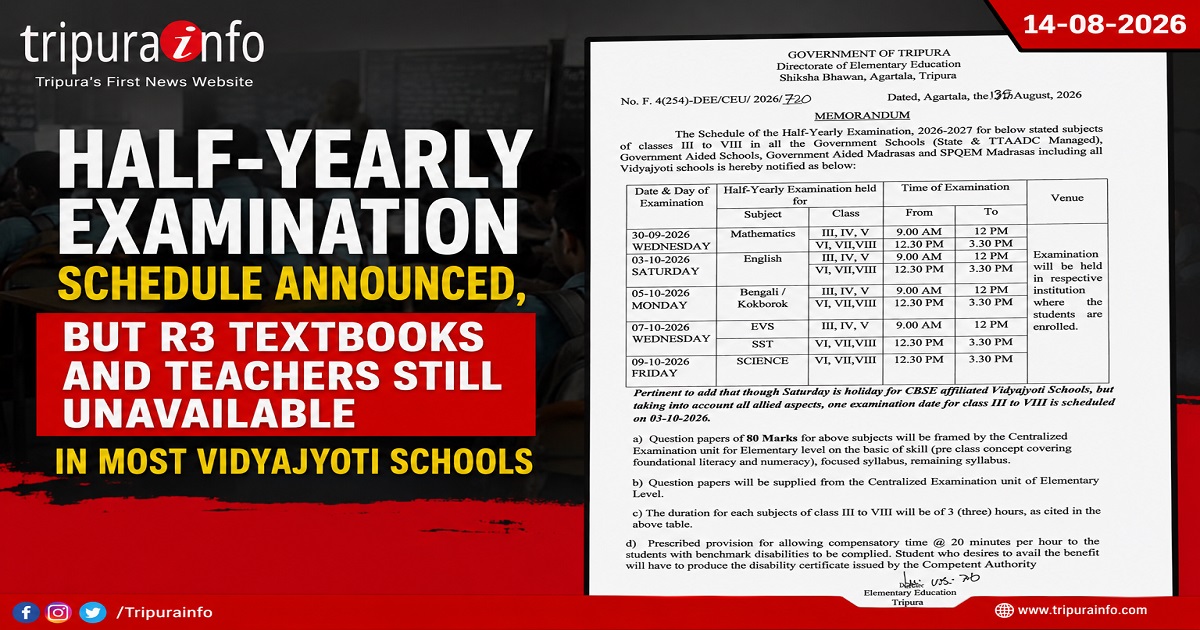 The Directorate of Elementary Education has issued a memorandum dated August 13, 2026, notifying the schedule for the 2026–27 Half-Yearly Examination for Classes III to VIII in Government schools, TTAADC-managed schools, Government-aided schools, Government-aided Madrasas, SPQEM Madrasas and Vidyajyoti schools.
According to the memorandum, the examinations will be conducted from September 30 to October 9, 2026. Mathematics will be held on September 30, English on October 3, Bengali/Kokborok on October 5, EVS for Classes III–V and Social Science for Classes VI–VIII on October 7, followed by Science for Classes VI–VIII on October 9.
The examinations will be held at the respective institutions where the students are enrolled. The Directorate has prescribed three hours for each examination, with Classes III–V appearing from 9 am to 12 noon and Classes VI–VIII from 12.30 pm to 3.30 pm.
The memorandum further states that 80-mark question papers for the prescribed subjects will be prepared by the Centralized Examination Unit at the elementary level, taking into consideration foundational literacy and numeracy concepts, the focused syllabus and the remaining syllabus. The centrally prepared question papers are intended to ensure uniformity in the assessment process across government and aided schools.
However, the announcement of the half-yearly examination schedule has added another dimension to the growing concerns surrounding the implementation of the new three-language curriculum and R3 (third-language) system in Tripura’s Vidyajyoti schools.
While the Education Department has already started the process of collecting school-wise information regarding the choice of R3 language, student enrolment and textbook requirements, textbooks for the newly introduced curriculum are reportedly still unavailable in most Vidyajyoti schools. More significantly, questions have also been raised over the availability of adequately trained teachers to teach the newly introduced third-language subjects.
The 2026–27 academic session began in April, but the process of determining the language requirements and arranging the necessary textbooks has only now reached the stage of collecting detailed information from schools. This has raised concerns among teachers and parents over how students are expected to properly learn a new subject when the prescribed learning materials and, in several schools, dedicated teachers are yet to be made available.
The timing becomes particularly significant as the first half of the academic session is already approaching its examination phase. Schools are now preparing for the half-yearly examinations scheduled from the end of September, even as the infrastructure required for implementing the new R3 curriculum remains incomplete.
Another concern is that the newly notified half-yearly examination schedule does not mention R3 as a separate examination subject. This has prompted questions about how the newly introduced third-language component is being integrated into the academic and assessment system, particularly for Class VI students who are entering the R3 framework for the first time.
The issue is not merely about the non-availability of textbooks. The introduction of a new curriculum requires a coordinated process involving language selection, preparation and supply of textbooks, identification of teachers, teacher training, classroom instruction and assessment. If these elements are not put in place simultaneously, students may face difficulties in receiving adequate instructional time during the academic session.
The Education Department has reportedly indicated that arrangements are being made for the supply of R3 textbooks and for capacity-building and training programmes for teachers. But with the half-yearly examinations already scheduled, the question remains whether these arrangements will be completed in sufficient time to ensure meaningful classroom teaching.
The situation has therefore raised a broader question over the preparedness of the Education Department, if the implementation of the new three-language curriculum was planned for the 2026–27 academic session, why were textbooks, teacher deployment and training not completed before the session began in April?
With the half-yearly examination schedule now officially announced, the pressure on the department has increased. Students cannot be expected to perform effectively in a new curriculum without timely access to textbooks and trained teachers.
more news...