Ten Electric Buses Planned for Agartala Before Durga Puja, But Questions Remain Over Earlier Unfulfilled Smart-City Promises
By Our Correspondent
Agartala, August 14, 2026
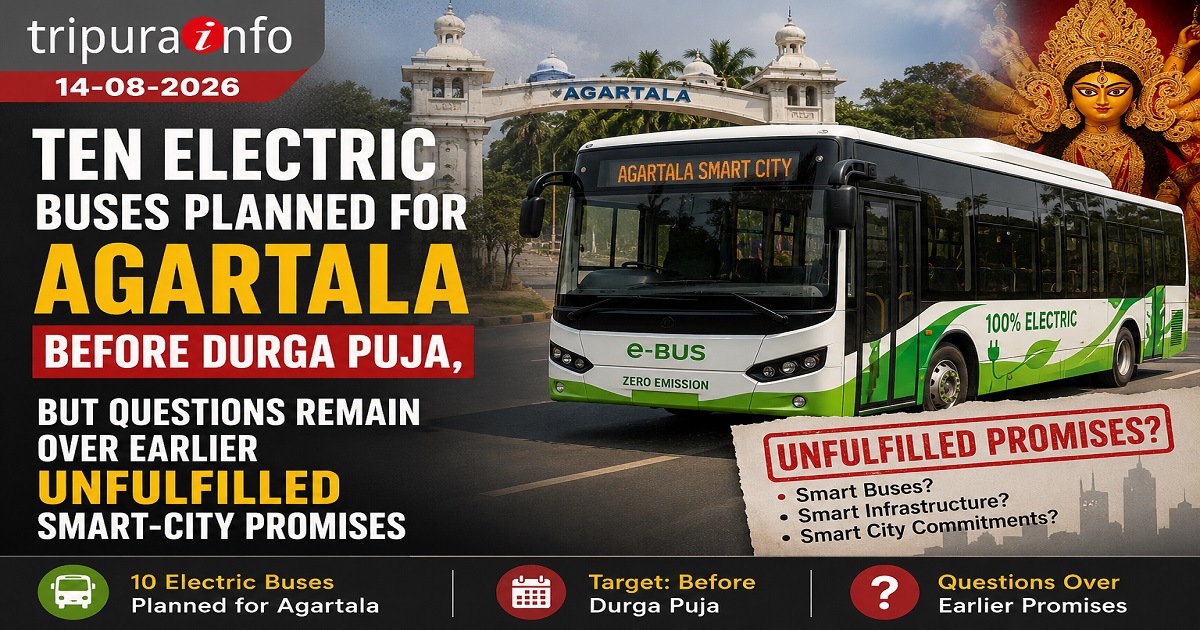 The Tripura Government is preparing to introduce 10 electric buses in Agartala before Durga Puja, marking another attempt to modernise the capital city's public transport system and promote cleaner urban mobility. According to the report, the initiative is being implemented with assistance from the Asian Development Bank (ADB), with the tendering process already underway and bids scheduled to open on August 21, 2026.
The proposed electric bus service is part of the ADB-funded Roads and Mobility project. In the first phase, 10 electric buses, each measuring around nine metres in length, are proposed to be procured along with the necessary charging infrastructure. The buses are planned to operate primarily within a radius of around 10–12 kilometres, covering important areas of Agartala and strengthening the city's public transport network.
Urban Development Department Secretary Dr. Milind Ramteke, according to the report, announced that the tendering process had already commenced with assistance from the Asian Development Bank. The authorities are reportedly aiming to have the buses operational before the upcoming Durga Puja, when passenger movement across Agartala increases substantially.
The project is being projected as a step towards creating a cleaner, more affordable and environmentally friendly public transport system in the capital. The government has also proposed integrating eco-friendly public transport with the ongoing urban road and infrastructure development programme.
However, the latest announcement has also brought back questions about several earlier promises made regarding Agartala's urban transport and civic infrastructure.
This is not the first time that the introduction of electric buses in Tripura has been announced. On an earlier occasion too, plans were announced to operate electric buses in the state, but the service ultimately did not materialise as expected. As a result, sections of the public are now waiting to see whether the latest announcement will actually translate into buses operating on city roads before the festival season.
Questions have also been raised over passenger information systems installed at several bus shelters in Agartala. These shelters were reportedly developed with the expectation that commuters would be able to see online information about when buses were expected to arrive at particular stops. However, commuters have complained that the promised real-time or online bus arrival information system has not become functional in the manner originally envisaged.
Similarly, announcements had earlier been made regarding the introduction of free Wi-Fi facilities at some crowded and important locations in Agartala. Despite those announcements, there has been little visible evidence of such facilities becoming widely operational, according to residents familiar with the city's civic infrastructure.
The issue of digital connectivity is not limited to public Wi-Fi. Even basic digital payment facilities continue to create problems at several markets in Agartala. Traders and customers frequently face difficulties with online money transfers, particularly during busy periods or when network connectivity becomes unstable. For a city being projected as a modern, technologydriven urban centre, residents argue that reliable digital infrastructure should be treated as an essential component rather than an additional facility.
Questions have also emerged over the maintenance of several parks that have undergone renovation at substantial public expenditure. While crores of rupees have reportedly been spent on developing or upgrading a number of parks in and around Agartala, residents have pointed out that regular cleaning and maintenance are not always visible. Newly developed civic assets, they argue, can lose their value quickly if adequate arrangements are not made for their day-to-day upkeep.
The proposed electric bus project therefore comes at a time when expectations are high regarding the modernisation of Agartala. The introduction of 10 electric buses could certainly provide a cleaner and more sustainable alternative to conventional public transport, particularly if the service is reliable, affordable and properly integrated with existing routes.
At the same time, residents and commuters are likely to judge the initiative not merely by the procurement of buses, but by whether the entire system functions effectively. This would include operational bus routes, charging infrastructure, regular maintenance, passenger information systems, reliable digital connectivity and proper upkeep of related urban facilities.
For Agartala, the real test will therefore begin after the inauguration. If the latest electric bus plan is implemented on schedule and supported by dependable infrastructure and maintenance, it could become an important step towards modernising public transport in the capital.
more news...