Agartala Nandanagar Eviction Drive Sparks Social and Political Debate Ahead of Crucial Supreme Court Proceedings
By Our Correspondent
Agartala, August 13, 2026
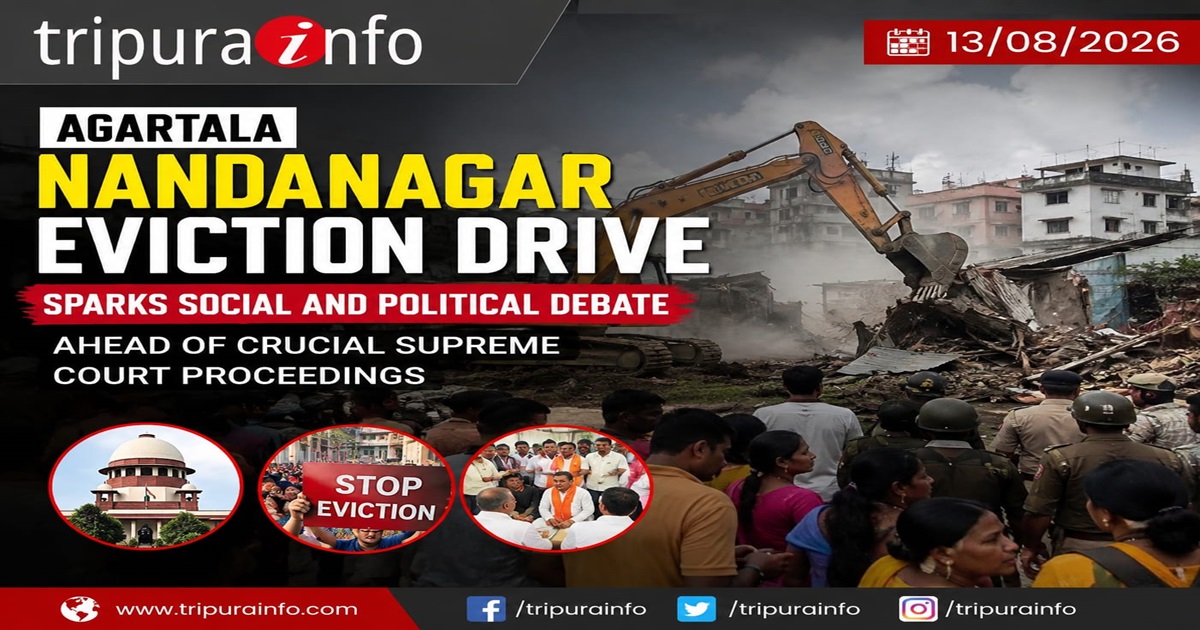 The ongoing eviction drive against alleged footpath encroachments in Agartalas Nandanagar has triggered an intense civic, social and political debate, with photographs and videos of the operations spreading rapidly across Facebook, X and local social-media groups. The Agartala Municipal Corporation (AMC) began its large-scale drive in commercial areas from August 8, with the operation continuing at Nandanagar on August 12.
While many residents have welcomed the move, arguing that pedestrians have long been forced onto busy roads because of encroachments, roadside vending, parked vehicles and other obstructions, concern has also been raised over the livelihood of small traders and street vendors who depend on daily vending.
The Nandanagar operation has given the controversy an additional tribal dimension. Several temporary stalls were reportedly dismantled on government vacant land opposite Don Bosco School. According to local accounts, many vendors, including women from economically vulnerable tribal families, come from tribal-dominated areas, sell vegetables, fried snacks and other items during the day and leave at night.
The incident has generated concern among sections of the tribal community over the alleged conduct of some municipal employees and police personnel. Videos and photographs circulated online have prompted demands for an impartial examination of the incident rather than conclusions based solely on social-media narratives.
TTAADC Chief Executive Member Suhel Debbarma and senior TIPRA Motha leader Rajeshwar Debbarma have expressed concern and called for restraint and an impartial examination. A senior TIPRA Motha legislator has also reportedly objected to aspects of the Nandanagar eviction. While critics have accused TIPRA Motha of attempting to derive political mileage from the incident, party supporters and sections of the tribal intelligentsia maintain that raising concerns over the treatment of vulnerable tribal vendors is a legitimate responsibility of political representatives.
Tribal educationist and social activist Dr. Sunil Kalai has separately appealed to Chief Minister Prof. Dr. Manik Saha to intervene and prevent the issue from becoming a source of social or communal tension. Dr. Kalai has urged authorities to examine available video footage impartially and has advocated a rehabilitation-oriented approach, including designated vending zones, basic market infrastructure and livelihood support for eligible vendors.
The controversy comes amid the Supreme Court’s landmark June 19, 2026 judgment in Maniyar Iliyaz @ Shaik Riyaz & Anr. v. P. Ayyappan & Ors., delivered by Justice P.S. Narasimha and Justice Atul S. Chandurkar, which recognised the right to walk on safe, demarcated footpaths as a fundamental right.
The Court held that pedestrian access to demarcated footpaths has priority over motorised movement and placed corresponding duties on municipal corporations, municipalities, panchayats and other authorities to provide and protect pedestrian infrastructure. The matter was subsequently taken forward under the title “Re: Fundamental Right to Walk and Footpath.”
On August 3, a Bench comprising Justice PS Narasimha and Justice Alok Aradhe directed authorities to ensure clearly demarcated, encroachment-free pedestrian spaces. Additional Solicitor General KM Nataraj was asked to communicate the Court’s concerns to the appropriate authorities.
The distinction between the two Benches is important: the June 19 judgment was delivered by Justice PS Narasimha and Justice Atul S Chandurkar, while the August 3 proceedings were before Justice PS Narasimha and Justice Alok Aradhe.
Against this legal backdrop, the August 17 Supreme Court proceedings are being closely watched in Tripura. The larger question is no longer simply whether the AMC should remove encroachments, but how Agartala can ensure unobstructed pedestrian space while protecting the lawful livelihood interests of vulnerable vendors.
For Agartala, the real test will be whether enforcement can be combined with transparent demarcation, regulated vending and humane rehabilitation. Footpaths must remain available to pedestrians, but displaced vendors also need lawful alternatives if the city is to avoid a continuing cycle of eviction and reoccupation.
The administration, political parties, vendors, community leaders and citizens have therefore been urged to exercise restraint and avoid provocative or unverified social-media campaigns. The Nandanagar episode has demonstrated that a municipal enforcement operation can quickly become a wider political and social issue.
Ultimately, the challenge before Agartala is to protect the constitutional right to walk without unnecessarily destroying livelihoods, while ensuring that political intervention does not turn a civic regulation issue into a wider social confrontation. A balanced approach based on law, transparency, dialogue, dignity and rehabilitation could provide the most sustainable way forward.
more news...