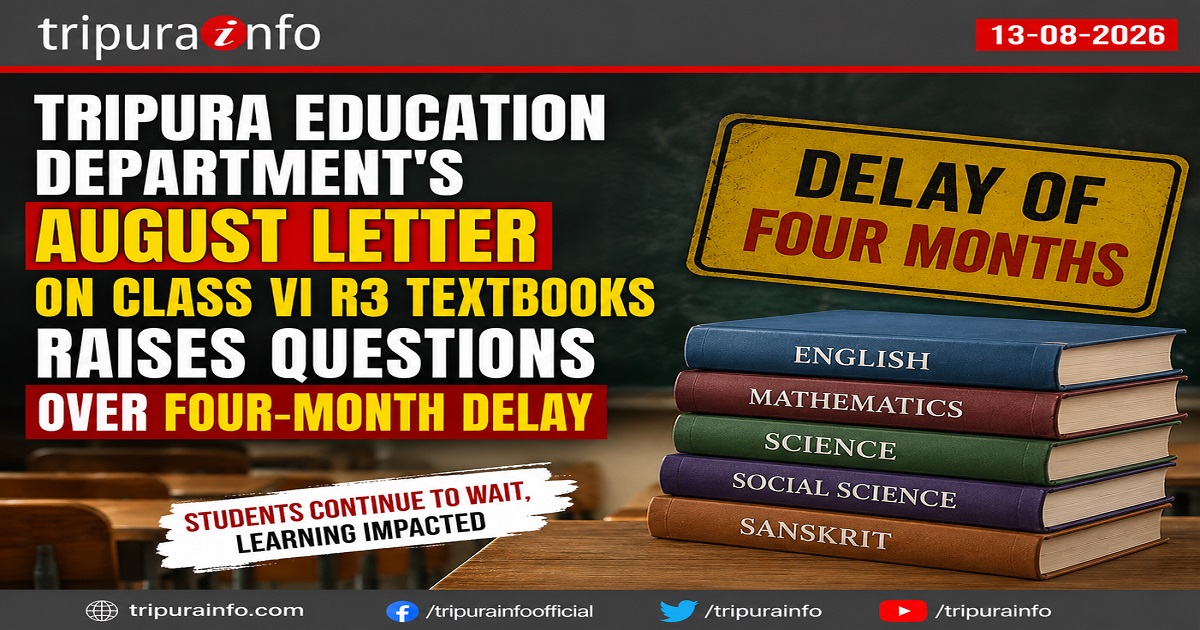
Tripura Education Department’s August Letter on Class VI R3 Textbooks Raises Questions Over Four-Month Delay
By Our Correspondent
Agartala, August 13, 2026
 A letter issued by the Directorate of Secondary Education in August has raised serious questions over the preparedness of Tripura’s education authorities to implement the CBSE Three-Language Policy in the state’s government Vidyajyoti schools.
The letter, issued by the Directorate of Secondary Education to the Director of the State Council of Educational Research and Training (SCERT), Tripura, seeks the collection of requisitions for R3 Language textbooks and their timely supply for students of Class VI onwards under the CBSE Three-Language Policy for the academic session 2026-27.
The letter, bearing No. F.25(9-5)/SE/VJ/2023/105 and signed by Under Secretary to the Government of Tripura Amit Ray Chaudhuri, TCS, is dated August 11, 2026. It refers to an earlier memorandum dated August 3 regarding implementation of the CBSE Three-Language Policy from the academic session 2026-27.
The timing of the communication has triggered criticism, as the academic session 2026-27 commenced in April. The latest correspondence indicates that even several months after the beginning of the academic year, the process of collecting requirements and arranging the R3 language textbooks is still being initiated.
According to the letter, SCERT has been requested to start collecting requisitions for R3 Language textbooks from all 125 CBSE-affiliated Government Vidyajyoti Schools, using the existing mechanism adopted for collecting textbook requirements from schools. However, this process is to begin only after individual schools complete the selection of their R3 language in accordance with the government memorandum and CBSE guidelines.
The letter further asks SCERT to take necessary action for the printing/procurement and timely distribution of CBSE-prescribed R3 language textbooks to the concerned schools at the earliest, so that the teaching-learning process is not disrupted, although it is allegedly already disrupted.
The Secondary education department letter also said that the process is not limited merely to printing books. The Directorate has also asked SCERT to coordinate with the Directorate of Kokborok & Other Minority Languages to ensure the availability and supply of textbooks in R3 languages, including Kokborok, Mizo and other applicable languages, in accordance with CBSE guidelines.
This means that the authorities would first have to ascertain the language selected by each school, collect enrolment and textbook requirements, coordinate for preparation or availability of the prescribed books, complete the procurement or printing process and subsequently distribute the books to the schools.
The Directorate has also asked SCERT to organise capacity-building and training programmes for teachers assigned to teach the R3 languages, with the objective of improving their pedagogical skills and ensuring effective implementation of the CBSE Three-Language Policy in the Vidyajyoti schools.
The sequence outlined in the letter has raised concerns among sections of the education community over whether students have already lost valuable instructional time because of the delayed preparation.
Questions are also being raised over administrative accountability. If the Three-Language Policy was scheduled for implementation from the academic session 2026-27, critics argue that the exercise of identifying languages, assessing student enrolment, estimating textbook requirements, arranging the prescribed books and preparing teachers should ideally have been completed before the academic session began.
Instead, the official correspondence in August indicates that an important part of the textbook-supply mechanism is still at the requisition and procurement stage.
The issue has therefore become a matter not only of textbook availability but also of planning and institutional preparedness. Teachers and students may face difficulties if the required R3 textbooks are not supplied promptly, particularly when classroom teaching is already well underway.
The controversy has also brought broader questions about the implementation of the revised CBSE curriculum in the state. Critics allege that adequate preparations for other components of the new curriculum, including technical and vocational education, related infrastructure and deployment of suitably trained teachers, have also not been visible at the required pace.
There are also allegations that instead of strengthening the permanent academic and teaching infrastructure, the education system is relying heavily on existing local teachers while outside NGOs and agencies are being engaged primarily for database-related exercises. These allegations, however, the August letter itself, meanwhile, provides a clear indication that the government machinery still has several steps to complete before R3 textbooks can reach students- school-wise language selection, collection of requisitions, coordination with the minority-language directorate, printing or procurement, distribution and teacher capacity-building.
With the 2026-27 academic session already several months old, the immediate question now is when the R3 textbooks will actually reach the 125 Vidyajyoti schools and whether students will receive them in time to avoid further disruption to classroom teaching.
The delay has consequently intensified concerns over the preparedness and accountability of the education administration in implementing the CBSE’s Three-Language Policy in Tripura.
more news...