Tripura Cabinet Removes PRTC Requirement for State Government Jobs, Five-Year Study Rule for Non-Residents
By Our Correspondent
Agartala, August 12, 2026
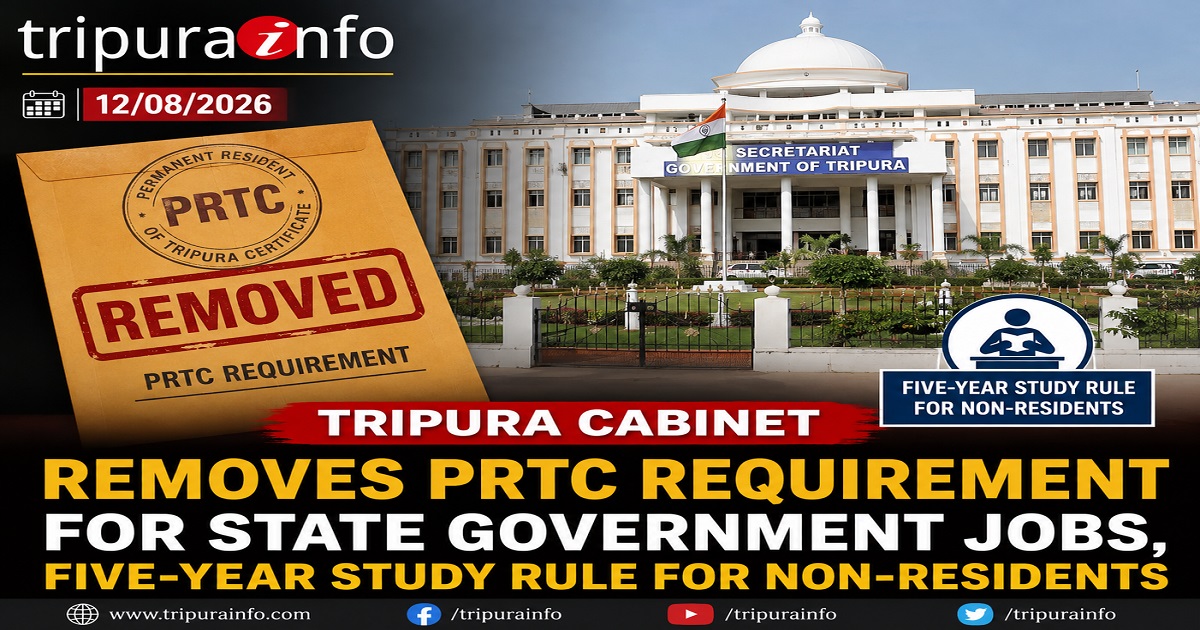 In a significant decision concerning recruitment to Tripura government jobs, the State Cabinet has decided to withdraw the requirement of producing a Permanent Resident of Tripura Certificate (PRTC) for government employment, Cabinet spokesperson and Minister Sushanta Chowdhury said at a press conference.
According to the new policy, candidates from outside Tripura seeking government employment in the state will have to establish a connection with Tripura by having studied continuously for five years in schools, colleges or universities in the state. The decision was reportedly taken in the wake of a case involving a person from outside the state and the subsequent legal position emerging from the Tripura High Court.
The Cabinet's decision has nevertheless raised a larger debate over the protection of employment opportunities for local youths. The PRTC requirement had traditionally functioned as an important eligibility condition for a number of direct-recruitment posts in Tripura. Government recruitment rules and recent recruitment notifications have specifically required PRTC for several posts.
The latest decision means that the eligibility framework for state government recruitment is set to undergo a significant change. Instead of relying on PRTC as the principal proof of permanent residence, the government will now use the five-year educational criterion for candidates coming from outside Tripura.
The development is particularly significant because the Tripura High Court's recent decisions have already had an impact on several aspects of the state's recruitment policies. In one 2026 case, the High Court considered the eligibility requirements of a candidate who could not establish permanent residence in Tripura through a PRTC and upheld the recruitment authority's decision in that particular matter.
The State Government's decision not to pursue the matter further before the Supreme Court, but instead to retain the legal position arising from the High Court proceedings, has also become a point of discussion among sections of the state's unemployed youth.
The controversy is not merely about the PRTC certificate. It raises a broader question about whether Tripura's local candidates receive adequate protection in state-level recruitment when compared with employment eligibility systems followed in several other states.
In a number of states, recruitment rules for certain categories of government employment impose additional eligibility requirements linked to local residence, knowledge of the state's official or regional language, or other state-specific conditions. Such provisions are generally designed to ensure that certain public employment opportunities remain accessible to people with a substantial connection to the state.
Tripura too has provisions requiring local eligibility or knowledge of Bengali or Kokborok in particular recruitment processes. Recent recruitment advertisements have, for example, required candidates to be permanent residents of Tripura and to possess PRTC for certain posts, while knowledge of Bengali or Kokborok has been prescribed as a desirable qualification in some cases.
This has now triggered questions about how the new policy will operate, particularly for Group C and Group D posts. If the PRTC requirement is withdrawn, unemployed candidates from outside Tripura could potentially seek eligibility for state government recruitment unless the respective Recruitment Rules or recruitment notifications contain additional restrictions.
The crucial issue, therefore, will be the exact wording of the revised Recruitment Rules and future recruitment advertisements. The Cabinet's broad policy decision alone may not automatically determine eligibility for every category of post. Individual departments may have specific service rules, qualifications and recruitment conditions.
The change is also likely to generate considerable discussion among Tripura's unemployed youth, who have long argued that limited government employment opportunities in the state should primarily benefit candidates who have grown up and studied in Tripura.
At the same time, the five-year education condition could provide the government with a mechanism to distinguish between candidates who merely seek employment in Tripura and those who have spent a substantial part of their educational life in the state.
The immediate question, however, remains whether the new system will adequately protect local employment interests. With PRTC no longer serving as the mandatory requirement, unemployed youths and recruitment aspirants are expected to closely examine upcoming notifications for Group C, Group D and other state government posts to determine whether candidates from outside Tripura will be permitted to apply and, if so, what additional eligibility conditions will apply.
The Cabinet's decision has therefore opened a new chapter in Tripura's government recruitment policy—one that could have far-reaching consequences for both local job seekers and candidates from outside the state.
more news...