Former BJP President Ranajay Deb Steps Up Attack on Tripura Power Tariff, Says Public Will Give Answer in 2028 Assembly Poll
By Our Correspondent
Agartala, August 12, 2026
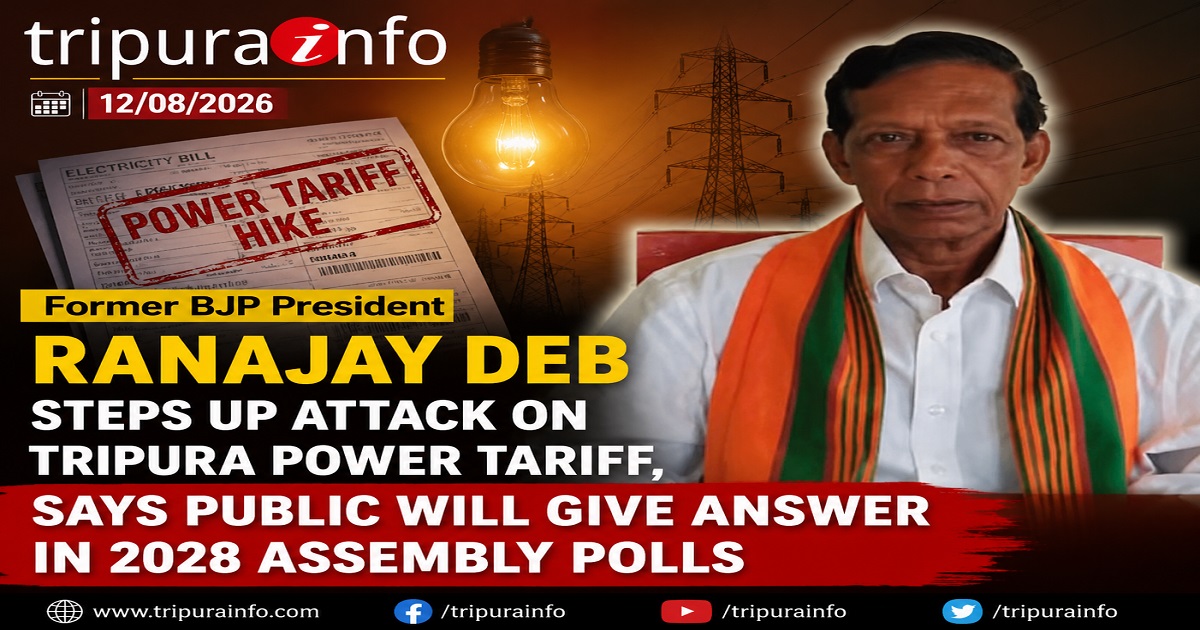 Former Tripura BJP State President Ranajay Deb has launched a sharp attack on the state government over the electricity billing system and the recently implemented power tariff structure, directly targeting Power Minister Ratan Lal Nath and the BJP-led government.
In a strongly worded social media post on Wednesday, Deb said the controversy over electricity bills would not go away and warned that the issue could have political consequences in the 2028 Tripura Assembly elections.
Deb questioned what he described as differing explanations being offered by Power Minister Ratan Lal Nath regarding the electricity billing system. According to Deb, the Minister had recently attributed problems to server issues, while subsequently stating that the introduction of smart meters had begun during the Left Front government.
“Whatever is being said at different times has no connection with reality,” Deb alleged, arguing that consumers are more aware than politicians may assume. He claimed that people are expressing dissatisfaction over electricity bills and road conditions in markets, rural areas and public gatherings.
Deb further claimed that the criticism was not confined to ordinary consumers and that sections of intellectuals and even people associated with the ruling party were also unhappy over the two issues. He described electricity bills and roads as major areas of alleged government failure and said the government could not resolve the public's concerns merely through explanations.
The former BJP state president also made a direct appeal to Ratan Lal Nath to publicly explain the different components appearing on electricity bills, particularly fixed charges, duty charges and fuel charges.
He questioned why consumers should bear fuel-related exta fixed charges if such costs were supposedly already covered through the unit-based electricity charge. He also asked the government to clarify the exact nature of the duty imposed on consumers and whether it represents GST or another form of tax.
Deb demanded that the Power Minister place the details before the public transparently, including whether such charges were reflected in the state Budget and under what regulatory or policy framework they were being collected.
He further alleged that the government could not remain in office for a long period by relying on what he described as misleading explanations. Deb warned that the electricity issue could become a significant political question ahead of the 2028 Assembly elections.
In another politically charged part of his statement, Deb criticised the changing political composition of the BJP in Tripura. He alleged that leaders who had previously been associated with other political parties had entered the BJP and that the process had weakened the party's original organisational identity and ideology in the state.
He particularly criticised what he described as the growing influence of leaders with Congress or Trinamool Congress backgrounds, alleging that long-time BJP workers who had made sacrifices for the party were being sidelined.
“Those who sacrificed everything for the party are now being asked who they are,” Deb alleged, arguing that political leaders who rely heavily on self-promotion through newspapers and social media while imposing additional financial burdens on ordinary people cannot expect governments to remain popular indefinitely.
His comments add to growing political criticism surrounding electricity bills and TSECL's tariff structure in Tripura. Earlier, former BJP MLA Dr Dilip Das had also criticised the power tariff policy and raised questions over the burden being placed on consumers.
The electricity tariff issue has also drawn criticism from the opposition CPIMand Congress. In June, the Tripura Pradesh Congress Committee alleged that consumers were facing increased fixed and fuel charges and demanded withdrawal of what it termed a clandestine hike in power tariffs. The Congress claimed that consumers had recently seen increases of around Rs 70–75 in fixed charges and Rs 200–250 in fuel charges.
The controversy therefore appears to be developing into a broader political debate over electricity pricing, smart meters, billing transparency and the financial burden on consumers.
Deb's latest statement is significant because it comes from within the BJP's own former state leadership and frames the electricity issue not merely as an administrative or technical matter, but as a potential electoral issue for the ruling party.
The former BJP state president's remarks, however, constitute political allegations and demands for clarification, the government and TSECL's detailed response to each of the issues raised by him would be necessary to establish the factual position regarding the individual components of consumers' electricity bills.
With electricity costs directly affecting households, commercial establishments, businesses and small business consumers across the state, the demand for a transparent public explanation of fixed charges, fuel charges, duty and other billing components is likely to remain an important issue in Tripura's political discourse in the coming months.
more news...