Tripura High Court Refuses to Quash FIRs Against Content Creator Madhabi Biswas, Orders Further Investigation
By Our Correspondent
Agartala, August 12, 2026
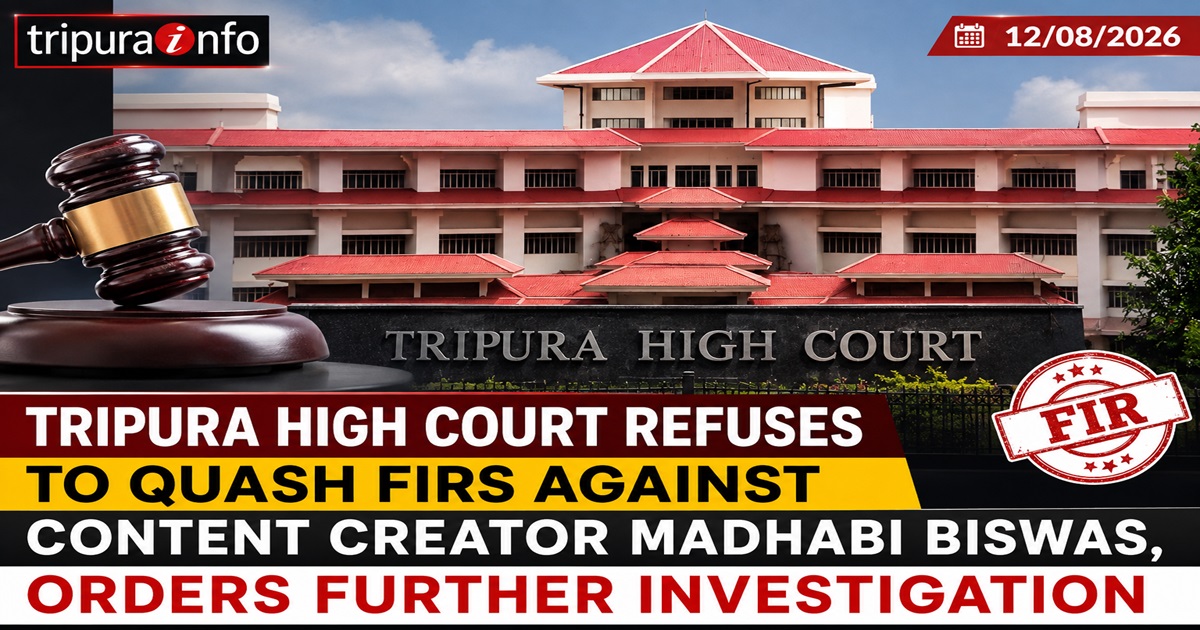 The High Court of Tripura has refused to quash two FIRs and the corresponding charge-sheets registered against content creator Madhabi Biswas Chakraborty alias Madhavi Biswas Chakraborty alias Moon Moon Biswas, observing that the allegations made against her prima facie require further examination at the trial stage. The Division Bench directed the Investigating Officer to conduct further investigation and submit a supplementary charge-sheet before the trial court.
The judgment was delivered on August 12, 2026, by a Division Bench comprising Justice Dr. T Amarnath Goud and Justice S Datta Purkayastha in W.P.(Crl.) Nos. 8/2026 and 9/2026. The petitions were heard together because they involved common questions of law and facts. The matter was heard on August 5, 2026, and the judgment has been marked fit for reporting.
The petitioner, Madhabi Biswas Chakraborty alias Madhavi Biswas Chakraborty alias Moon Moon Biswas, daughter of Ratan Biswas and Usha Rani Biswas of Jogendranagar, Agartala, had approached the High Court seeking quashing of the FIRs registered in East Agartala Police Station Case No. 2025 EAG 108 and West Agartala Police Station Case No. 2025 EAG 113. She also challenged the charge-sheets dated December 29, 2025 and December 31, 2025, respectively. The FIRs were registered under Sections 356, 356(2) and 356(3) of the Bharatiya Nyaya Sanhita, 2023, along with Section 67 of the Information Technology Act, 2000.
The State of Tripura was represented before the High Court by Public Prosecutor Raju Datta, while the petitioner was represented by Senior Advocate P Roy Barman and Advocate T Dhar. The respondents included the State of Tripura, represented by the Public Prosecutor, and the respective Investigating Officers of East Agartala and West Agartala Police Stations.
According to the judgment, the cases originated from complaints lodged against the petitioner, who was described as a content creator. The complaints alleged that she had used abusive, derogatory and critical language concerning the Prime Minister of India, allegedly with an intention to malign him. The complaints further alleged that she had used objectionable words concerning the Mayor of Agartala and Mata Tripureswari. Based on those complaints, the two FIRs were registered against her.
The petitioner was arrested in connection with the allegations. She was subsequently released on interim bail by an order of the High Court dated January 7, 2026. Charge-sheets were later submitted in both cases. The Investigating Officer had also sought custodial interrogation, but the trial court rejected that prayer on January 27, 2026. Thereafter, on February 13, 2026, the petitioner was enlarged on permanent bail.
The judgment records that further complaints were subsequently lodged alleging that, after being released on bail, the petitioner had threatened the complainant to withdraw the complaint. The petitioner, however, claimed that she herself had approached the authorities on April 15, 2026, alleging that her house had been ransacked and that she and her son had been brutally assaulted. She also alleged that her complaint had not been registered, while FIRs had been registered against her without sufficient material evidence.
Petitioner's Arguments
Senior Advocate P Roy Barman, appearing for Madhabi Biswas Chakraborty, argued that the allegations in the complaints did not satisfy the ingredients required to constitute an offence under Sections 356, 356(2) and 356(3) of the BNS. According to the petitioner’s counsel, she had merely expressed her opinions and had not made defamatory statements against the Prime Minister, the Mayor or Mata Tripureswari.
The petitioner's counsel further alleged that the complaints were motivated by political considerations and that statements recorded during the investigation under Section 180 of the BNSS were omnibus in nature and failed to establish the ingredients of defamation.
It was also argued that because the ingredients of Section 356(2) had not been established, Section 67 of the IT Act could not be sustained in the present case. The defence contended that the investigation was perfunctory and politically motivated and that the charge-sheets did not identify precise evidence, the petitioner's specific role or material facts sufficient to sustain the allegations.
Mr. Roy Barman further relied on the petitioner's constitutional right to freedom of speech and expression under Article 19(1)(a), arguing that her statements were made in good faith and were protected by the exceptions contained in Section 356 of the BNS. He also argued that the FIRs were vague, did not disclose a cognizable offence and that continuing the criminal proceedings amounted to an abuse of the process of law.
In support of the plea for quashing, the petitioner's counsel relied upon Supreme Court decisions including Rajendra Bihari Lal and another vs. State of Uttar Pradesh & others, Imran Pratapgadhi vs. State of Gujarat and another, and State of Haryana vs. Bhajan Lal.
State's Opposition
Public Prosecutor Raju Datta, appearing for the State, opposed the petitions and argued that the petitioner had intentionally used derogatory words against the Prime Minister with an intention to defame him globally.
The State argued that freedom of speech under Article 19 is subject to constitutionally permissible restrictions and that, during the investigation, the Investigating Officer had found prima facie material supporting the offences before submitting the charge-sheets. The Public Prosecutor contended that once the charge-sheets had been filed and specific cases had been registered, quashing the proceedings at that stage would amount to an abuse of the judicial process.
The State also alleged that the petitioner had deliberately hurt the sentiments of people in Tripura through derogatory remarks concerning Mata Tripureswari and argued that the allegations and evidence should be tested during a full trial rather than being terminated at the threshold.
The prosecution further submitted that the petitioner had repeatedly made derogatory statements against the Prime Minister and other political dignitaries and that these allegations required adjudication through the trial process. The State also explained that arrangements made during the Prime Minister's visit to Tripura, including floral decoration, security and other protocol-related arrangements, were necessary because of the nature of the visit. The prosecution relied on Supreme Court decisions including Abhishek Singh vs. Ajay Kumar and others and Somjeet Mallick vs. State of Jharkhand and others.
Justice Dr. T Amarnath Goud, who authored the judgment, observed that social media has become an integral part of modern life and is extensively used for communication, information-sharing and interaction. The Court noted that false information can spread rapidly through social media and potentially cause significant damage to a person's reputation.
The Bench observed that the allegations in the FIR indicated that the petitioner had allegedly used derogatory words concerning the Prime Minister and the Mayor with an intention to defame them globally. According to the judgment, some of the statements allegedly mocked their names and surnames and, to some extent, hurt the sentiments of people who worship Mata Tripureswari. The Court held that such statements, if established, could constitute defamation and that the complainants retained their right to pursue a defamation claim.
At the same time, the Court emphasised that the cases were still at an early stage. The Bench noted that witness statements under Section 180 BNSS had been recorded and were apparently corroborative in nature. The Investigating Officer had seized the petitioner's mobile phone, but the relevant video clips or screen recordings had not yet been recovered. The IO had sought time to produce the videos before the trial court.
The High Court therefore held that the investigation had not been fully completed and pointed out that Section 193(9) of the BNSS permits the investigating agency to conduct further investigation and place additional documentary evidence before the trial court through a supplementary charge-sheet.
The Court discussed the relationship between freedom of speech and the protection of reputation. It observed that Section 356 of the BNS deals with criminal defamation involving words, signs or visible representations intended or known to harm a person's reputation.
The judgment stated that freedom of speech is a fundamental right but does not extend to defamatory, abusive or malicious content. The Court also noted that whether a particular statement is defamatory can involve an assessment of how the alleged statement was understood by people who heard or read it.
The Bench stressed that the proceedings were at the stage of appearance and supply of the accused's copy and therefore remained at a nascent stage.
The High Court relied on the established principle that, while considering a petition seeking quashing of an FIR or criminal proceeding at the threshold, the Court is required to determine whether the allegations, taken at face value, disclose a prima facie offence. It is not supposed to conduct a mini-trial or undertake detailed appreciation of evidence at that stage.
The Court referred to the Supreme Court's observations in Abhishek Singh, Somjeet Mallick, State through Central Bureau of Investigation vs. Hemendhra Reddy, and other decisions concerning the scope of further investigation and the High Court's power to quash criminal proceedings.
The Bench also considered the legal position concerning further investigation after filing of a charge-sheet. It noted that further investigation is a continuation of the earlier investigation and is distinct from fresh investigation or reinvestigation. The Court relied on Supreme Court precedents explaining that the investigating agency can continue investigating where additional evidence is required to arrive at the truth and ensure substantial justice.
The judgment further noted that the mere possibility of delay in the conclusion of a trial should not prevent further investigation where such investigation may assist the Court in arriving at the truth and securing effective justice.
In its final order, the Division Bench of the High Court of Tripura declined to quash the two FIRs and the charge-sheets at this stage.
Accordingly, the writ petitions filed by Madhabi Biswas Chakraborty were dismissed to that extent. However, the Court directed the Investigating Officer to conduct further investigation and file a supplementary charge-sheet under Section 193(9) of the BNSS before the trial court.
The High Court made it clear that after receiving the supplementary charge-sheet, the trial court shall proceed in accordance with law. The petitioner has also been granted liberty to raise her contentions before the trial court.
Any pending applications were also disposed of. The judgment was signed by Justice S Datta Purkayastha and Justice Dr. T Amarnath Goud on August 12, 2026.
more news...