TIPRA Motha-BJP Alliance Hinges on Implementation of 2024 Tripartite Accord, Questions Mount Over What Can Actually Be Delivered Before ADC Polls
By Our Correspondent
Agartala, August 12, 2026
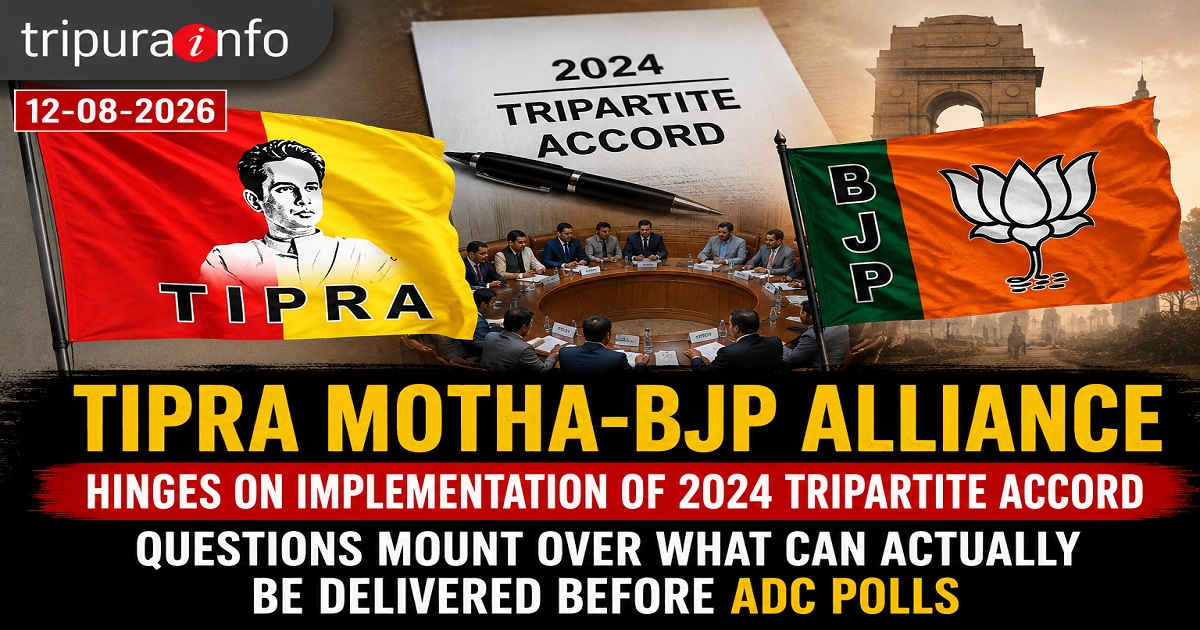 The political negotiations between the TIPRA Motha leadership and the BJP’s central leadership over implementation of the tripartite agreement signed on March 2, 2024, appear to have entered a crucial phase, with the upcoming Tripura Tribal Areas Autonomous District Council (TTAADC) Village Council elections emerging as a major political bargaining point.
TIPRA Motha founder Pradyot Kishore Manikya Debbarma has been holding a series of meetings in New Delhi seeking what he describes as implementation of the commitments made in the tripartite agreement involving the Government of India, the Government of Tripura and TIPRA Motha.
On August 11, a high-level meeting was held in New Delhi in the presence of BJP national president Nitin Nabin, BJP national general secretary (organisation) BL Santosh and party national spokesperson and Northeast coordinator Sambit Patra. Pradyot Kishore Debbarma attended the meeting along with TIPRA Motha MLA Ranjit Debbarma, ministers Brishaketu Debbarma and Purna Chandra Jamatia.
Following the meeting, Pradyot Debbarma made it clear during a Facebook Live that TIPRA Motha would not enter into an alliance with the BJP for the forthcoming ADC Village Council elections if the Tripartite Agreement is not implemented.
He also announced that a meeting of senior TIPRA Motha leaders would be held in Agartala on August 17, following which the party would decide its next political strategy.
Pradyot, however, did not publicly clarify whether the August 11 meeting had produced a concrete breakthrough.
Tipra Motha MLA Ranjit Debbarma, on the other hand, described the meeting as “fruitful” and said the BJP central leadership was keen to do something positive for Tripura’s indigenous communities.
Ranjit also acknowledged that the BJP leadership wants its alliance with TIPRA Motha to continue and would prefer electoral coordination between the two parties in the forthcoming ADC Village Council elections. At the same time, he reiterated that TIPRA Motha would not agree to an electoral understanding unless there was progress on implementation of the Tripartite Agreement.
According to Ranjit Debbarma, the BJP central leadership has indicated that it will examine which provisions of the agreement can be implemented before the ADC elections and take an effective decision shortly.
But this has simultaneously triggered a much larger question among sections of Tripura’s tribal intellectuals, legal experts and political observers: What exactly is there in the March 2, 2024 agreement that can be implemented immediately?
What Does the 2024 Agreement Actually Provide?
The March 2, 2024 tripartite agreement broadly speaks about finding an amicable solution to various issues concerning Tripura’s indigenous population, including history, land rights, political rights, economic development, identity, culture and language.
The agreement also envisages identifying mutually agreed issues and implementing them expeditiously through a Joint Working Committee.
The document released by the Union Ministry of Home Affairs similarly describes the framework for addressing these issues.
However, critics argue that the agreement should not be interpreted as a ready-made “final package” containing a clearly defined list of constitutional, financial or administrative concessions that can simply be implemented through executive orders.
Instead, they argue, the agreement provides a framework for dialogue and settlement of issues.
This has led to a fundamental political question that if the agreement is a framework for negotiations, which specific provisions have already been finalised and are now ready for implementation?
One of the issues being raised is the demand for greater financial and administrative empowerment of the TTAADC.
Critics point out that the 2024 agreement does not specifically state that the ADC will receive direct funding from the Centre.
Similarly, the much-discussed Constitution (125th Amendment) Bill, 2019 is not specifically incorporated into the March 2, 2024 agreement as an implementation commitment.
The Constitution (125th Amendment) Bill was introduced in the Rajya Sabha on February 6, 2019, with proposals concerning provisions relating to the Sixth Schedule and the Finance Commission. The Bill was subsequently referred to a Parliamentary Standing Committee but did not move forward legislatively.
This has created another question that if the demand is for powers beyond those currently available to the ADC under the Sixth Schedule, can such powers be granted merely through an administrative decision, or would constitutional and legislative changes be necessary?
The answer could have significant political implications.
What Does ‘Constitutional Solution’ Mean?
The phrase “constitutional solution” has become one of the most politically significant expressions associated with the TIPRA Motha movement.
But its precise meaning remains unclear to many observers.
What additional powers would the ADC receive? Would these relate to land, finance, administration, employment, policing, education or other subjects? Would existing Sixth Schedule provisions be amended? Would Parliament have to pass legislation? Would a constitutional amendment be required?
These questions have not yet been publicly answered in sufficient detail.
The debate has also extended to education, language, culture and the script of the Kokborok language.
While tribal intellectuals acknowledge that language and cultural rights are fundamental issues, some argue that education and language alone cannot constitute a comprehensive solution to the socio-economic challenges facing Tripura’s indigenous population.
They say that land security must be accompanied by employment, education, healthcare, agriculture, industry, tourism, connectivity, economic opportunities and sustainable livelihoods.
more news...