“Sometimes, Silence Is Wisdom”: IAS Officer Rakhi Biswas Shares Reflective Message on Age, Self-Respect and Inner Peace
By Our Correspondent
Agartala, August 10, 2026
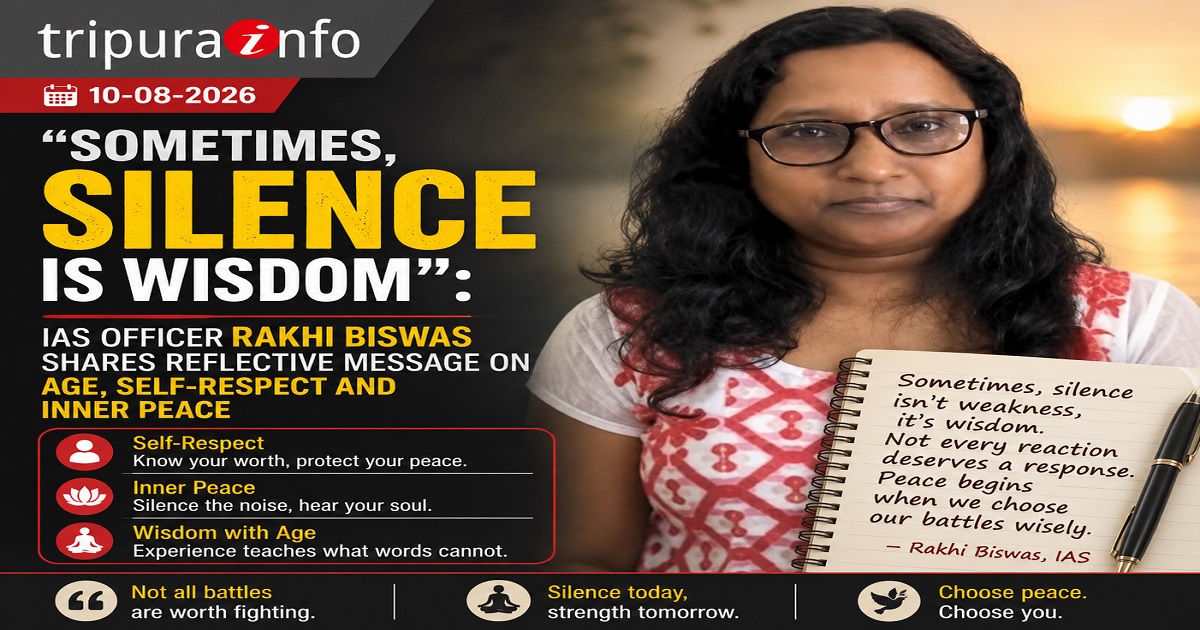 Senior Tripura-cadre IAS officer Rakhi Biswas has shared a deeply reflective message on social media, speaking about how age and experience have gradually changed her approach towards injustice, lies, betrayal, strained relationships and personal conflicts.
Biswas, a 2013-batch IAS officer of the Tripura cadre, was inducted into the IAS from the State Civil Service. She was transferred and posted as Special Secretary to the Government of Tripura in February this year, while continuing to hold responsibilities relating to Small Savings, Group Insurance and Institutional Finance. The Tripura Government’s 2025 official diary also lists her in connection with Small Savings, Group Insurance and Institutional Finance.
In her Facebook post, Biswas said that she has increasingly learned to remain silent when people ignore her, commit injustice, tell lies or betray her. However, she made it clear that such incidents still affect and hurt her, but no longer create the same emotional turmoil within her as they once did.
She recalled that there was a time when she could not remain silent after witnessing wrongdoing. If someone misunderstood her, she would try to explain herself; if someone lied, she would attempt to establish the truth; and when someone hurt her, she would seek an explanation and try to understand what had gone wrong.
According to her, she once believed that conversations could resolve almost every problem, relationships could be saved, misunderstandings could be removed and truth could ultimately defeat falsehood.
But with the passage of time, she said, she has realised that not everything can be fixed, not every relationship can be saved and not everyone can be made to understand one's perspective.
She wrote that there is also little meaning in sacrificing one's own peace by standing against every wrong committed by others.
Reflecting on her present outlook, Biswas said that when someone lies, she now considers the lie to be that person's responsibility. When someone betrays her, she may still feel the pain, but she no longer feels the urge to retaliate. And when someone ignores her, she does not feel the need to stand at that person's door trying to prove her own worth.
Instead, she prefers to quietly walk away.
At the same time, the IAS officer stressed that silence does not mean that injustice ceases to be injustice, a lie ceases to be a lie or betrayal stops hurting. Rather, she suggested that the real change is in refusing to allow someone else's behaviour to destroy one's inner peace.
She described this as perhaps one of the lessons of growing older.
According to Biswas, age does not merely leave its mark on a person's face, hair or body; it also gradually transforms a person's inner outlook. Things that once could ruin an entire night's sleep may eventually become easier to ignore. Similarly, people whose behaviour once had the power to affect an entire day may no longer deserve to occupy the centre of one's life.
She also reflected on the changing need for validation. Earlier, she felt that she had to make others understand her, explain herself and prove that she was right. Now, she believes that it is not her responsibility to explain herself to everyone.
Those who genuinely want to understand her, she suggested, will understand even her silence, while those who do not want to understand cannot necessarily be convinced through endless explanations.
Another important theme of her message was the wisdom of choosing one's battles.
Biswas observed that not every battle needs to be fought in order to be won. Sometimes avoiding a confrontation can itself be an act of wisdom. Not responding to certain people can itself be an answer, while quietly walking away from some relationships can represent self-respect.
She said that there can also be considerable strength in choosing not to speak.
The officer further rejected the idea that silence should automatically be viewed as weakness. Instead, she described silence as something that can protect a person's mental peace by preventing unnecessary emotional turmoil and freeing them from the constant strain of relationships that no longer contribute positively to their lives.
Her message also touched upon the changing priorities that come with age. She suggested that as people grow older, the ability to remain peaceful despite losing certain things may become more important than the desire to possess everything.
Questions such as who stayed, who left, who loved, who ignored, who spoke the truth and who lied, she suggested, gradually lose their importance.
Life, she reflected, is already short enough that it is unnecessary to answer every word, fight every injustice or drag every relationship to its final limit.
At the heart of her message was the distinction between silence and surrender.
Biswas made it clear that becoming silent does not mean accepting everything. It does not mean defeat. Rather, it can mean refusing to hand over control of one's inner peace to another person's behaviour.
She concluded her reflection by suggesting that one of the greatest gains of growing older is learning not to constantly try to change other people, but instead learning how to keep one's own mind peaceful.
Her final message was that age does not merely add years to life; it teaches people to make choices — where to speak, where to protest and where to quietly step away in order to preserve their peace.
While the post does not appear to refer to any specific individual, incident or ongoing administrative matter, its personal and philosophical tone has drawn attention because it comes from a serving senior civil servant and speaks candidly about the value of silence, emotional restraint, self-respect and choosing one's battles.
The views expressed in the Facebook post are personal reflections and should not be interpreted as an official statement of the Government of Tripura.
more news...