Senior Paediatrician Alleges Nearly Rs. 7 Lakh Cyber Fraud, Questions How Bank Transfers Were Authorised Without OTP
By Our Correspondent
Agartala, August 9, 2026
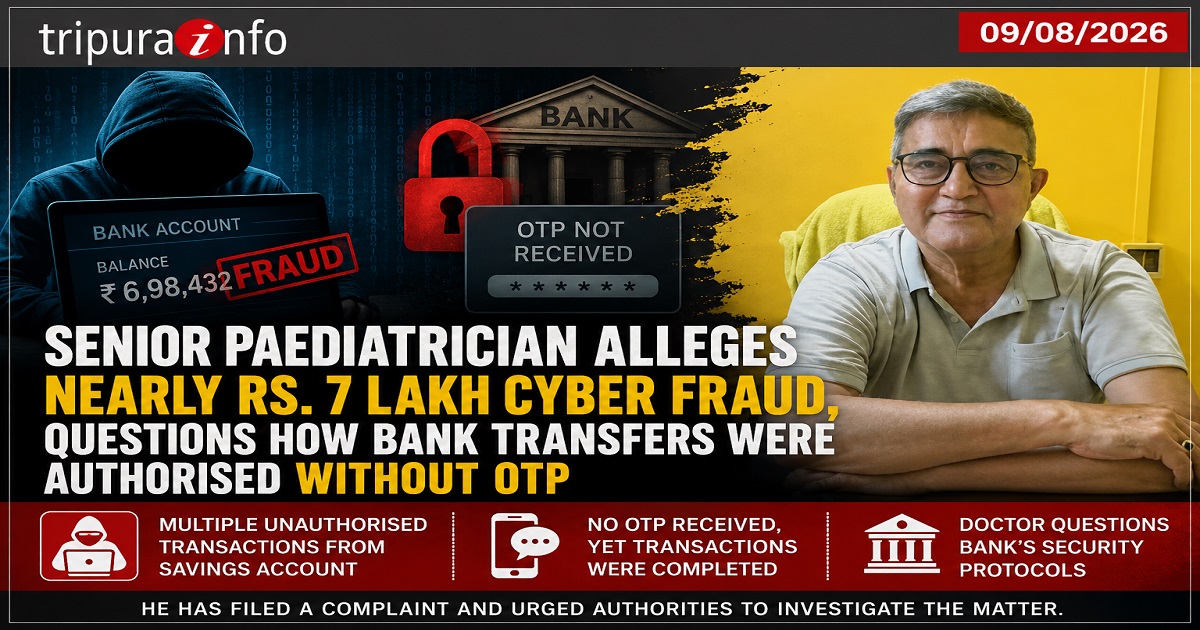 A senior paediatrician in Agartala, Dr. Satyajit Chakraborty, has alleged that nearly Rs. 7 lakh was siphoned from his UCO Bank account through multiple transactions between July 6 and July 15, despite his claim that he neither shared any One-Time Password (OTP) nor used internet banking during the period.
The septuagenarian doctor, who maintains an account with the Purvasha branch of UCO Bank, said he discovered the alleged fraud only after returning to Agartala and visiting the bank on August 7 to withdraw money.
According to Dr. Chakraborty, he had been staying in Kolkata for nearly a month while undergoing treatment for an eye-related ailment. On medical advice, he said, he had substantially reduced his use of his mobile phone during his stay.
During this period, an unidentified caller allegedly contacted his family claiming to represent the bank and sought an OTP for verification. The call was answered by his wife, who, according to the doctor, told the caller that they would directly contact the bank if any verification was required. Dr. Chakraborty maintains that no OTP was disclosed to the caller.
After returning to Agartala, the doctor said he was informed by the bank that several transactions had taken place from his account between July 6 and July 15, involving a total amount of nearly Rs. 7 lakh. He was subsequently advised that he had apparently become a victim of cyber fraud.
What has particularly concerned the doctor is his assertion that he had never opted for internet banking and did not use an ATM card. He said he generally operated his bank account through cheques. Against this backdrop, he has questioned how the transactions could have been initiated and authorised without his knowledge or consent.
Dr. Chakraborty further alleged that bank officials informed him that transaction-related messages had been sent to his registered mobile number. He, however, questioned whether the mere sending of SMS alerts could establish that the transactions were authorised by the account holder, particularly when he was away from Agartala for medical treatment and claims that he did not have access to or use his phone regularly.
The doctor also alleged that the bank did not provide him with a satisfactory explanation regarding the mechanism through which the money was transferred or a clear account of the steps being taken to recover the allegedly siphoned funds. Instead, he said, he was advised to approach the police cybercrime authorities.
Dr. Chakraborty subsequently approached the cybercrime unit at AD Nagar. According to him, he was directed to East Agartala police station to lodge an FIR.
The doctor has further alleged that during his interaction at the police station, questions were raised about why he had not checked the transaction messages received on his mobile phone. He claimed that the incident was viewed, at least initially, as a matter of his alleged lack of awareness and that he was asked to return home.
The allegations have raised broader questions about the vulnerability of elderly bank customers and the mechanisms followed by financial institutions when transactions are reported as unauthorised. While customers are routinely advised never to disclose OTPs, PINs, passwords or other confidential banking credentials, Dr. Chakraborty's claim is that no OTP was shared and that he did not even have internet banking facilities.
The key question now is how the transactions were authenticated, through which digital or banking channels the funds were moved, whether any credentials were compromised, and whether there was any failure in the bank's internal safeguards or transaction-monitoring mechanisms.
The case has also brought renewed attention to UCO Bank's operations in Agartala. Dr. Chakraborty referred to an earlier alleged cheque fraud involving around Rs. 16 crore belonging to the Agartala Municipal Corporation, which had also raised concerns surrounding banking transactions and security. The circumstances and progress of that earlier case are separate matters and would require verification from the investigating authorities.
In the latest case, the doctor has urged the authorities to conduct a detailed investigation into the alleged transactions, identify the beneficiary accounts and channels through which the money was transferred, and determine whether the funds can be traced or frozen.
Cybercrime investigators generally stress that victims should report unauthorised transactions as quickly as possible because prompt reporting can assist banks and law-enforcement agencies in tracing and potentially freezing funds transferred to other accounts.
Dr. Chakraborty has appealed to the authorities to treat his complaint seriously and ensure that the investigation reaches a clear conclusion.
more news...