Tripura's Education System Under Severe Strain as Teacher Shortage, Administrative Gaps and Delayed Reforms Raise Alarm
By Our Correspondent
Agartala, August 7, 2026
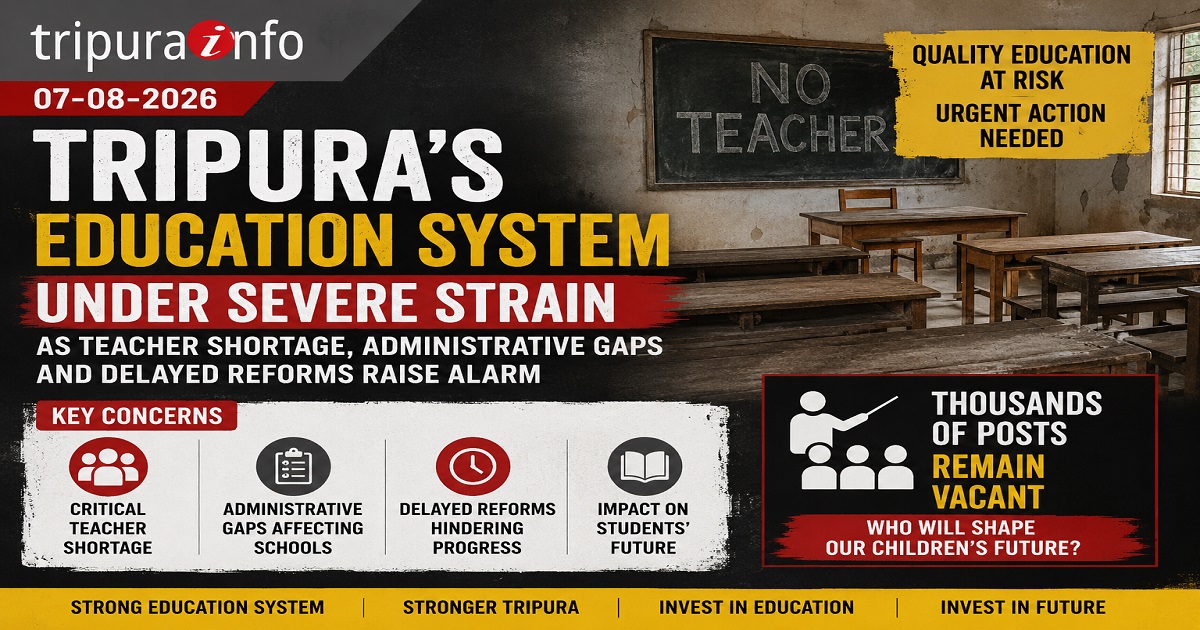 A growing disconnect between ambitious policy announcements and the ground reality has raised serious concerns over the condition of Tripura's education sector, with reports from across the state pointing to an acute shortage of teachers, declining student enrolment, delayed infrastructure projects and administrative challenges affecting schools, colleges and universities.
While Higher Education Minister Kishore Barman recently announced an ambitious target of increasing higher education participation in Tripura from 22 percent to 75 percent by 2030 and spoke of developing model institutions with improved infrastructure, libraries and laboratories, the situation on the ground appears to present a starkly different picture.
Reports published over the past few days highlight a number of concerns. In several government schools, a single teacher is reportedly handling multiple classes, while some schools have witnessed a sharp decline in enrolment due to inadequate staffing. In one case, a government school reportedly has only six students, while another school with nearly 100 students is functioning with just one teacher. Similar reports from rural areas indicate that teacher shortages are disrupting regular classroom teaching and forcing schools to merge classes.
The higher education sector is also facing significant challenges. The proposed Technical University and Women's University are yet to become operational because of pending infrastructure, faculty recruitment and administrative arrangements. Student organisations have also raised concerns regarding campus security, infrastructure deficiencies and delays in institutional reforms.
Critics argue that despite repeated announcements and review meetings, implementation has remained slow. They contend that the Education Department requires stronger monitoring and faster decision-making to address long-pending vacancies, improve infrastructure and restore confidence in government educational institutions.
The concerns have also sparked questions about administrative oversight. Opposition voices and education observers allege that the Higher Education Department has not provided sufficient attention to resolving the sector's structural problems. However, it is alleged that individual ministers, secretaries or directors are not able to give sufficient time to their responsibilities for personal or political reasons.
Educationists warn that unless large-scale recruitment of teachers, strengthening of administrative capacity and timely implementation of infrastructure projects are undertaken, Tripura may find it difficult to achieve its stated educational goals. They stress that improving enrolment figures alone will not be sufficient unless schools, colleges and universities are equipped with adequate teachers, modern facilities and effective governance.
The widening gap between official targets and classroom realities has intensified calls for immediate government intervention to prevent further deterioration of the state's education system.
more news...