BMS Road Blockade Near Circuit House Sparks Questions Over Police Role and ‘Good Governance’ in Tripura
By Our Correspondent
Agartala, August 5, 2026
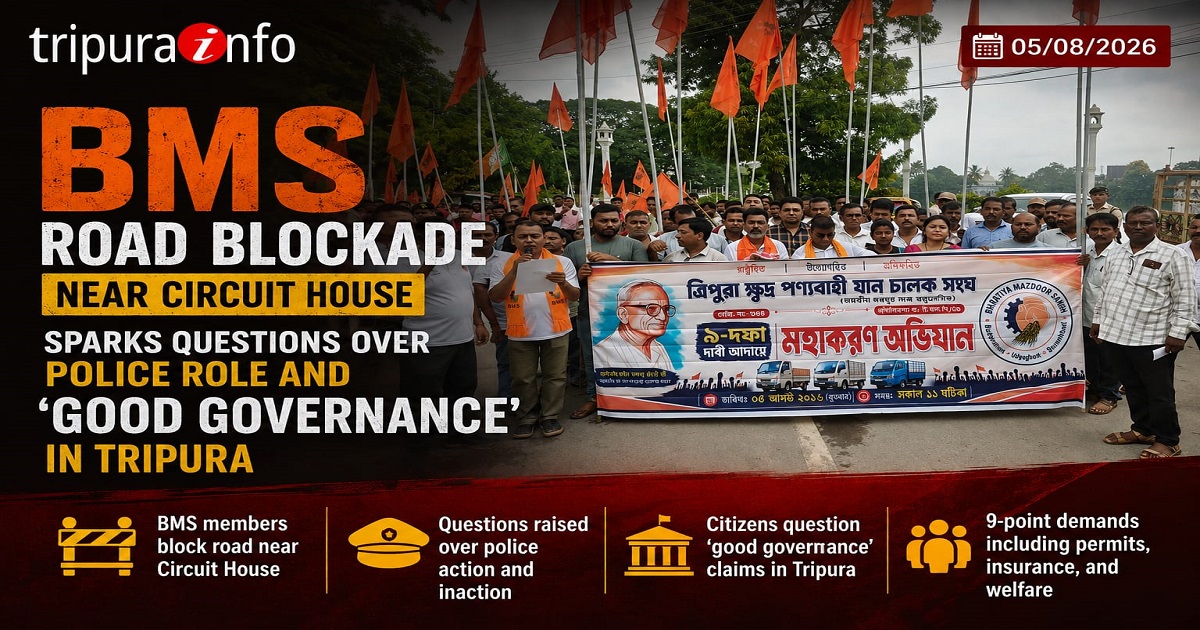 The manner in which a group of Bharatiya Mazdoor Sangh (BMS) supporters allegedly blocked a key road near the Circuit House-Gandhi statue area in Agartala on Wednesday, in the presence of police officials, has triggered sharp criticism and raised questions over traffic management, policing and equal application of the law in the state capital.
The BMS supporters had assembled as part of a “Mahakaran Abhiyan”, reportedly pressing a nine-point charter of demands. However, controversy erupted after the demonstrators occupied the road during office hours, disrupting normal movement of vehicles and commuters.
According to eyewitness accounts, at around 11 am, when the number of protesters at the blockade point was still relatively small, police personnel allegedly diverted ordinary commuters and vehicles through alternative routes instead of clearing the road and ensuring uninterrupted traffic.
The incident prompted questions among commuters over how a major road could effectively be closed for a political or organisational programme during peak office hours without adequate advance public notice.
Critics questioned whether the police had formally permitted the road blockade and, if so, why adequate traffic advisories and alternative arrangements were not announced beforehand. They also argued that, with only around 50-60 protesters reportedly present during the initial stage, police could have kept the carriageway open while allowing the organisation to continue its democratic protest at a designated location.
The controversy has also brought allegations of selective policing to the fore.
It has been pointed out that when members of the Cockroch Janata Party had recently assembled in the same Circuit House area, police reportedly confined the gathering behind barricades so that pedestrian and vehicular movement was not disrupted.
In contrast, during Wednesday's BMS programme, commuters were reportedly asked by police to turn back from a distance and take alternative routes while the protesters remained on the roadway.
The contrasting approach has prompted sections of the public to question whether the same policing standards are being applied irrespective of the political or organisational affiliation of demonstrators.
Similar questions have been raised by opposition parties in the past over alleged restrictions on CPI(M) and Congress programmes at places including Julaibari, Santirbazar, Belonia and Dharmanagar. Opposition parties have alleged that some processions and street meetings were prevented despite prior permission. Such claims, however, need to be assessed against the specific permissions, restrictions and law-and-order circumstances applicable to each event.
The timing of Wednesday's incident has added another dimension to the controversy.
While commuters were facing disruption not far from the Secretariat, Chief Minister Prof. (Dr.) Manik Saha was holding a meeting with senior officials at the Secretariat on strengthening good governance and ensuring that the benefits of government initiatives reach citizens on time.
Referring to the meeting on social media, the Chief Minister said the government's objective was to ensure good governance across every corner of Tripura while bringing greater transparency, efficiency and accountability into the administration.
During the Task Monitoring System meeting, progress of various projects, the status of pending works and measures to accelerate implementation of public welfare schemes across the state were reviewed.
Against that backdrop, Wednesday's traffic disruption has led to an uncomfortable question: Can the principles of transparency, accountability and rule of law promoted inside the Secretariat be considered complete if citizens experience apparently inconsistent enforcement of rules just outside it?
Peaceful protest is a democratic right, but so is the public's right to move freely on important roads. The controversy therefore centres not on the BMS's right to demonstrate, but on whether police handled the programme impartially, lawfully and with minimum inconvenience to ordinary citizens.
The police administration may need to clarify whether permission had been granted for blocking the road, whether commuters were given prior notice, and why traffic was diverted rather than protesters being restricted to a designated area.
For an administration emphasising “Sushasan” or good governance, consistent and politically neutral enforcement of the law remains one of its most visible tests.
more news...