Tripura's Sporting Talent at a Crossroads : Lack of Attractive Incentives Driving Young Athletes Away from the State
By Our Correspondent
Agartala, August 2, 2026
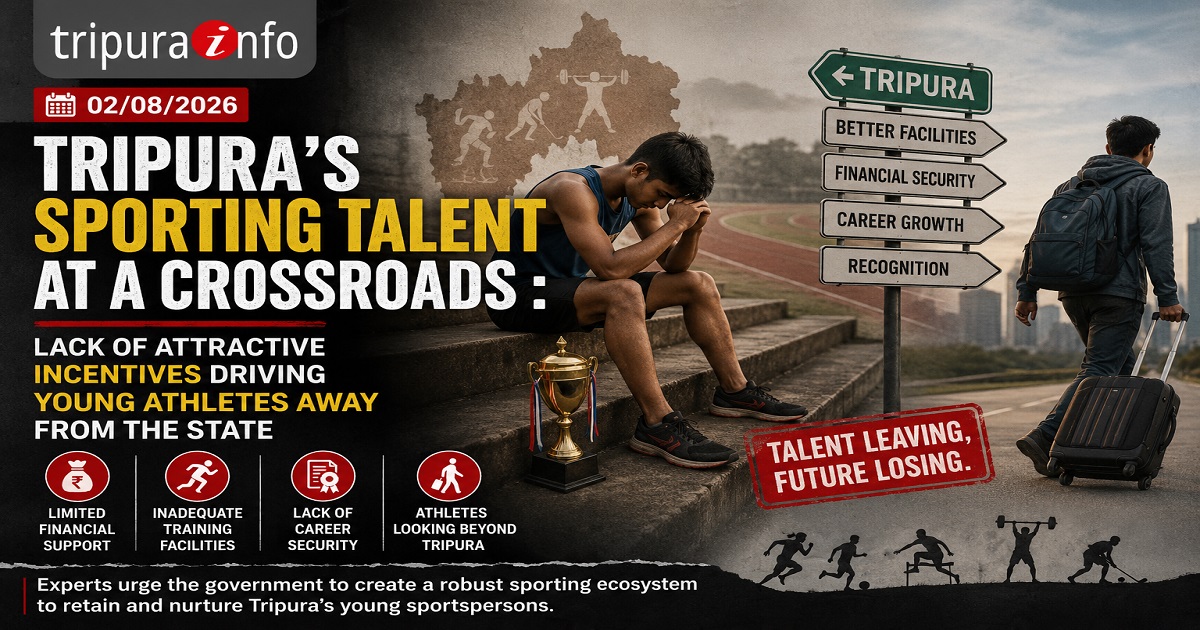 Despite having a rich legacy of producing internationally acclaimed sportspersons, Tripura is witnessing a worrying trend as many talented young athletes are either abandoning sports altogether or leaving the state in search of better opportunities, recognition, employment, and financial security.
Sports enthusiasts, coaches, and former athletes believe that the absence of an attractive long-term sports policy with adequate incentives has discouraged many promising boys and girls from pursuing professional sports. They argue that while Tripura has immense sporting potential, inadequate career prospects and limited financial support have forced many of the state's brightest talents to migrate to other states where they receive better facilities, employment, coaching, and recognition.
Tripura has produced several sporting icons who have brought glory to India on national and international platforms. Among them are Commonwealth Games gold medal-winning judoka Asmita Dey, Olympic gymnast Dipa Karmakar, former Davis Cup tennis star Somdev Devvarman, Indian women's football goalkeeper Laxmita Reang, renowned Dronacharya Award-winning coach Bisweswar Nandi, and cricketer Manisankar Murasingh.
The debate has intensified following the remarkable achievement of judoka Asmita Dey, who won the gold medal at the 2026 Commonwealth Games. Sports circles point out that Asmita left Tripura in 2018 in search of better opportunities and later joined the Uttar Pradesh Police under the Outstanding Sportsperson Quota in 2023. Her historic success has reignited questions over why many of Tripura's finest sporting talents are compelled to leave their home state to pursue their sporting careers.
Her achievement has also triggered a wider debate on the state's sports ecosystem. Sports enthusiasts, former athletes, coaches, and parents are asking why Tripura has not been able to formulate a modern, attractive, and comprehensive sports policy since 1977 that could motivate young boys and girls to take up sports as a career. They argue that an sports and games and athlete-friendly policy with competitive cash rewards, scholarships, assured government employment, quality coaching, sports science support, insurance coverage, and world-class infrastructure would not only retain the state's talented sportspersons but also inspire thousands of youngsters to participate in sports.
Many in the sporting community believe that if timely policy reforms are not introduced, Tripura may continue to lose its best sporting talents to other states that offer better career opportunities and incentives. They say Asmita Dey's inspiring journey should serve as a wake-up call for policymakers to create a vibrant sports ecosystem where the state's young athletes can achieve national and international success without having to leave Tripura in search of better prospects.
However, many other talented athletes, including gymnast Ratan Debnath, swimmer Arati Saha, and athlete Kalpana Debnath, had to leave Tripura to pursue their sporting careers due to the lack of adequate opportunities and recognition within the state.
Sports observers say that these successful athletes should have inspired a new generation of players. Instead, many youngsters are becoming reluctant to take up sports because they see limited career prospects after years of rigorous training.
The concern has gained renewed attention following the historic Commonwealth Games gold medal won by Asmita Dey, which once again highlighted Tripura's ability to produce world-class athletes despite limited resources. Experts believe her success should become a turning point for strengthening sports infrastructure and athlete welfare in the state.
The Tripura Youth Affairs Policy emphasizes personality development, leadership, discipline, self-reliance, national integration, skill development, and creating opportunities for employment through youth empowerment. It also seeks to develop leadership qualities, provide vocational training, and encourage youth participation in nation-building. However, many believe that these objectives can only be effectively achieved if sports are treated as a viable career with meaningful financial and professional incentives.
To provide employment opportunities, the state government launched the Mukhyamantri Sports Development Scheme, Unemployed Young Professional Sportsperson on February 9, 2024. Under the scheme, selected junior coaches receive a fixed monthly remuneration of Rs. 20,000 on a contractual basis for a maximum period of 12 months, with provisions for extension or curtailment.
While the initiative has been welcomed as a positive step, sports experts and former athletes argue that its scope remains limited. They point out that only a small section of sportspersons benefits from the scheme, while thousands of aspiring athletes continue to struggle with inadequate coaching facilities, insufficient financial assistance, lack of scholarships, poor competition exposure, and uncertain career prospects.
Many coaches believe that talented athletes often shift to states such as Haryana, Odisha, Uttar Pradesh, Maharashtra, and the services sector, where they receive government jobs, higher cash incentives for medal winners, improved training infrastructure, sports hostels, and sustained institutional support.
According to sports administrators, the declining participation of young boys and girls in competitive sports is becoming a matter of concern.
more news...