Asmita: The Girl From Belonia Who Made History Tremble!!!
By Our Correspondent
Agartala, August 1, 2026
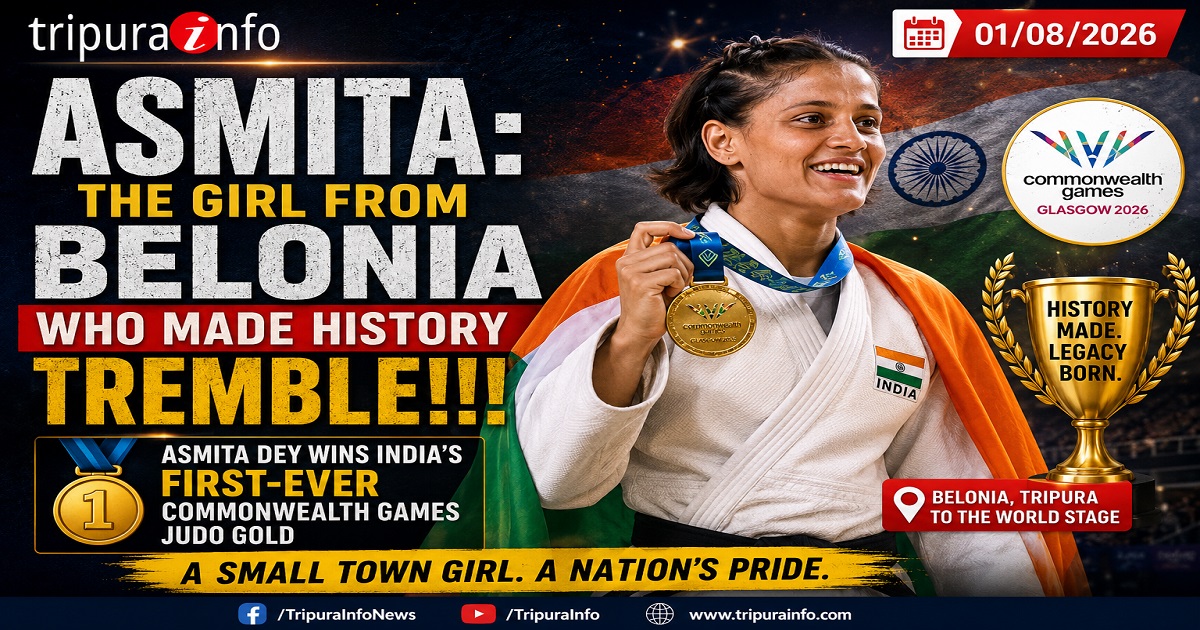 Some victories arrive like daylight — quiet, tender, almost merciful, touching the horizon with gold, asking only to be admired. Others do not arrive. They strike from the dark. They come like thunder after a long, starless night — after hunger has learned the names of children, after hope has been forced to whisper in mud-walled rooms, after grief has sat beside the bed like a second shadow and dared the heart to rise. Asmita Dey’s victory belongs to the thunder.
It did not merely shine in Glasgow on 31 July 2026; it cracked open the sky and left an echo inside the nation. It shook loose a lie buried deep in the Indian sporting imagination — the lie that greatness must be born in comfort, fed by privilege, polished by pedigree. Asmita, a 23-year-old judoka from Belonia in South Tripura, defeated Canada’s Heidi Quach in the women’s 48 kg final at the Commonwealth Games and became the first Indian judoka, male or female, to win Commonwealth Games gold. The bout plunged into Golden Score, that pitiless chamber of sudden death where breath becomes verdict, silence becomes witness, and one movement can redraw the borders of memory.
Before her, India had waited through decades of Commonwealth judo without gold. Before her, the highest step of that podium stood like an unanswered question under cold light. Then a girl from a border town climbed it, and history did not applaud politely. It trembled.
To understand Asmita Dey, one must abandon the podium first. Leave the lights. Leave the cameras. Leave the clean gleam of the arena. Walk instead into Belonia, near the Bangladesh border, where evenings may fall softly but hardship has a loud voice; where families count survival in small notes and smaller margins; where dreams are often buried quietly before anyone learns their names.
Asmita was born on 22 March 2003 into a family where every rupee had a sound and every sacrifice left a mark. Her father, Arjun Kumar Dey, repaired bicycles for a living. News reports describe him as earning only a modest amount each day, enough to keep the home moving but never enough to make life easy. Her mother guarded the household with the quiet heroism of women who do not make speeches but hold entire worlds together. There were siblings, responsibilities, limitations, and a mud-house childhood in which comfort was thin, yet hope remained like a lamp no storm could fully kill.
Yet inside that narrowness, something in the girl refused to kneel; something kept listening for a door the world had not yet opened.
She did not begin as a judoka. She began as an 800-metre runner — a child chasing distance, lungs burning, feet striking the earth as if trying to outrun the map assigned to her. Judo entered almost by accident, through a local trial and the eye of a coach who saw in her not just athletic promise but something more dangerous: balance mixed with fire, discipline wrapped around hunger, a stillness that looked harmless until it moved.
At Belonia Vidyapeeth Coaching Centre, under Bina Debnath, the first shape of that force appeared. At Tripura Sports School, under Manik Lal Deb, it hardened. In 2018, her performances in school and Khelo India circuits carried her to the Sports Authority of India centre in Bhopal, later the National Centre of Excellence. There, under Yashpal Solanki, she entered the long furnace of elite sport: repeated drills, aching muscles, scientific training, nutrition, physiotherapy, psychology, and the lonely education of becoming someone the world could no longer ignore.
Asmita’s ascent was not the clean upward line of a fairy tale. It was a road of bruises, hunger, distance, homesickness and return. She became the first judoka from Tripura to win an international medal for India at the Asian Cadet and Junior level. She won gold at the 2023 Junior Asia Cup in Macau. She earned silver at the Asian Open in Kuwait. She became junior national champion. She won at Khelo India. In 2025, she took her first senior international title at the Casablanca African Open in Morocco. In 2026, she finished fifth at the Asian Senior Championships, close enough to the continent’s best to smell the podium and far enough to remain restless.
Each medal was not metal. It was defiance given weight.
It answered the old, cruel question: What can a girl from Belonia become? Macau answered. Kuwait answered. Morocco answered. Bhopal answered. Then Glasgow rose in the distance like a storm waiting for a name.
But life, having already tested her with scarcity, returned with a darker weapon.
In December 2025, her father died after a brain stroke. The man who had repaired bicycles by day and carried his daughter’s impossible dream by faith was gone before the dream could fully bloom. Reports after her victory recalled how deeply his death shook her. Asmita said she felt everything had ended. She had lost not simply a parent, but the first witness of her becoming — the man who stood beside her through injury, treatment, medicine, travel, doubt and exhaustion.
There are losses that do not leave the body. They enter the bones, darken the blood, and begin speaking from there.
For Asmita, grief did not become a chapter she closed; it became a weight she learned to lift in secret. Her mother, refusing to let despair swallow the purpose her father had protected, pushed her back toward training. If Asmita stopped, it would be as if the dream died twice — once with the father, once with the daughter who carried it.
So, she returned.
Not whole. Not untouched. Not the same girl who had left the mat before grief entered her life.
She returned sharper. Quieter. Harder to break. More dangerous than before, because now she was fighting with the living and the dead inside her, and grief had become a second grip.
When she stepped into Glasgow, she was not carrying only India. She was carrying Belonia’s dust, her mother’s command, and a bicycle mechanic’s unfinished prayer walking beside her unseen.
The final against Heidi Quach did not open like destiny. It opened like a warning.
Asmita fell behind. A yuko conceded. A penalty followed. The scoreboard leaned toward Canada. The clock hardened. In a final, seconds do not pass; they accuse, they tighten, they begin to sound like doors closing in a corridor with no light.
But Asmita had known more brutal pressures than a scoreboard. She had known poverty pressing against the ribs. She had known distance from home. She had known the loneliness of proving a small-town girl belonged among the world’s trained elite. She had known mourning so deep it could turn a mat into a graveyard. Against that, a deficit was not disaster. It was only another wall waiting to hear her name.
She changed the rhythm. She drove forward. She attacked with the urgency of someone who had already buried fear. She levelled the score and dragged the contest into Golden Score — the afterlife of a tied bout, where one mistake becomes ruin and one clean movement becomes immortality.
Then the moment came — not softly, not ceremonially, but like thunder finding the earth.
A final attack near the edge. A decisive yuko. A breath seized across continents. A scoreboard transformed. A silence split in two, and somewhere beyond the arena, a father’s dream seemed to stand up.
And then — history did not whisper. It broke open.
India had its first Commonwealth Games judo gold. Belonia had sent a daughter into the world, and the world had felt her impact like thunder under the ribs.
Asmita’s life is not only the story of a champion in a white judogi. It is also the story of a young woman who found steadiness in service. In 2023, she joined the Uttar Pradesh Police through the Outstanding Sportsperson Quota, and reports after her Commonwealth triumph identified her as a Sub-Inspector. That detail matters. It means the girl who once fought for stability now wears responsibility as part of her daily life. It means discipline did not end at the mat; it followed her into public service.
She is Tripura’s pride. She is Uttar Pradesh’s strength. She is India’s reminder that greatness does not always announce itself from stadium towns, academy corridors or wealthy homes. Sometimes it rises from a mud house. Sometimes it learns its first lessons beside a bicycle repair shop. Sometimes it carries grief like a hidden medal long before the world sees gold.
There is something unsettling about Asmita Dey’s story because it removes our excuses. It does not allow us to say that the road was easy, that the athlete was protected, that destiny had softened the blows for her. It shows a child who was offered scarcity and answered with motion. It shows a family that had little and still invested faith. It shows a father who did not live to witness the anthem but whose belief stood invisibly beside his daughter when the tricolour rose.
That is why her victory haunts. Not because it was beautiful alone, but because it was costly. Because it came carrying mud, sweat, grief, discipline, hunger, memory and refusal. Because gold, in her hands, did not look ornamental. It looked resurrected.
Because it is not only about sport. It is about inheritance. Not the inheritance of land or wealth, but the inheritance of courage. A father gave it quietly. A mother preserved it fiercely. A daughter carried it across years of labour until, one night in Glasgow, it became visible to a nation.
On the podium, Asmita Dey did not stand alone. Belonia stood with her. Tripura stood with her. A mud house stood with her. A mother’s hand, a father’s memory, every uncelebrated coach, every unseen sacrifice, every child warned not to dream too far — all of them stood in that gold-lit moment.
Some victories shine for a night. Hers will not merely shine — it will summon. It will move through Belonia like a storm returning home. It will pass through every small town where a child folds a dream under the pillow because the world has called it impossible. It will stand beside every daughter told to be practical, every athlete training without applause, every family sacrificing in silence, and it will say: do not surrender your fire.
Let Asmita Dey’s thunder not end in Glasgow. Let it roll through every village, every school ground, every forgotten coaching centre, every mud house where courage is still waiting to be named. Let it remind us that India’s next champion may not come wrapped in privilege, but in dust, doubt, hunger and a dream too stubborn to die.
So remember her. Speak her name. Tell her story. Build more roads for girls like her. Open the doors, fund the mats, honour the coaches, protect the dreams, and when the world tells a child that history is not written for people like them — hand them the pen, clear the arena, and watch them make history tremble.
more news...